

5.4.3 Nonlinear Thomson Scattering
Nonlinear Thomson scattering provides higher harmonic generation (HHG), and
the maximum harmonic number n of HHG increases rapidly with the laser intensity.
Efficient conversion of low-frequency laser photon energy to HHG of the order of
n ¼ 100 can provide the photon in the range of 100 keV. This is called laser
synchrotron source (LSS) and may provide a practical method of generating
tunable, near-monochromatic, well-collimated, short-pulse X-rays in a compact,
relatively inexpensive source. As we see below, two examples of LSS configurations
are possible theoretically: an electron beam LSS generating hard (30 keV, 0.4-A)
X-rays and a plasma LSS generating soft (0.3 keV, 40 A) X-rays. The former one is
based on the use of Doppler up-shift from an electron in strong field drifting with a
relativistic velocity given in (5.3.24).
In the case where the normalized laser intensity a 0 increases toward unity or over
unity, it is clear that the higher harmonic components in (5.4.3) dramatically
increase. In the case of a simple harmonic oscillation assumed in deriving (5.4.3),
we have all harmonic component of the laser frequency ω 0 . It is found that an
electron with the figure-of-eight motion emits only odd integer harmonics in the
backward direction to the laser incidence. On the other hand, with the scattering
toward the perpendicular direction along y-axis, all higher harmonics components
appear. This fact is easily proven by the following mathematics.
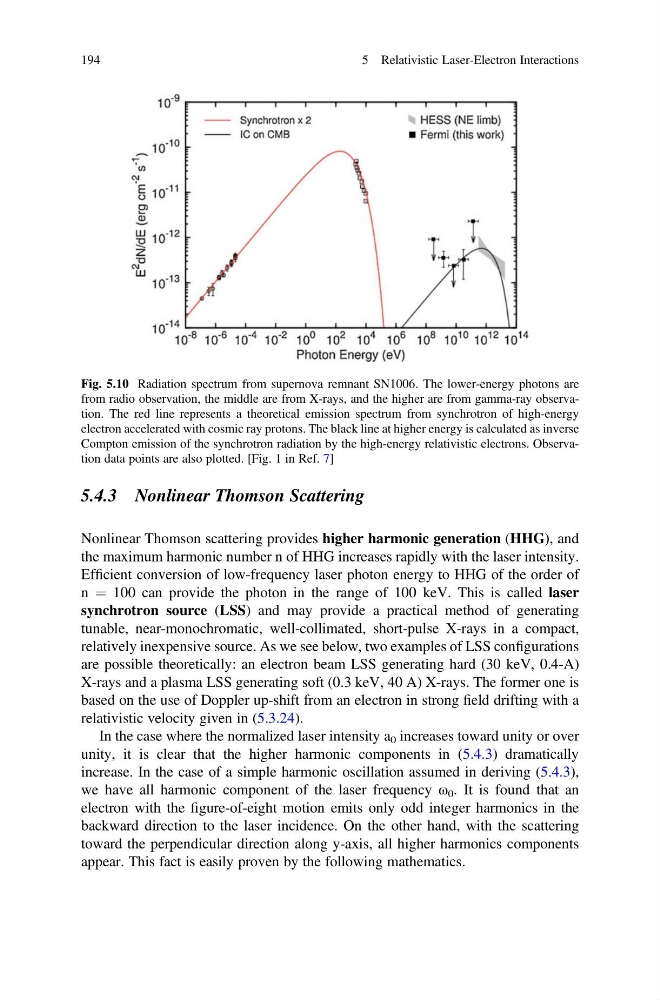
Fig. 5.10 Radiation spectrum from supernova remnant SN1006. The lower-energy photons are
from radio observation, the middle are from X-rays, and the higher are from gamma-ray observation. The red line represents a theoretical emission spectrum from synchrotron of high-energy
electron accelerated with cosmic ray protons. The black line at higher energy is calculated as inverse
Compton emission of the synchrotron radiation by the high-energy relativistic electrons. Observation data points are also plotted. [Fig. 1 in Ref. 7]
194
5 Relativistic Laser-Electron Interactions
Nonlinear Thomson scattering provides higher harmonic generation (HHG), and
the maximum harmonic number n of HHG increases rapidly with the laser intensity.
Efficient conversion of low-frequency laser photon energy to HHG of the order of
n ¼ 100 can provide the photon in the range of 100 keV. This is called laser
synchrotron source (LSS) and may provide a practical method of generating
tunable, near-monochromatic, well-collimated, short-pulse X-rays in a compact,
relatively inexpensive source. As we see below, two examples of LSS configurations
are possible theoretically: an electron beam LSS generating hard (30 keV, 0.4-A)
X-rays and a plasma LSS generating soft (0.3 keV, 40 A) X-rays. The former one is
based on the use of Doppler up-shift from an electron in strong field drifting with a
relativistic velocity given in (5.3.24).
In the case where the normalized laser intensity a 0 increases toward unity or over
unity, it is clear that the higher harmonic components in (5.4.3) dramatically
increase. In the case of a simple harmonic oscillation assumed in deriving (5.4.3),
we have all harmonic component of the laser frequency ω 0 . It is found that an
electron with the figure-of-eight motion emits only odd integer harmonics in the
backward direction to the laser incidence. On the other hand, with the scattering
toward the perpendicular direction along y-axis, all higher harmonics components
appear. This fact is easily proven by the following mathematics.
Fig. 5.10 Radiation spectrum from supernova remnant SN1006. The lower-energy photons are
from radio observation, the middle are from X-rays, and the higher are from gamma-ray observation. The red line represents a theoretical emission spectrum from synchrotron of high-energy
electron accelerated with cosmic ray protons. The black line at higher energy is calculated as inverse
Compton emission of the synchrotron radiation by the high-energy relativistic electrons. Observation data points are also plotted. [Fig. 1 in Ref. 7]
194
5 Relativistic Laser-Electron Interactions