

Δθ $
1
γ e
ð5:4:9Þ
It is noted that in the combination of the conventional accelerators and optical lasers,
the condition ν 0 γ e < < 1 is valid at the present technology.
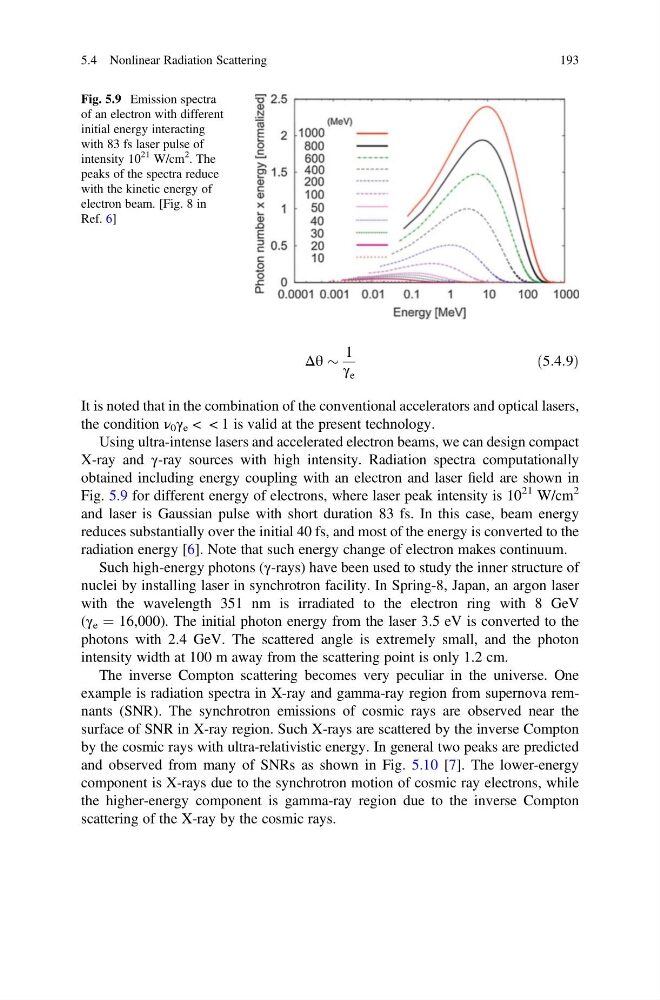
Using ultra-intense lasers and accelerated electron beams, we can design compact
X-ray and γ-ray sources with high intensity. Radiation spectra computationally
obtained including energy coupling with an electron and laser field are shown in
Fig. 5.9 for different energy of electrons, where laser peak intensity is 10
21 W/cm
2
and laser is Gaussian pulse with short duration 83 fs. In this case, beam energy
reduces substantially over the initial 40 fs, and most of the energy is converted to the
radiation energy [6]. Note that such energy change of electron makes continuum.
Such high-energy photons (γ-rays) have been used to study the inner structure of
nuclei by installing laser in synchrotron facility. In Spring-8, Japan, an argon laser
with the wavelength 351 nm is irradiated to the electron ring with 8 GeV
(γ e ¼ 16,000). The initial photon energy from the laser 3.5 eV is converted to the
photons with 2.4 GeV. The scattered angle is extremely small, and the photon
intensity width at 100 m away from the scattering point is only 1.2 cm.
The inverse Compton scattering becomes very peculiar in the universe. One
example is radiation spectra in X-ray and gamma-ray region from supernova remnants (SNR). The synchrotron emissions of cosmic rays are observed near the
surface of SNR in X-ray region. Such X-rays are scattered by the inverse Compton
by the cosmic rays with ultra-relativistic energy. In general two peaks are predicted
and observed from many of SNRs as shown in Fig. 5.10 [7]. The lower-energy
component is X-rays due to the synchrotron motion of cosmic ray electrons, while
the higher-energy component is gamma-ray region due to the inverse Compton
scattering of the X-ray by the cosmic rays.
Fig. 5.9 Emission spectra
of an electron with different
initial energy interacting
with 83 fs laser pulse of
intensity 10
21 W/cm
2
. The
peaks of the spectra reduce
with the kinetic energy of
electron beam. [Fig. 8 in
Ref. 6]
5.4 Nonlinear Radiation Scattering
193
1
γ e
ð5:4:9Þ
It is noted that in the combination of the conventional accelerators and optical lasers,
the condition ν 0 γ e < < 1 is valid at the present technology.
Using ultra-intense lasers and accelerated electron beams, we can design compact
X-ray and γ-ray sources with high intensity. Radiation spectra computationally
obtained including energy coupling with an electron and laser field are shown in
Fig. 5.9 for different energy of electrons, where laser peak intensity is 10
21 W/cm
2
and laser is Gaussian pulse with short duration 83 fs. In this case, beam energy
reduces substantially over the initial 40 fs, and most of the energy is converted to the
radiation energy [6]. Note that such energy change of electron makes continuum.
Such high-energy photons (γ-rays) have been used to study the inner structure of
nuclei by installing laser in synchrotron facility. In Spring-8, Japan, an argon laser
with the wavelength 351 nm is irradiated to the electron ring with 8 GeV
(γ e ¼ 16,000). The initial photon energy from the laser 3.5 eV is converted to the
photons with 2.4 GeV. The scattered angle is extremely small, and the photon
intensity width at 100 m away from the scattering point is only 1.2 cm.
The inverse Compton scattering becomes very peculiar in the universe. One
example is radiation spectra in X-ray and gamma-ray region from supernova remnants (SNR). The synchrotron emissions of cosmic rays are observed near the
surface of SNR in X-ray region. Such X-rays are scattered by the inverse Compton
by the cosmic rays with ultra-relativistic energy. In general two peaks are predicted
and observed from many of SNRs as shown in Fig. 5.10 [7]. The lower-energy
component is X-rays due to the synchrotron motion of cosmic ray electrons, while
the higher-energy component is gamma-ray region due to the inverse Compton
scattering of the X-ray by the cosmic rays.
Fig. 5.9 Emission spectra
of an electron with different
initial energy interacting
with 83 fs laser pulse of
intensity 10
21 W/cm
2
. The
peaks of the spectra reduce
with the kinetic energy of
electron beam. [Fig. 8 in
Ref. 6]
5.4 Nonlinear Radiation Scattering
193