

incident and scattered photons are affected Doppler shift in (5.2.44) two times as
shown below.
In the frame moving with the electron beam with its Lorentz factor β e , the
incoming laser frequency is upshifted as shown in (5.2.44):
ω 1 ¼
1 þ β e
1 À β e
1=2
ω 0
ð5:4:6Þ
It is reasonable to consider that the photon ω 1 is scattered by the Thomson scattering
in this beam frame. This frequency is again upshifted in the laboratory frame by the
Doppler shift to ω 2 in the form:
ω 2 ¼
1 þ β e
1 À β e
ω 0 ¼
1 þ β e
ð
Þ
2
1 À β
2
e
ω 0 % 4γ
2
e ω 0
ð5:4:7Þ
It is intuitively understood that angular distribution of the photon flux near the
frequency ω 2 has a strong peak at the direction to the electron beam because of
relativistic beaming effect. It is informative to show the angular dependence of the
radiation with frequency ω 2 :
ω peak θ
ð Þ ¼
4γ
2
e ω 0
1 þ ν 0 γ e
ð
Þ
1 þ
γ
2
e
1 þ 4ν 0 γ e
θ
2
! À1
ν 0 ¼
ħω 0
mc 2
ð5:4:8Þ
It is seen in (5.4.8) that due to the relativistic beaming effect of radiation from an
object moving near the speed of light, the scattered radiation is concentrated within
an angle about
1
0
-1
-130
-120
-110
x [micron]
y [micron]
I=10 23 W/cm 2
100 MeV
-100
-90
-80
-70
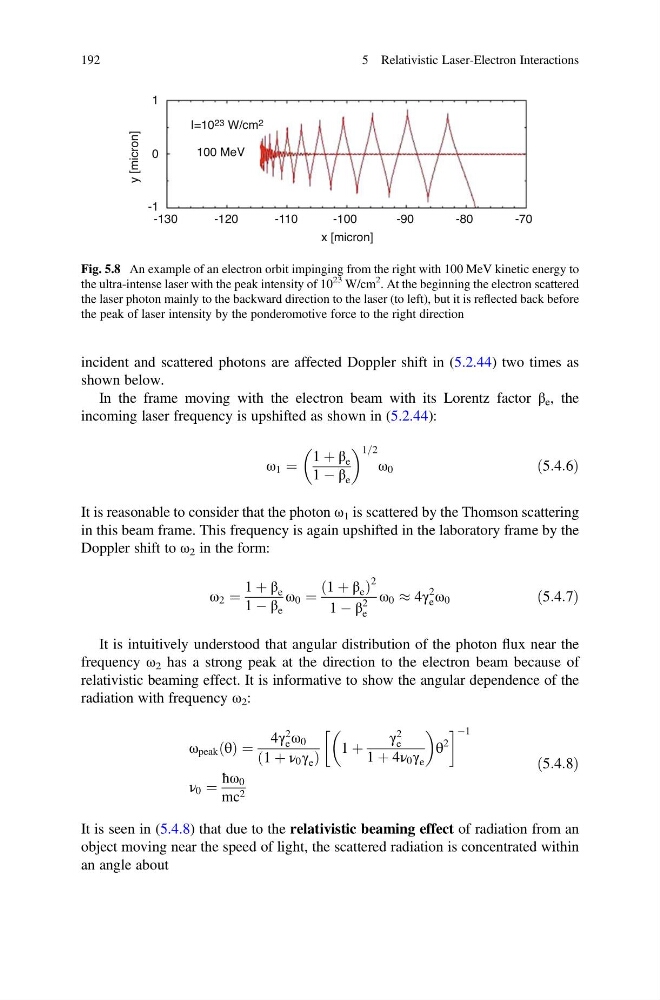
Fig. 5.8 An example of an electron orbit impinging from the right with 100 MeV kinetic energy to
the ultra-intense laser with the peak intensity of 10
23 W/cm
2
. At the beginning the electron scattered
the laser photon mainly to the backward direction to the laser (to left), but it is reflected back before
the peak of laser intensity by the ponderomotive force to the right direction
192
5 Relativistic Laser-Electron Interactions
shown below.
In the frame moving with the electron beam with its Lorentz factor β e , the
incoming laser frequency is upshifted as shown in (5.2.44):
ω 1 ¼
1 þ β e
1 À β e
1=2
ω 0
ð5:4:6Þ
It is reasonable to consider that the photon ω 1 is scattered by the Thomson scattering
in this beam frame. This frequency is again upshifted in the laboratory frame by the
Doppler shift to ω 2 in the form:
ω 2 ¼
1 þ β e
1 À β e
ω 0 ¼
1 þ β e
ð
Þ
2
1 À β
2
e
ω 0 % 4γ
2
e ω 0
ð5:4:7Þ
It is intuitively understood that angular distribution of the photon flux near the
frequency ω 2 has a strong peak at the direction to the electron beam because of
relativistic beaming effect. It is informative to show the angular dependence of the
radiation with frequency ω 2 :
ω peak θ
ð Þ ¼
4γ
2
e ω 0
1 þ ν 0 γ e
ð
Þ
1 þ
γ
2
e
1 þ 4ν 0 γ e
θ
2
! À1
ν 0 ¼
ħω 0
mc 2
ð5:4:8Þ
It is seen in (5.4.8) that due to the relativistic beaming effect of radiation from an
object moving near the speed of light, the scattered radiation is concentrated within
an angle about
1
0
-1
-130
-120
-110
x [micron]
y [micron]
I=10 23 W/cm 2
100 MeV
-100
-90
-80
-70
Fig. 5.8 An example of an electron orbit impinging from the right with 100 MeV kinetic energy to
the ultra-intense laser with the peak intensity of 10
23 W/cm
2
. At the beginning the electron scattered
the laser photon mainly to the backward direction to the laser (to left), but it is reflected back before
the peak of laser intensity by the ponderomotive force to the right direction
192
5 Relativistic Laser-Electron Interactions