

J n α
ð Þ / α
n
ð5:4:5Þ
it is enough to assume that only the fundamental frequency is scattered in the linear
Thomson scattering case.
5.4.2 Compton and Inverse Compton Scatterings
It is well-known that energy shift of the scattered photon is observed when the
incoming photon energy is relativistic, ħω $ mc
2 . In the normal condition, the
optical laser photon energy is about 1 eV (<
¼ 500 keV). It looks like intense
laser application has no relation with Compton scattering. With use of relativistic
electron beams, intense lasers are used to generate extremely high-energy photon via
inverse Compton scattering.
The principle is very simple. Assume that a relativistic electron beam is traveling
as shown in Fig. 5.8, where intense laser pulse collides the electron beam on the
same axis. Then, the laser photons are scattered mainly backward direction at the
beginning, or the laser intensity is weak enough so that the electrons can keep
moving to the initial velocity direction. But if the beam kinetic energy is small
compared to the photon pressure as shown in Fig. 5.8, the central orbit of oscillating
motion will alter the direction. In such case, scattered radiations are Doppler shifted
due to the time-dependent drift velocity. We assume that the electron beam energy is
large enough under the not-so-strong laser strength and a constant drift velocity
derived in (5.3.24) is enough to take into account the deceleration of the interacting
electron beam. Under such condition, the mechanism of radiation emission is due to
the linear Thomson scattering in the frame moving with electron beams, but the
0.6
0.4
0.2
-0.2
1
2
X
Bessel function J n (x)=1-5
3
4
5
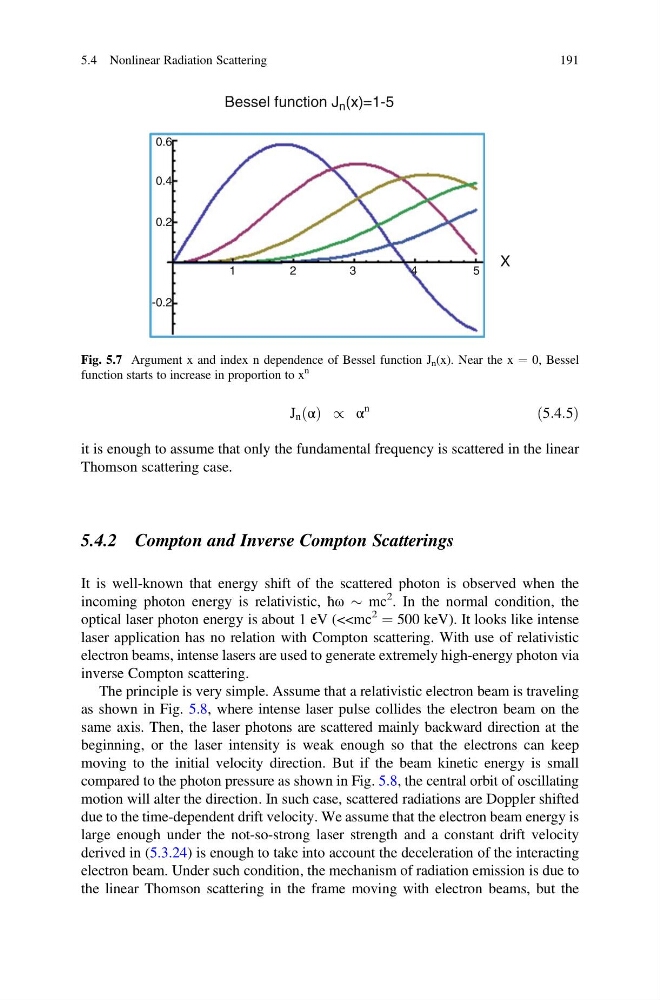
Fig. 5.7 Argument x and index n dependence of Bessel function J n (x). Near the x ¼ 0, Bessel
function starts to increase in proportion to x
n
5.4 Nonlinear Radiation Scattering
191
ð Þ / α
n
ð5:4:5Þ
it is enough to assume that only the fundamental frequency is scattered in the linear
Thomson scattering case.
5.4.2 Compton and Inverse Compton Scatterings
It is well-known that energy shift of the scattered photon is observed when the
incoming photon energy is relativistic, ħω $ mc
2 . In the normal condition, the
optical laser photon energy is about 1 eV (<
¼ 500 keV). It looks like intense
laser application has no relation with Compton scattering. With use of relativistic
electron beams, intense lasers are used to generate extremely high-energy photon via
inverse Compton scattering.
The principle is very simple. Assume that a relativistic electron beam is traveling
as shown in Fig. 5.8, where intense laser pulse collides the electron beam on the
same axis. Then, the laser photons are scattered mainly backward direction at the
beginning, or the laser intensity is weak enough so that the electrons can keep
moving to the initial velocity direction. But if the beam kinetic energy is small
compared to the photon pressure as shown in Fig. 5.8, the central orbit of oscillating
motion will alter the direction. In such case, scattered radiations are Doppler shifted
due to the time-dependent drift velocity. We assume that the electron beam energy is
large enough under the not-so-strong laser strength and a constant drift velocity
derived in (5.3.24) is enough to take into account the deceleration of the interacting
electron beam. Under such condition, the mechanism of radiation emission is due to
the linear Thomson scattering in the frame moving with electron beams, but the
0.6
0.4
0.2
-0.2
1
2
X
Bessel function J n (x)=1-5
3
4
5
Fig. 5.7 Argument x and index n dependence of Bessel function J n (x). Near the x ¼ 0, Bessel
function starts to increase in proportion to x
n
5.4 Nonlinear Radiation Scattering
191