

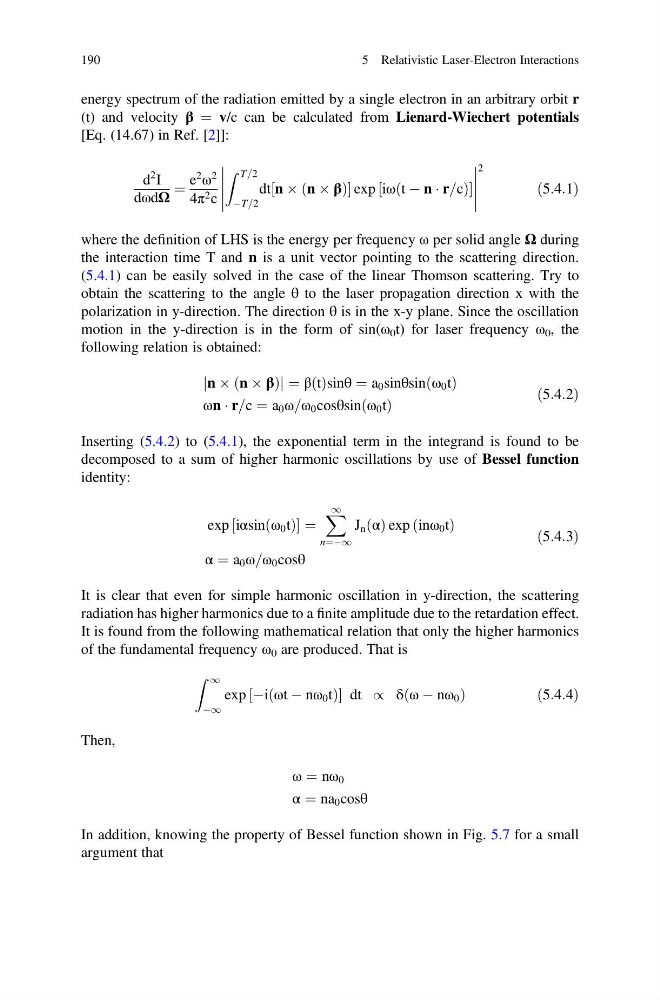
energy spectrum of the radiation emitted by a single electron in an arbitrary orbit r
(t) and velocity β ¼ v/c can be calculated from Lienard-Wiechert potentials
[Eq. (14.67) in Ref. [2]]:
d
2 I
dωdΩ
¼
e
2
ω
2
4π 2 c
Z T=2
ÀT=2
dt n  n  β
ð
Þ
½
exp iω t À n Á r=c
ð
Þ
½
2
ð5:4:1Þ
where the definition of LHS is the energy per frequency ω per solid angle Ω during
the interaction time T and n is a unit vector pointing to the scattering direction.
(5.4.1) can be easily solved in the case of the linear Thomson scattering. Try to
obtain the scattering to the angle θ to the laser propagation direction x with the
polarization in y-direction. The direction θ is in the x-y plane. Since the oscillation
motion in the y-direction is in the form of sin(ω 0 t) for laser frequency ω 0 , the
following relation is obtained:
n  n  β
ð
Þ
j
j¼ β t
ð Þsinθ ¼ a 0 sinθsin ω 0 t
ð Þ
ωn Á r=c ¼ a 0 ω=ω 0 cosθsin ω 0 t
ð Þ
ð5:4:2Þ
Inserting (5.4.2) to (5.4.1), the exponential term in the integrand is found to be
decomposed to a sum of higher harmonic oscillations by use of Bessel function
identity:
exp iαsin ω 0 t
ð Þ
½
¼
X 1
n¼À1
J n α
ð Þ exp inω 0 t
ð
Þ
α ¼ a 0 ω=ω 0 cosθ
ð5:4:3Þ
It is clear that even for simple harmonic oscillation in y-direction, the scattering
radiation has higher harmonics due to a finite amplitude due to the retardation effect.
It is found from the following mathematical relation that only the higher harmonics
of the fundamental frequency ω 0 are produced. That is
Z 1
À1
exp Ài ωt À nω 0 t
ð
Þ
½
dt / δ ω À nω 0
ð
Þ
ð 5:4:4Þ
Then,
ω ¼ nω 0
α ¼ na 0 cosθ
In addition, knowing the property of Bessel function shown in Fig. 5.7 for a small
argument that
190
5 Relativistic Laser-Electron Interactions
(t) and velocity β ¼ v/c can be calculated from Lienard-Wiechert potentials
[Eq. (14.67) in Ref. [2]]:
d
2 I
dωdΩ
¼
e
2
ω
2
4π 2 c
Z T=2
ÀT=2
dt n  n  β
ð
Þ
½
exp iω t À n Á r=c
ð
Þ
½
2
ð5:4:1Þ
where the definition of LHS is the energy per frequency ω per solid angle Ω during
the interaction time T and n is a unit vector pointing to the scattering direction.
(5.4.1) can be easily solved in the case of the linear Thomson scattering. Try to
obtain the scattering to the angle θ to the laser propagation direction x with the
polarization in y-direction. The direction θ is in the x-y plane. Since the oscillation
motion in the y-direction is in the form of sin(ω 0 t) for laser frequency ω 0 , the
following relation is obtained:
n  n  β
ð
Þ
j
j¼ β t
ð Þsinθ ¼ a 0 sinθsin ω 0 t
ð Þ
ωn Á r=c ¼ a 0 ω=ω 0 cosθsin ω 0 t
ð Þ
ð5:4:2Þ
Inserting (5.4.2) to (5.4.1), the exponential term in the integrand is found to be
decomposed to a sum of higher harmonic oscillations by use of Bessel function
identity:
exp iαsin ω 0 t
ð Þ
½
¼
X 1
n¼À1
J n α
ð Þ exp inω 0 t
ð
Þ
α ¼ a 0 ω=ω 0 cosθ
ð5:4:3Þ
It is clear that even for simple harmonic oscillation in y-direction, the scattering
radiation has higher harmonics due to a finite amplitude due to the retardation effect.
It is found from the following mathematical relation that only the higher harmonics
of the fundamental frequency ω 0 are produced. That is
Z 1
À1
exp Ài ωt À nω 0 t
ð
Þ
½
dt / δ ω À nω 0
ð
Þ
ð 5:4:4Þ
Then,
ω ¼ nω 0
α ¼ na 0 cosθ
In addition, knowing the property of Bessel function shown in Fig. 5.7 for a small
argument that
190
5 Relativistic Laser-Electron Interactions