

electron beam. This is called inverse Compton scattering. With increase of laser
intensity to ultra-high intensity, the inverse Compton scattering is also affected
nonlinear effect due to relativistic motion of electrons in the laser field. Let us
explain these phenomena one by one.
5.4.1 Linear Thomson Scatterings
As shown in (5.2.8), the vector potential A can be generated, when an external
current source is imposed. The simplest example is an antenna, where AC current
flows in a tube to emit electromagnetic waves in space. In the non-relativistic laser
limit, the induced current by an electron scatters the laser, and it is Thomson
scattering. The directed photon energy is slightly scattered mainly to the perpendicular directions according to Larmor emission shown in (2.3.16). The classical
Thomson scattering due to the retardation from oscillating electron is called linear
Thomson scattering, and nonlinear one becomes important as seen below.
Thomson scattering is dominant for the case when the photon energy is much
smaller than the electron one, ħω < < mc
2 . When the photon has higher energy in
colliding an electron, quantum effect becomes important, and Compton scattering is
dominant with the shift of photon frequency. When a low-energy photon interacts
with a relativistic electron, Compton scattering occurs in the frame moving with the
electron. This is due to frequency up-shift of the photon by Doppler effects in the
moving frame. We will see more details below.
In Chap. 2, we saw that electrons in a strong laser field induce the figure-of-eight
relativistic motion of electrons in linear polarized laser and cycle motion in circularly
polarized laser. In addition, the speed of oscillating electron is almost the speed of
light so that we cannot neglect the finiteness of the light travel, namely, so-called
retardation effect should be taken into account the evaluation of the radiation
emission from such charged particle. The radiation emission from arbitrary motion
of a charged particle is well explained in Chap. 14 in the book by Jackson [2]. The
Laser pulse
Electron
x
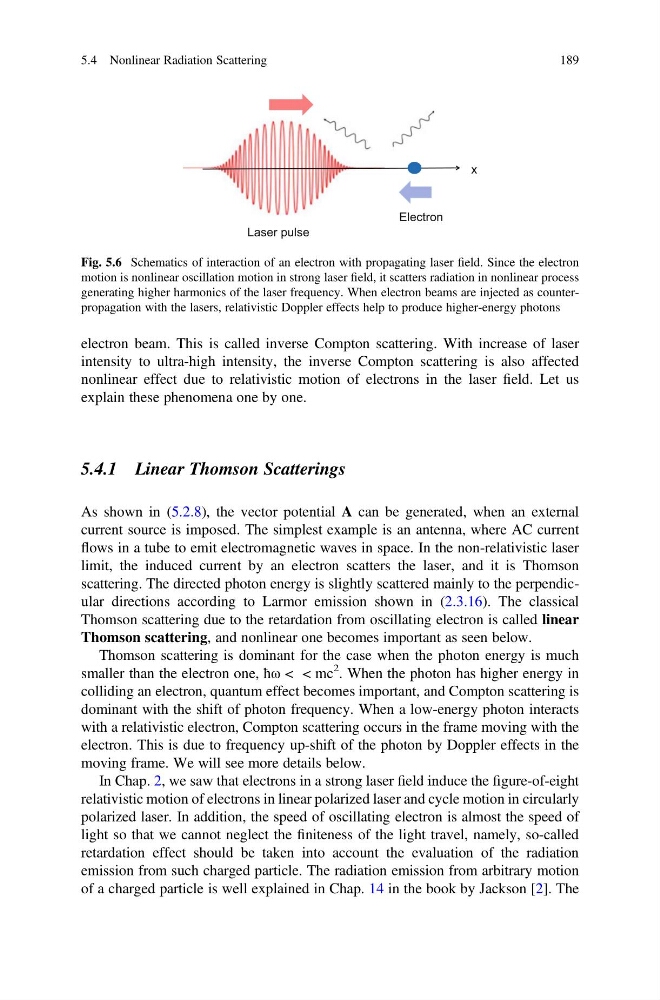
Fig. 5.6 Schematics of interaction of an electron with propagating laser field. Since the electron
motion is nonlinear oscillation motion in strong laser field, it scatters radiation in nonlinear process
generating higher harmonics of the laser frequency. When electron beams are injected as counterpropagation with the lasers, relativistic Doppler effects help to produce higher-energy photons
5.4 Nonlinear Radiation Scattering
189
intensity to ultra-high intensity, the inverse Compton scattering is also affected
nonlinear effect due to relativistic motion of electrons in the laser field. Let us
explain these phenomena one by one.
5.4.1 Linear Thomson Scatterings
As shown in (5.2.8), the vector potential A can be generated, when an external
current source is imposed. The simplest example is an antenna, where AC current
flows in a tube to emit electromagnetic waves in space. In the non-relativistic laser
limit, the induced current by an electron scatters the laser, and it is Thomson
scattering. The directed photon energy is slightly scattered mainly to the perpendicular directions according to Larmor emission shown in (2.3.16). The classical
Thomson scattering due to the retardation from oscillating electron is called linear
Thomson scattering, and nonlinear one becomes important as seen below.
Thomson scattering is dominant for the case when the photon energy is much
smaller than the electron one, ħω < < mc
2 . When the photon has higher energy in
colliding an electron, quantum effect becomes important, and Compton scattering is
dominant with the shift of photon frequency. When a low-energy photon interacts
with a relativistic electron, Compton scattering occurs in the frame moving with the
electron. This is due to frequency up-shift of the photon by Doppler effects in the
moving frame. We will see more details below.
In Chap. 2, we saw that electrons in a strong laser field induce the figure-of-eight
relativistic motion of electrons in linear polarized laser and cycle motion in circularly
polarized laser. In addition, the speed of oscillating electron is almost the speed of
light so that we cannot neglect the finiteness of the light travel, namely, so-called
retardation effect should be taken into account the evaluation of the radiation
emission from such charged particle. The radiation emission from arbitrary motion
of a charged particle is well explained in Chap. 14 in the book by Jackson [2]. The
Laser pulse
Electron
x
Fig. 5.6 Schematics of interaction of an electron with propagating laser field. Since the electron
motion is nonlinear oscillation motion in strong laser field, it scatters radiation in nonlinear process
generating higher harmonics of the laser frequency. When electron beams are injected as counterpropagation with the lasers, relativistic Doppler effects help to produce higher-energy photons
5.4 Nonlinear Radiation Scattering
189