

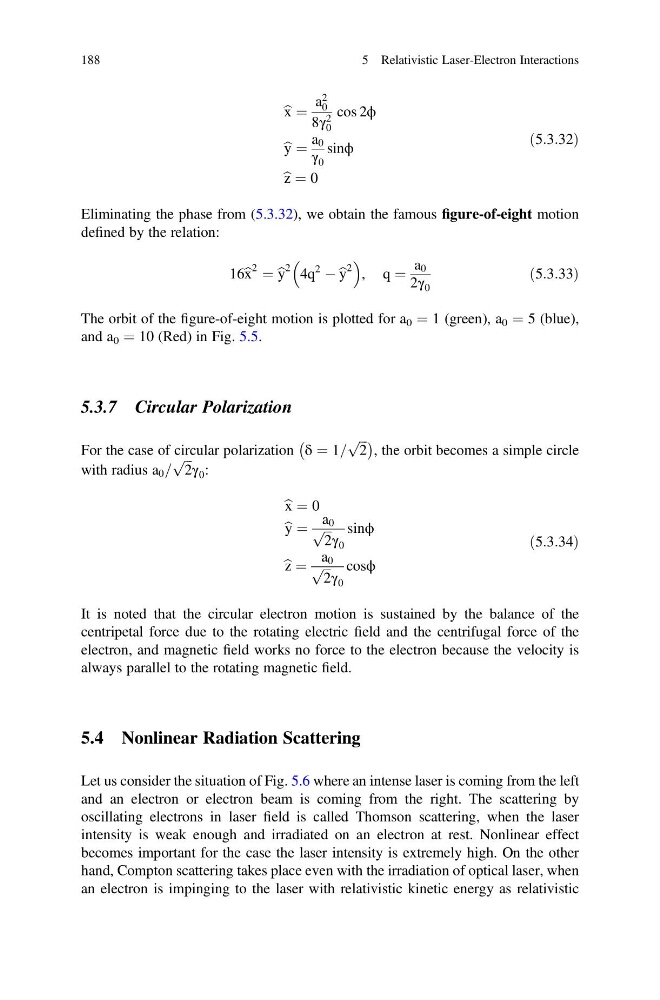
b x ¼
a
2
0
8γ 2
0
cos 2ϕ
b y ¼
a 0
γ 0
sinϕ
b z ¼ 0
ð5:3:32Þ
Eliminating the phase from (5.3.32), we obtain the famous figure-of-eight motion
defined by the relation:
16b x
2 ¼ b y
2 4q
2
À b y
2
, q ¼
a 0
2γ 0
ð5:3:33Þ
The orbit of the figure-of-eight motion is plotted for a 0 ¼ 1 (green), a 0 ¼ 5 (blue),
and a 0 ¼ 10 (Red) in Fig. 5.5.
5.3.7 Circular Polarization
For the case of circular polarization δ ¼ 1=
ffiffi ffi
2
p
À
Á
, the orbit becomes a simple circle
with radius a 0 =
ffiffi ffi
2
p γ 0 :
b x ¼ 0
b y ¼
a 0
ffiffi ffi
2
p γ 0
sinϕ
b z ¼
a 0
ffiffi ffi
2
p γ 0
cosϕ
ð5:3:34Þ
It is noted that the circular electron motion is sustained by the balance of the
centripetal force due to the rotating electric field and the centrifugal force of the
electron, and magnetic field works no force to the electron because the velocity is
always parallel to the rotating magnetic field.
5.4 Nonlinear Radiation Scattering
Let us consider the situation of Fig. 5.6 where an intense laser is coming from the left
and an electron or electron beam is coming from the right. The scattering by
oscillating electrons in laser field is called Thomson scattering, when the laser
intensity is weak enough and irradiated on an electron at rest. Nonlinear effect
becomes important for the case the laser intensity is extremely high. On the other
hand, Compton scattering takes place even with the irradiation of optical laser, when
an electron is impinging to the laser with relativistic kinetic energy as relativistic
188
5 Relativistic Laser-Electron Interactions
a
2
0
8γ 2
0
cos 2ϕ
b y ¼
a 0
γ 0
sinϕ
b z ¼ 0
ð5:3:32Þ
Eliminating the phase from (5.3.32), we obtain the famous figure-of-eight motion
defined by the relation:
16b x
2 ¼ b y
2 4q
2
À b y
2
, q ¼
a 0
2γ 0
ð5:3:33Þ
The orbit of the figure-of-eight motion is plotted for a 0 ¼ 1 (green), a 0 ¼ 5 (blue),
and a 0 ¼ 10 (Red) in Fig. 5.5.
5.3.7 Circular Polarization
For the case of circular polarization δ ¼ 1=
ffiffi ffi
2
p
À
Á
, the orbit becomes a simple circle
with radius a 0 =
ffiffi ffi
2
p γ 0 :
b x ¼ 0
b y ¼
a 0
ffiffi ffi
2
p γ 0
sinϕ
b z ¼
a 0
ffiffi ffi
2
p γ 0
cosϕ
ð5:3:34Þ
It is noted that the circular electron motion is sustained by the balance of the
centripetal force due to the rotating electric field and the centrifugal force of the
electron, and magnetic field works no force to the electron because the velocity is
always parallel to the rotating magnetic field.
5.4 Nonlinear Radiation Scattering
Let us consider the situation of Fig. 5.6 where an intense laser is coming from the left
and an electron or electron beam is coming from the right. The scattering by
oscillating electrons in laser field is called Thomson scattering, when the laser
intensity is weak enough and irradiated on an electron at rest. Nonlinear effect
becomes important for the case the laser intensity is extremely high. On the other
hand, Compton scattering takes place even with the irradiation of optical laser, when
an electron is impinging to the laser with relativistic kinetic energy as relativistic
188
5 Relativistic Laser-Electron Interactions