

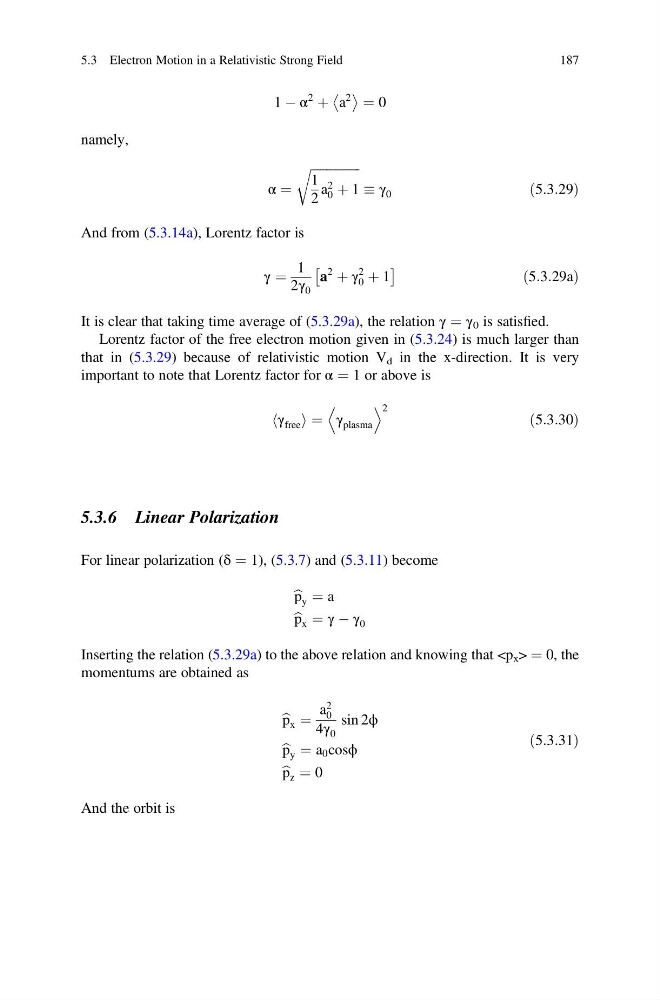
1 À α
2
þ a
2
¼ 0
namely,
α ¼
ffiffiffiffiffiffiffiffiffiffiffiffiffiffiffi ffi
1
2
a 2
0 þ 1
r
γ 0
ð5:3:29Þ
And from (5.3.14a), Lorentz factor is
γ ¼
1
2γ 0
a
2
þ γ
2
0 þ 1
Â
Ã
ð5:3:29aÞ
It is clear that taking time average of (5.3.29a), the relation γ ¼ γ 0 is satisfied.
Lorentz factor of the free electron motion given in (5.3.24) is much larger than
that in (5.3.29) because of relativistic motion V d in the x-direction. It is very
important to note that Lorentz factor for α ¼ 1 or above is
γ free
h
i ¼ γ plasma
D
E 2
ð5:3:30Þ
5.3.6 Linear Polarization
For linear polarization (δ ¼ 1), (5.3.7) and (5.3.11) become
b p y ¼ a
b p x ¼ γ À γ 0
Inserting the relation (5.3.29a) to the above relation and knowing that
2
þ a
2
¼ 0
namely,
α ¼
ffiffiffiffiffiffiffiffiffiffiffiffiffiffiffi ffi
1
2
a 2
0 þ 1
r
γ 0
ð5:3:29Þ
And from (5.3.14a), Lorentz factor is
γ ¼
1
2γ 0
a
2
þ γ
2
0 þ 1
Â
Ã
ð5:3:29aÞ
It is clear that taking time average of (5.3.29a), the relation γ ¼ γ 0 is satisfied.
Lorentz factor of the free electron motion given in (5.3.24) is much larger than
that in (5.3.29) because of relativistic motion V d in the x-direction. It is very
important to note that Lorentz factor for α ¼ 1 or above is
γ free
h
i ¼ γ plasma
D
E 2
ð5:3:30Þ
5.3.6 Linear Polarization
For linear polarization (δ ¼ 1), (5.3.7) and (5.3.11) become
b p y ¼ a
b p x ¼ γ À γ 0
Inserting the relation (5.3.29a) to the above relation and knowing that
¼ 0, the
momentums are obtained as
b p x ¼
a
2
0
4γ 0
sin 2ϕ
b p y ¼ a 0 cosϕ
b p z ¼ 0
ð5:3:31Þ
And the orbit is
5.3 Electron Motion in a Relativistic Strong Field
187