

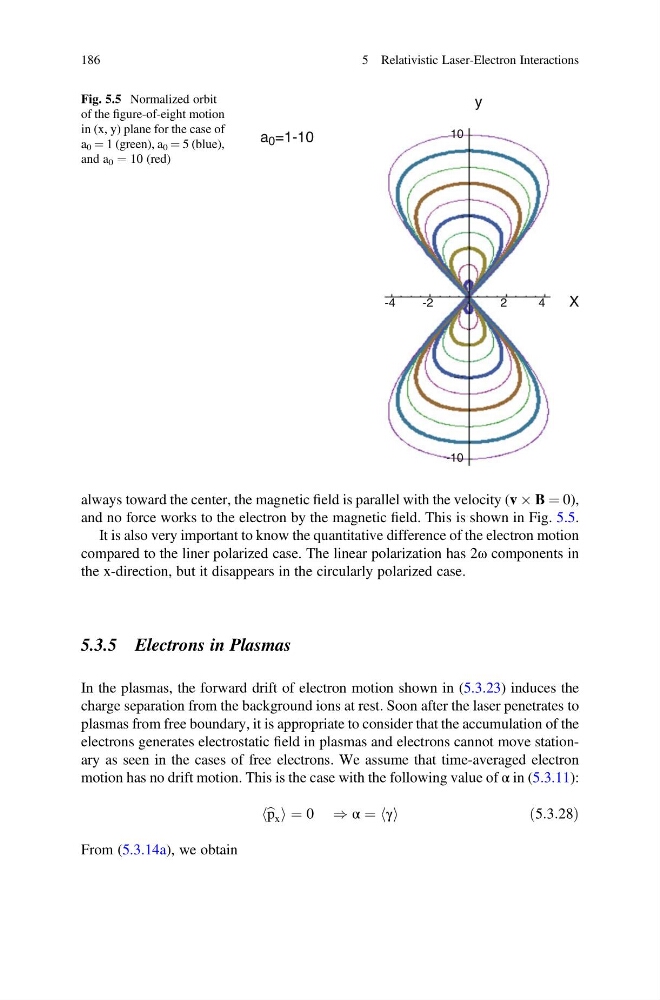
always toward the center, the magnetic field is parallel with the velocity (v  B ¼ 0),
and no force works to the electron by the magnetic field. This is shown in Fig. 5.5.
It is also very important to know the quantitative difference of the electron motion
compared to the liner polarized case. The linear polarization has 2ω components in
the x-direction, but it disappears in the circularly polarized case.
5.3.5 Electrons in Plasmas
In the plasmas, the forward drift of electron motion shown in (5.3.23) induces the
charge separation from the background ions at rest. Soon after the laser penetrates to
plasmas from free boundary, it is appropriate to consider that the accumulation of the
electrons generates electrostatic field in plasmas and electrons cannot move stationary as seen in the cases of free electrons. We assume that time-averaged electron
motion has no drift motion. This is the case with the following value of α in (5.3.11):
b p x
h i ¼ 0 ) α ¼ γ
h i
ð5:3:28Þ
From (5.3.14a), we obtain
-4
-2
10
-10
2
4
X
y
a 0 =1-10
Fig. 5.5 Normalized orbit
of the figure-of-eight motion
in (x, y) plane for the case of
a 0 ¼ 1 (green), a 0 ¼ 5 (blue),
and a 0 ¼ 10 (red)
186
5 Relativistic Laser-Electron Interactions
and no force works to the electron by the magnetic field. This is shown in Fig. 5.5.
It is also very important to know the quantitative difference of the electron motion
compared to the liner polarized case. The linear polarization has 2ω components in
the x-direction, but it disappears in the circularly polarized case.
5.3.5 Electrons in Plasmas
In the plasmas, the forward drift of electron motion shown in (5.3.23) induces the
charge separation from the background ions at rest. Soon after the laser penetrates to
plasmas from free boundary, it is appropriate to consider that the accumulation of the
electrons generates electrostatic field in plasmas and electrons cannot move stationary as seen in the cases of free electrons. We assume that time-averaged electron
motion has no drift motion. This is the case with the following value of α in (5.3.11):
b p x
h i ¼ 0 ) α ¼ γ
h i
ð5:3:28Þ
From (5.3.14a), we obtain
-4
-2
10
-10
2
4
X
y
a 0 =1-10
Fig. 5.5 Normalized orbit
of the figure-of-eight motion
in (x, y) plane for the case of
a 0 ¼ 1 (green), a 0 ¼ 5 (blue),
and a 0 ¼ 10 (red)
186
5 Relativistic Laser-Electron Interactions