

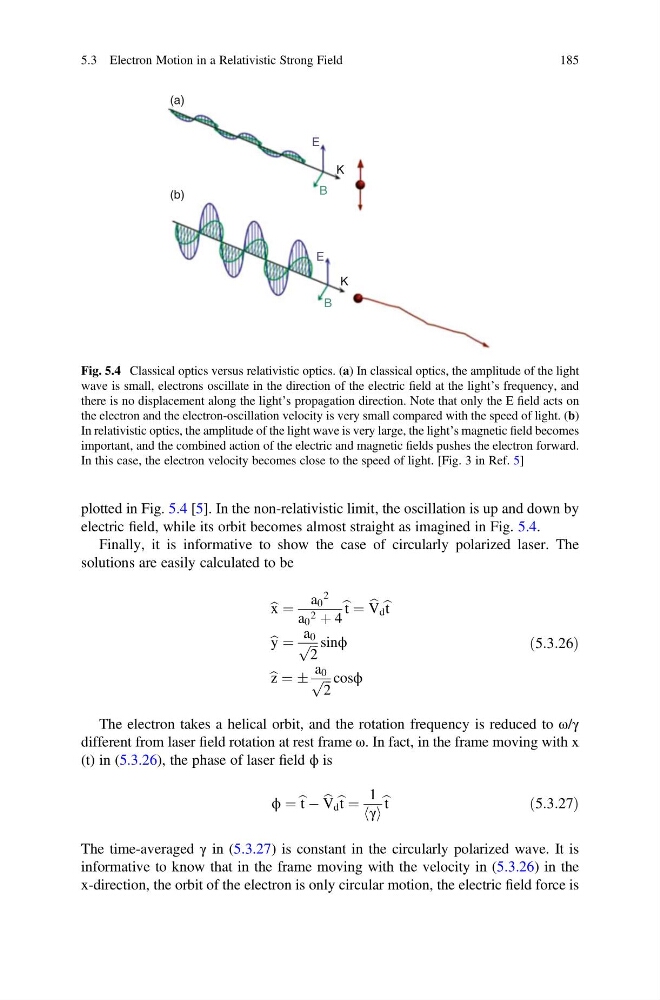
plotted in Fig. 5.4 [5]. In the non-relativistic limit, the oscillation is up and down by
electric field, while its orbit becomes almost straight as imagined in Fig. 5.4.
Finally, it is informative to show the case of circularly polarized laser. The
solutions are easily calculated to be
b x ¼
a 0
2
a 0
2 þ 4
b t ¼ b
V d b t
b y ¼
a 0 ffiffi ffi
2
p sinϕ
b z ¼ Æ
a 0 ffiffi ffi
2
p cosϕ
ð5:3:26Þ
The electron takes a helical orbit, and the rotation frequency is reduced to ω/γ
different from laser field rotation at rest frame ω. In fact, in the frame moving with x
(t) in (5.3.26), the phase of laser field ϕ is
ϕ ¼ b t À b
V d b t ¼
1
γ
h i
b t
ð5:3:27Þ
The time-averaged γ in (5.3.27) is constant in the circularly polarized wave. It is
informative to know that in the frame moving with the velocity in (5.3.26) in the
x-direction, the orbit of the electron is only circular motion, the electric field force is
(a)
(b)
E
K
B
E
K
B
Fig. 5.4 Classical optics versus relativistic optics. (a) In classical optics, the amplitude of the light
wave is small, electrons oscillate in the direction of the electric field at the light’s frequency, and
there is no displacement along the light’s propagation direction. Note that only the E field acts on
the electron and the electron-oscillation velocity is very small compared with the speed of light. (b)
In relativistic optics, the amplitude of the light wave is very large, the light’s magnetic field becomes
important, and the combined action of the electric and magnetic fields pushes the electron forward.
In this case, the electron velocity becomes close to the speed of light. [Fig. 3 in Ref. 5]
5.3 Electron Motion in a Relativistic Strong Field
185
electric field, while its orbit becomes almost straight as imagined in Fig. 5.4.
Finally, it is informative to show the case of circularly polarized laser. The
solutions are easily calculated to be
b x ¼
a 0
2
a 0
2 þ 4
b t ¼ b
V d b t
b y ¼
a 0 ffiffi ffi
2
p sinϕ
b z ¼ Æ
a 0 ffiffi ffi
2
p cosϕ
ð5:3:26Þ
The electron takes a helical orbit, and the rotation frequency is reduced to ω/γ
different from laser field rotation at rest frame ω. In fact, in the frame moving with x
(t) in (5.3.26), the phase of laser field ϕ is
ϕ ¼ b t À b
V d b t ¼
1
γ
h i
b t
ð5:3:27Þ
The time-averaged γ in (5.3.27) is constant in the circularly polarized wave. It is
informative to know that in the frame moving with the velocity in (5.3.26) in the
x-direction, the orbit of the electron is only circular motion, the electric field force is
(a)
(b)
E
K
B
E
K
B
Fig. 5.4 Classical optics versus relativistic optics. (a) In classical optics, the amplitude of the light
wave is small, electrons oscillate in the direction of the electric field at the light’s frequency, and
there is no displacement along the light’s propagation direction. Note that only the E field acts on
the electron and the electron-oscillation velocity is very small compared with the speed of light. (b)
In relativistic optics, the amplitude of the light wave is very large, the light’s magnetic field becomes
important, and the combined action of the electric and magnetic fields pushes the electron forward.
In this case, the electron velocity becomes close to the speed of light. [Fig. 3 in Ref. 5]
5.3 Electron Motion in a Relativistic Strong Field
185