

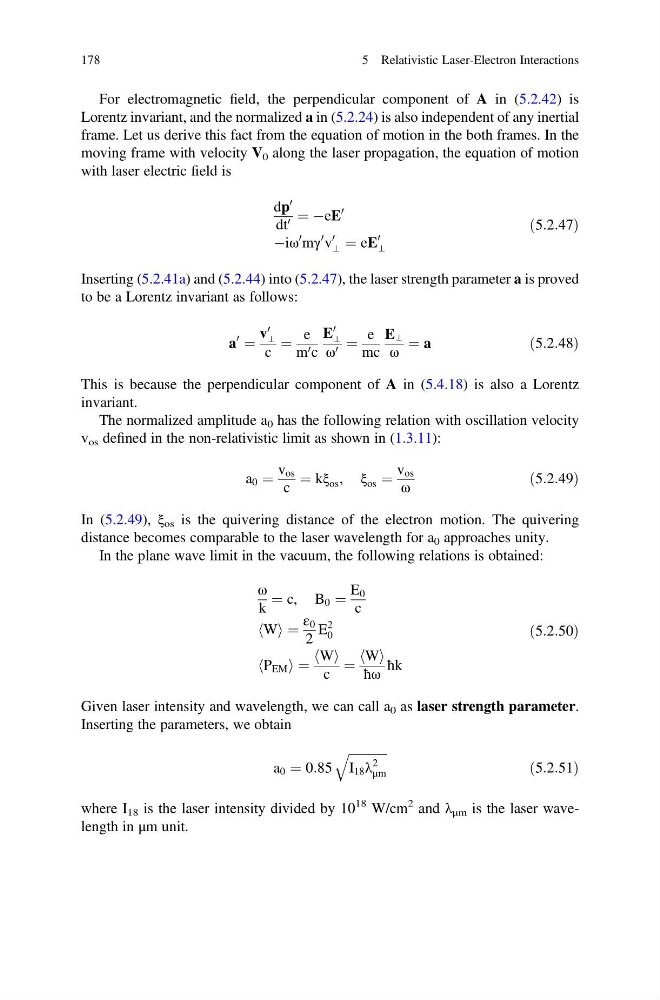
For electromagnetic field, the perpendicular component of A in (5.2.42) is
Lorentz invariant, and the normalized a in (5.2.24) is also independent of any inertial
frame. Let us derive this fact from the equation of motion in the both frames. In the
moving frame with velocity V 0 along the laser propagation, the equation of motion
with laser electric field is
dp
0
dt 0 ¼ ÀeE
0
Àiω
0 mγ
0 v
0
⊥ ¼ eE
0
⊥
ð5:2:47Þ
Inserting (5.2.41a) and (5.2.44) into (5.2.47), the laser strength parameter a is proved
to be a Lorentz invariant as follows:
a
0
¼
v
0
⊥
c
¼
e
m 0 c
E
0
⊥
ω 0 ¼
e
mc
E ⊥
ω
¼ a
ð5:2:48Þ
This is because the perpendicular component of A in (5.4.18) is also a Lorentz
invariant.
The normalized amplitude a 0 has the following relation with oscillation velocity
v os defined in the non-relativistic limit as shown in (1.3.11):
a 0 ¼
v os
c
¼ kξ os , ξ os ¼
v os
ω
ð5:2:49Þ
In (5.2.49), ξ os is the quivering distance of the electron motion. The quivering
distance becomes comparable to the laser wavelength for a 0 approaches unity.
In the plane wave limit in the vacuum, the following relations is obtained:
ω
k
¼ c, B 0 ¼
E 0
c
W
h i ¼
ε 0
2
E
2
0
P EM
h
i ¼
W
h i
c
¼
W
h i
ħω
ħk
ð5:2:50Þ
Given laser intensity and wavelength, we can call a 0 as laser strength parameter.
Inserting the parameters, we obtain
a 0 ¼ 0:85
ffiffiffiffiffiffiffiffiffiffiffiffi ffi
I 18 λ
2
μm
q
ð5:2:51Þ
where I 18 is the laser intensity divided by 10
18 W/cm
2 and λ μm is the laser wavelength in μm unit.
178
5 Relativistic Laser-Electron Interactions
Lorentz invariant, and the normalized a in (5.2.24) is also independent of any inertial
frame. Let us derive this fact from the equation of motion in the both frames. In the
moving frame with velocity V 0 along the laser propagation, the equation of motion
with laser electric field is
dp
0
dt 0 ¼ ÀeE
0
Àiω
0 mγ
0 v
0
⊥ ¼ eE
0
⊥
ð5:2:47Þ
Inserting (5.2.41a) and (5.2.44) into (5.2.47), the laser strength parameter a is proved
to be a Lorentz invariant as follows:
a
0
¼
v
0
⊥
c
¼
e
m 0 c
E
0
⊥
ω 0 ¼
e
mc
E ⊥
ω
¼ a
ð5:2:48Þ
This is because the perpendicular component of A in (5.4.18) is also a Lorentz
invariant.
The normalized amplitude a 0 has the following relation with oscillation velocity
v os defined in the non-relativistic limit as shown in (1.3.11):
a 0 ¼
v os
c
¼ kξ os , ξ os ¼
v os
ω
ð5:2:49Þ
In (5.2.49), ξ os is the quivering distance of the electron motion. The quivering
distance becomes comparable to the laser wavelength for a 0 approaches unity.
In the plane wave limit in the vacuum, the following relations is obtained:
ω
k
¼ c, B 0 ¼
E 0
c
W
h i ¼
ε 0
2
E
2
0
P EM
h
i ¼
W
h i
c
¼
W
h i
ħω
ħk
ð5:2:50Þ
Given laser intensity and wavelength, we can call a 0 as laser strength parameter.
Inserting the parameters, we obtain
a 0 ¼ 0:85
ffiffiffiffiffiffiffiffiffiffiffiffi ffi
I 18 λ
2
μm
q
ð5:2:51Þ
where I 18 is the laser intensity divided by 10
18 W/cm
2 and λ μm is the laser wavelength in μm unit.
178
5 Relativistic Laser-Electron Interactions