

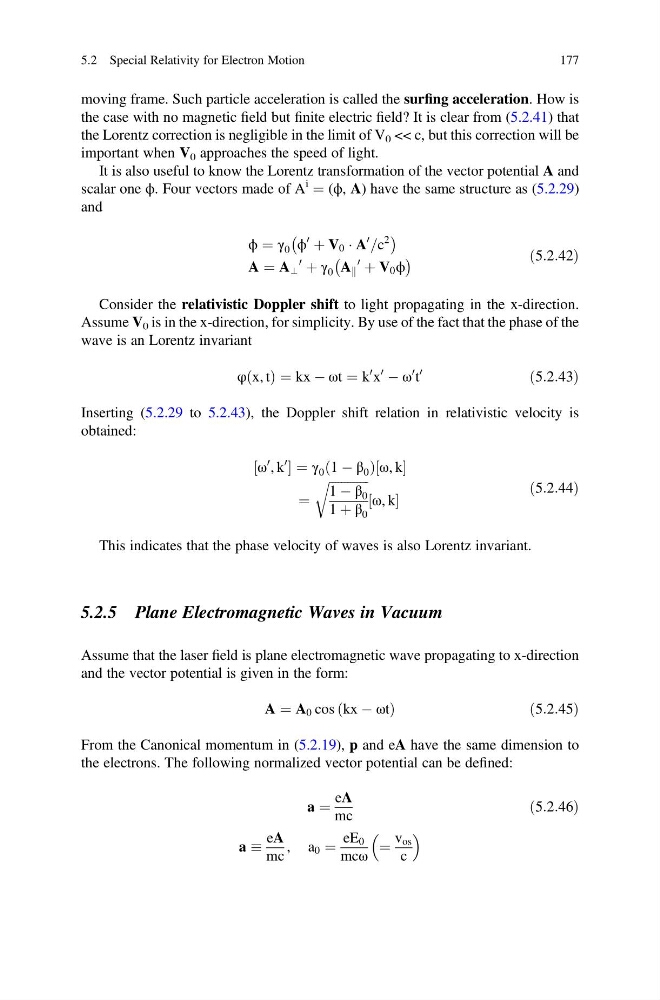
moving frame. Such particle acceleration is called the surfing acceleration. How is
the case with no magnetic field but finite electric field? It is clear from (5.2.41) that
the Lorentz correction is negligible in the limit of V 0 << c, but this correction will be
important when V 0 approaches the speed of light.
It is also useful to know the Lorentz transformation of the vector potential A and
scalar one ϕ. Four vectors made of A
i
¼ (ϕ, A) have the same structure as (5.2.29)
and
ϕ ¼ γ 0 ϕ
0
þ V 0 Á A
0
=c
2
À
Á
A ¼ A ⊥
0
þ γ 0 A k
0
þ V 0 ϕ
À
Á
ð5:2:42Þ
Consider the relativistic Doppler shift to light propagating in the x-direction.
Assume V 0 is in the x-direction, for simplicity. By use of the fact that the phase of the
wave is an Lorentz invariant
φ x, t
ð Þ ¼ kx À ωt ¼ k
0 x
0
À ω
0 t
0
ð5:2:43Þ
Inserting (5.2.29 to 5.2.43), the Doppler shift relation in relativistic velocity is
obtained:
ω
0 , k
0
½
¼γ 0 1 À β 0
ð
Þω, k
½
¼
ffiffiffiffiffiffiffiffiffiffiffiffiffi
1 À β 0
1 þ β 0
r
ω, k
½
ð5:2:44Þ
This indicates that the phase velocity of waves is also Lorentz invariant.
5.2.5 Plane Electromagnetic Waves in Vacuum
Assume that the laser field is plane electromagnetic wave propagating to x-direction
and the vector potential is given in the form:
A ¼ A 0 cos kx À ωt
ð
Þ
ð 5:2:45Þ
From the Canonical momentum in (5.2.19), p and eA have the same dimension to
the electrons. The following normalized vector potential can be defined:
a ¼
eA
mc
ð5:2:46Þ
a
eA
mc
, a 0 ¼
eE 0
mcω
¼
v os
c
5.2 Special Relativity for Electron Motion
177
the case with no magnetic field but finite electric field? It is clear from (5.2.41) that
the Lorentz correction is negligible in the limit of V 0 << c, but this correction will be
important when V 0 approaches the speed of light.
It is also useful to know the Lorentz transformation of the vector potential A and
scalar one ϕ. Four vectors made of A
i
¼ (ϕ, A) have the same structure as (5.2.29)
and
ϕ ¼ γ 0 ϕ
0
þ V 0 Á A
0
=c
2
À
Á
A ¼ A ⊥
0
þ γ 0 A k
0
þ V 0 ϕ
À
Á
ð5:2:42Þ
Consider the relativistic Doppler shift to light propagating in the x-direction.
Assume V 0 is in the x-direction, for simplicity. By use of the fact that the phase of the
wave is an Lorentz invariant
φ x, t
ð Þ ¼ kx À ωt ¼ k
0 x
0
À ω
0 t
0
ð5:2:43Þ
Inserting (5.2.29 to 5.2.43), the Doppler shift relation in relativistic velocity is
obtained:
ω
0 , k
0
½
¼γ 0 1 À β 0
ð
Þω, k
½
¼
ffiffiffiffiffiffiffiffiffiffiffiffiffi
1 À β 0
1 þ β 0
r
ω, k
½
ð5:2:44Þ
This indicates that the phase velocity of waves is also Lorentz invariant.
5.2.5 Plane Electromagnetic Waves in Vacuum
Assume that the laser field is plane electromagnetic wave propagating to x-direction
and the vector potential is given in the form:
A ¼ A 0 cos kx À ωt
ð
Þ
ð 5:2:45Þ
From the Canonical momentum in (5.2.19), p and eA have the same dimension to
the electrons. The following normalized vector potential can be defined:
a ¼
eA
mc
ð5:2:46Þ
a
eA
mc
, a 0 ¼
eE 0
mcω
¼
v os
c
5.2 Special Relativity for Electron Motion
177