

1 À β
0 2 ¼
1 À β
2
γ 2
0 1 À V 0 Á v=c 2
ð
Þ
ð5:2:37Þ
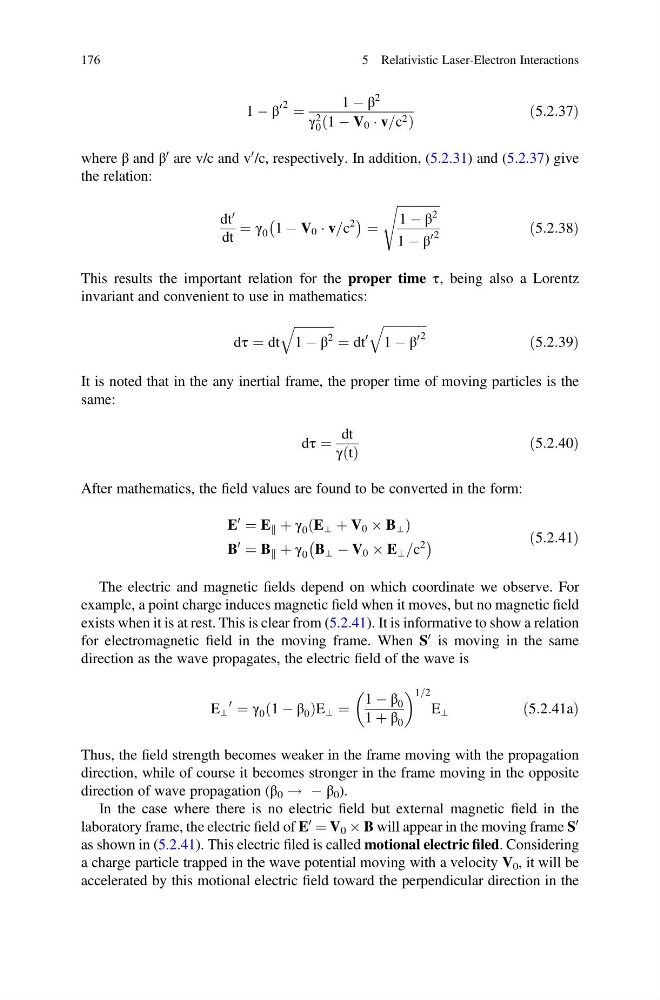
where β and β
0 are v/c and v
0 /c, respectively. In addition, (5.2.31) and (5.2.37) give
the relation:
dt
0
dt
¼ γ 0 1 À V 0 Á v=c
2
À
Á ¼
ffiffiffiffiffiffiffiffiffiffiffiffiffiffi
1 À β
2
1 À β
0 2
s
ð5:2:38Þ
This results the important relation for the proper time τ, being also a Lorentz
invariant and convenient to use in mathematics:
dτ ¼ dt
ffiffiffiffiffiffiffiffiffiffiffiffiffi
1 À β
2
q
¼ dt
0
ffiffiffiffiffiffiffiffiffiffiffiffiffiffi
1 À β
0 2
q
ð5:2:39Þ
It is noted that in the any inertial frame, the proper time of moving particles is the
same:
dτ ¼
dt
γ t
ð Þ
ð5:2:40Þ
After mathematics, the field values are found to be converted in the form:
E
0
¼ E k þ γ 0 E ⊥ þ V 0 Â B ⊥
ð
Þ
B
0
¼ B k þ γ 0 B ⊥ À V 0 Â E ⊥ =c
2
À
Á
ð5:2:41Þ
The electric and magnetic fields depend on which coordinate we observe. For
example, a point charge induces magnetic field when it moves, but no magnetic field
exists when it is at rest. This is clear from (5.2.41). It is informative to show a relation
for electromagnetic field in the moving frame. When S
0 is moving in the same
direction as the wave propagates, the electric field of the wave is
E ⊥
0
¼ γ 0 1 À β 0
ð
ÞE ⊥ ¼
1 À β 0
1 þ β 0
1=2
E ⊥
ð5:2:41aÞ
Thus, the field strength becomes weaker in the frame moving with the propagation
direction, while of course it becomes stronger in the frame moving in the opposite
direction of wave propagation (β 0 ! À β 0 ).
In the case where there is no electric field but external magnetic field in the
laboratory frame, the electric field of E
0
¼ V 0 Â B will appear in the moving frame S
0
as shown in (5.2.41). This electric filed is called motional electric filed. Considering
a charge particle trapped in the wave potential moving with a velocity V 0 , it will be
accelerated by this motional electric field toward the perpendicular direction in the
176
5 Relativistic Laser-Electron Interactions
0 2 ¼
1 À β
2
γ 2
0 1 À V 0 Á v=c 2
ð
Þ
ð5:2:37Þ
where β and β
0 are v/c and v
0 /c, respectively. In addition, (5.2.31) and (5.2.37) give
the relation:
dt
0
dt
¼ γ 0 1 À V 0 Á v=c
2
À
Á ¼
ffiffiffiffiffiffiffiffiffiffiffiffiffiffi
1 À β
2
1 À β
0 2
s
ð5:2:38Þ
This results the important relation for the proper time τ, being also a Lorentz
invariant and convenient to use in mathematics:
dτ ¼ dt
ffiffiffiffiffiffiffiffiffiffiffiffiffi
1 À β
2
q
¼ dt
0
ffiffiffiffiffiffiffiffiffiffiffiffiffiffi
1 À β
0 2
q
ð5:2:39Þ
It is noted that in the any inertial frame, the proper time of moving particles is the
same:
dτ ¼
dt
γ t
ð Þ
ð5:2:40Þ
After mathematics, the field values are found to be converted in the form:
E
0
¼ E k þ γ 0 E ⊥ þ V 0 Â B ⊥
ð
Þ
B
0
¼ B k þ γ 0 B ⊥ À V 0 Â E ⊥ =c
2
À
Á
ð5:2:41Þ
The electric and magnetic fields depend on which coordinate we observe. For
example, a point charge induces magnetic field when it moves, but no magnetic field
exists when it is at rest. This is clear from (5.2.41). It is informative to show a relation
for electromagnetic field in the moving frame. When S
0 is moving in the same
direction as the wave propagates, the electric field of the wave is
E ⊥
0
¼ γ 0 1 À β 0
ð
ÞE ⊥ ¼
1 À β 0
1 þ β 0
1=2
E ⊥
ð5:2:41aÞ
Thus, the field strength becomes weaker in the frame moving with the propagation
direction, while of course it becomes stronger in the frame moving in the opposite
direction of wave propagation (β 0 ! À β 0 ).
In the case where there is no electric field but external magnetic field in the
laboratory frame, the electric field of E
0
¼ V 0 Â B will appear in the moving frame S
0
as shown in (5.2.41). This electric filed is called motional electric filed. Considering
a charge particle trapped in the wave potential moving with a velocity V 0 , it will be
accelerated by this motional electric field toward the perpendicular direction in the
176
5 Relativistic Laser-Electron Interactions