

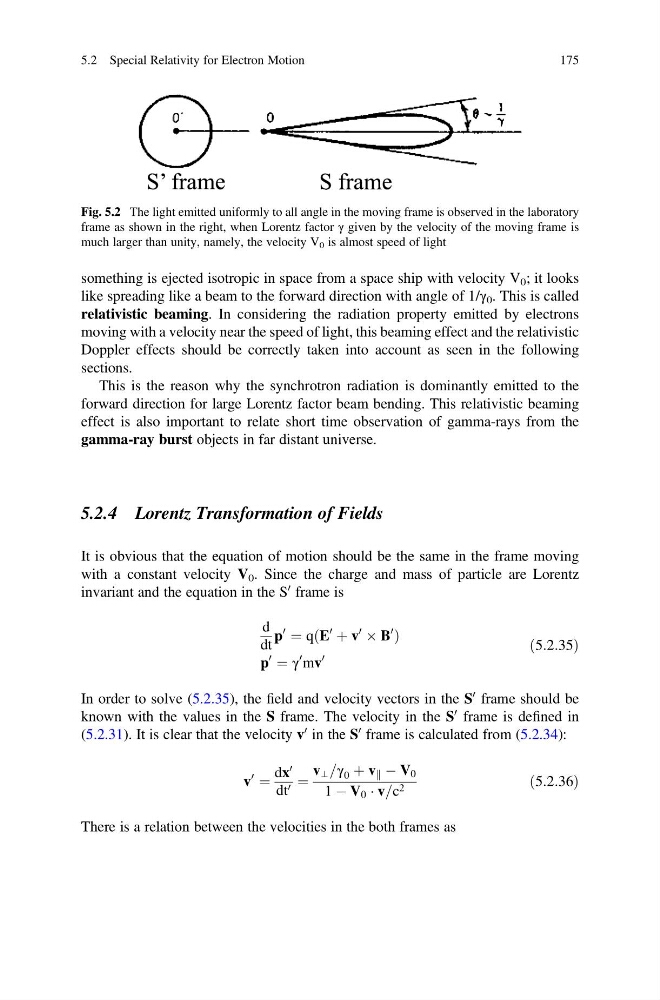
something is ejected isotropic in space from a space ship with velocity V 0 ; it looks
like spreading like a beam to the forward direction with angle of 1/γ 0 . This is called
relativistic beaming. In considering the radiation property emitted by electrons
moving with a velocity near the speed of light, this beaming effect and the relativistic
Doppler effects should be correctly taken into account as seen in the following
sections.
This is the reason why the synchrotron radiation is dominantly emitted to the
forward direction for large Lorentz factor beam bending. This relativistic beaming
effect is also important to relate short time observation of gamma-rays from the
gamma-ray burst objects in far distant universe.
5.2.4 Lorentz Transformation of Fields
It is obvious that the equation of motion should be the same in the frame moving
with a constant velocity V 0 . Since the charge and mass of particle are Lorentz
invariant and the equation in the S
0 frame is
d
dt
p
0
¼ q E
0
þ v
0
 B
0
ð
Þ
p
0
¼ γ
0 mv
0
ð5:2:35Þ
In order to solve (5.2.35), the field and velocity vectors in the S
0 frame should be
known with the values in the S frame. The velocity in the S
0 frame is defined in
(5.2.31). It is clear that the velocity v
0 in the S
0 frame is calculated from (5.2.34):
v
0
¼
dx
0
dt 0 ¼
v ⊥ =γ 0 þ v k À V 0
1 À V 0 Á v=c 2
ð5:2:36Þ
There is a relation between the velocities in the both frames as
Fig. 5.2 The light emitted uniformly to all angle in the moving frame is observed in the laboratory
frame as shown in the right, when Lorentz factor γ given by the velocity of the moving frame is
much larger than unity, namely, the velocity V 0 is almost speed of light
5.2 Special Relativity for Electron Motion
175
like spreading like a beam to the forward direction with angle of 1/γ 0 . This is called
relativistic beaming. In considering the radiation property emitted by electrons
moving with a velocity near the speed of light, this beaming effect and the relativistic
Doppler effects should be correctly taken into account as seen in the following
sections.
This is the reason why the synchrotron radiation is dominantly emitted to the
forward direction for large Lorentz factor beam bending. This relativistic beaming
effect is also important to relate short time observation of gamma-rays from the
gamma-ray burst objects in far distant universe.
5.2.4 Lorentz Transformation of Fields
It is obvious that the equation of motion should be the same in the frame moving
with a constant velocity V 0 . Since the charge and mass of particle are Lorentz
invariant and the equation in the S
0 frame is
d
dt
p
0
¼ q E
0
þ v
0
 B
0
ð
Þ
p
0
¼ γ
0 mv
0
ð5:2:35Þ
In order to solve (5.2.35), the field and velocity vectors in the S
0 frame should be
known with the values in the S frame. The velocity in the S
0 frame is defined in
(5.2.31). It is clear that the velocity v
0 in the S
0 frame is calculated from (5.2.34):
v
0
¼
dx
0
dt 0 ¼
v ⊥ =γ 0 þ v k À V 0
1 À V 0 Á v=c 2
ð5:2:36Þ
There is a relation between the velocities in the both frames as
Fig. 5.2 The light emitted uniformly to all angle in the moving frame is observed in the laboratory
frame as shown in the right, when Lorentz factor γ given by the velocity of the moving frame is
much larger than unity, namely, the velocity V 0 is almost speed of light
5.2 Special Relativity for Electron Motion
175