

5.3 Electron Motion in a Relativistic Strong Field
In the case of laser intensity near or more than I L ¼ 10
18 W/cm
2 (a 0 ¼ 1), relativistic
analysis is essential to electron motions in laser field. Then, it seems that complex
mathematics is probably required. However, very simple conservation laws are
obtained as seen below by assuming plane wave of laser field. Before proceeding
to the laser-plasma interaction, derive several important relations of an electron in
relativistic laser field. The electron motions in relativistic fields are well developed in
textbook, for example, [3, 4].
Let us assume that the laser field is monochromatic plane wave given with the
vector potential A and ϕ ¼ 0 in (5.2.7), and therefore
E ¼ À
∂A
∂t
,
B ¼ ∇ Â A
ð5:3:1Þ
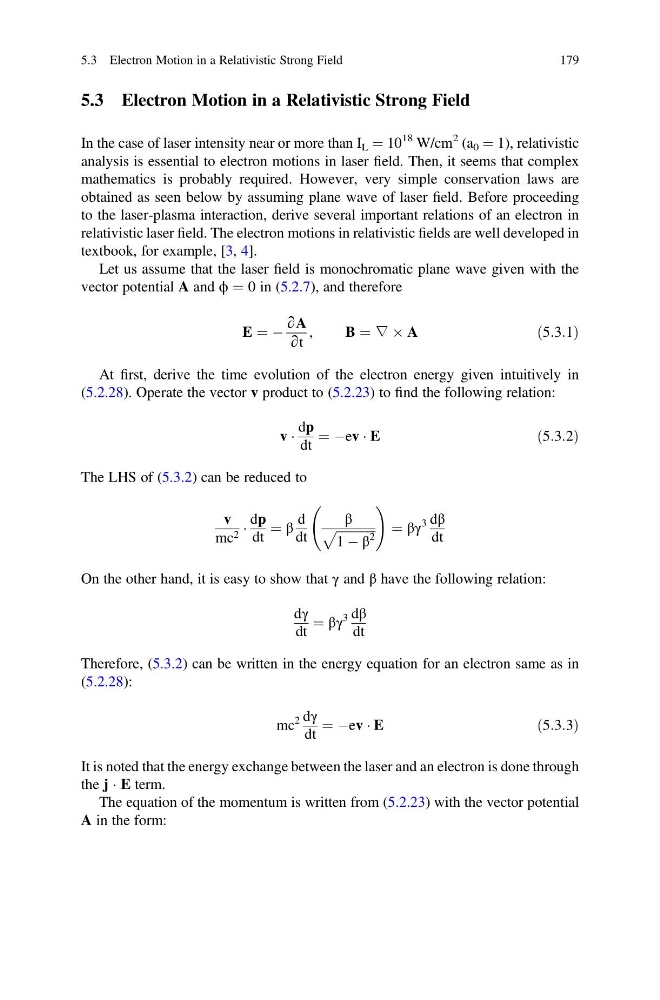
At first, derive the time evolution of the electron energy given intuitively in
(5.2.28). Operate the vector v product to (5.2.23) to find the following relation:
v Á
dp
dt
¼ Àev Á E
ð5:3:2Þ
The LHS of (5.3.2) can be reduced to
v
mc 2 Á
dp
dt
¼ β
d
dt
β
ffiffiffiffiffiffiffiffiffiffiffiffiffi
1 À β
2
p
!
¼ βγ
3 dβ
dt
On the other hand, it is easy to show that γ and β have the following relation:
dγ
dt
¼ βγ
3 dβ
dt
Therefore, (5.3.2) can be written in the energy equation for an electron same as in
(5.2.28):
mc
2 dγ
dt
¼ Àev Á E
ð5:3:3Þ
It is noted that the energy exchange between the laser and an electron is done through
the j Á E term.
The equation of the momentum is written from (5.2.23) with the vector potential
A in the form:
5.3 Electron Motion in a Relativistic Strong Field
179
In the case of laser intensity near or more than I L ¼ 10
18 W/cm
2 (a 0 ¼ 1), relativistic
analysis is essential to electron motions in laser field. Then, it seems that complex
mathematics is probably required. However, very simple conservation laws are
obtained as seen below by assuming plane wave of laser field. Before proceeding
to the laser-plasma interaction, derive several important relations of an electron in
relativistic laser field. The electron motions in relativistic fields are well developed in
textbook, for example, [3, 4].
Let us assume that the laser field is monochromatic plane wave given with the
vector potential A and ϕ ¼ 0 in (5.2.7), and therefore
E ¼ À
∂A
∂t
,
B ¼ ∇ Â A
ð5:3:1Þ
At first, derive the time evolution of the electron energy given intuitively in
(5.2.28). Operate the vector v product to (5.2.23) to find the following relation:
v Á
dp
dt
¼ Àev Á E
ð5:3:2Þ
The LHS of (5.3.2) can be reduced to
v
mc 2 Á
dp
dt
¼ β
d
dt
β
ffiffiffiffiffiffiffiffiffiffiffiffiffi
1 À β
2
p
!
¼ βγ
3 dβ
dt
On the other hand, it is easy to show that γ and β have the following relation:
dγ
dt
¼ βγ
3 dβ
dt
Therefore, (5.3.2) can be written in the energy equation for an electron same as in
(5.2.28):
mc
2 dγ
dt
¼ Àev Á E
ð5:3:3Þ
It is noted that the energy exchange between the laser and an electron is done through
the j Á E term.
The equation of the momentum is written from (5.2.23) with the vector potential
A in the form:
5.3 Electron Motion in a Relativistic Strong Field
179