

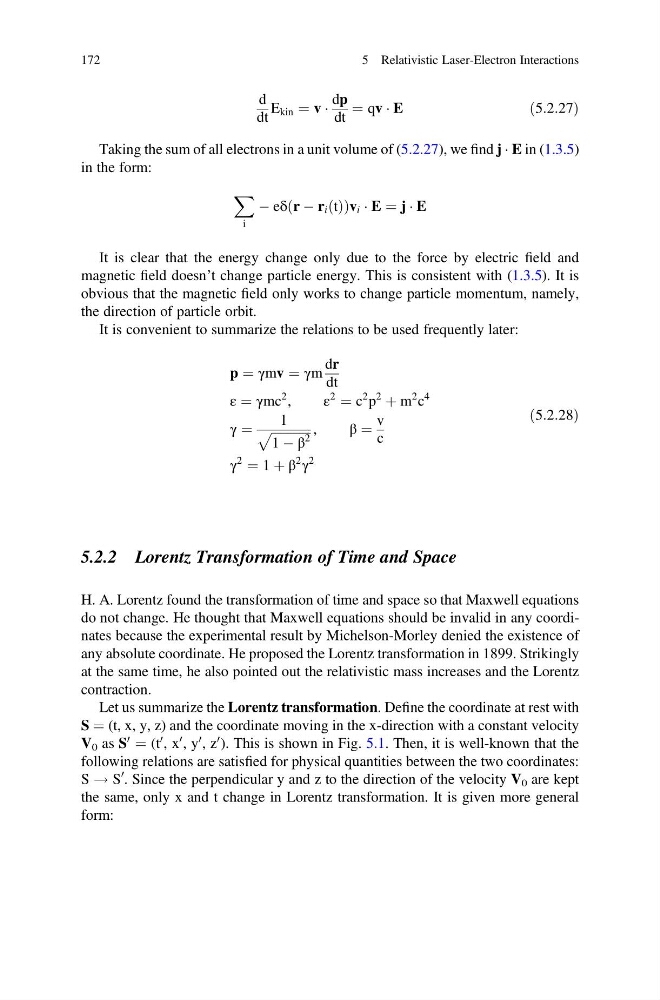
d
dt
E kin ¼ v Á
dp
dt
¼ qv Á E
ð5:2:27Þ
Taking the sum of all electrons in a unit volume of (5.2.27), we find j Á E in (1.3.5)
in the form:
X
i
À eδ r À r i t
ð Þ
ð
Þ v i Á E ¼ j Á E
It is clear that the energy change only due to the force by electric field and
magnetic field doesn’t change particle energy. This is consistent with (1.3.5). It is
obvious that the magnetic field only works to change particle momentum, namely,
the direction of particle orbit.
It is convenient to summarize the relations to be used frequently later:
p ¼ γmv ¼ γm
dr
dt
ε ¼ γmc
2 ,
ε
2
¼ c
2 p
2
þ m
2 c
4
γ ¼
1
ffiffiffiffiffiffiffiffiffiffiffiffiffi
1 À β
2
p
,
β ¼
v
c
γ
2
¼ 1 þ β
2
γ
2
ð5:2:28Þ
5.2.2 Lorentz Transformation of Time and Space
H. A. Lorentz found the transformation of time and space so that Maxwell equations
do not change. He thought that Maxwell equations should be invalid in any coordinates because the experimental result by Michelson-Morley denied the existence of
any absolute coordinate. He proposed the Lorentz transformation in 1899. Strikingly
at the same time, he also pointed out the relativistic mass increases and the Lorentz
contraction.
Let us summarize the Lorentz transformation. Define the coordinate at rest with
S ¼ (t, x, y, z) and the coordinate moving in the x-direction with a constant velocity
V 0 as S
0
¼ (t
0 , x
0 , y
0 , z
0 ). This is shown in Fig. 5.1. Then, it is well-known that the
following relations are satisfied for physical quantities between the two coordinates:
S ! S
0
. Since the perpendicular y and z to the direction of the velocity V 0 are kept
the same, only x and t change in Lorentz transformation. It is given more general
form:
172
5 Relativistic Laser-Electron Interactions
dt
E kin ¼ v Á
dp
dt
¼ qv Á E
ð5:2:27Þ
Taking the sum of all electrons in a unit volume of (5.2.27), we find j Á E in (1.3.5)
in the form:
X
i
À eδ r À r i t
ð Þ
ð
Þ v i Á E ¼ j Á E
It is clear that the energy change only due to the force by electric field and
magnetic field doesn’t change particle energy. This is consistent with (1.3.5). It is
obvious that the magnetic field only works to change particle momentum, namely,
the direction of particle orbit.
It is convenient to summarize the relations to be used frequently later:
p ¼ γmv ¼ γm
dr
dt
ε ¼ γmc
2 ,
ε
2
¼ c
2 p
2
þ m
2 c
4
γ ¼
1
ffiffiffiffiffiffiffiffiffiffiffiffiffi
1 À β
2
p
,
β ¼
v
c
γ
2
¼ 1 þ β
2
γ
2
ð5:2:28Þ
5.2.2 Lorentz Transformation of Time and Space
H. A. Lorentz found the transformation of time and space so that Maxwell equations
do not change. He thought that Maxwell equations should be invalid in any coordinates because the experimental result by Michelson-Morley denied the existence of
any absolute coordinate. He proposed the Lorentz transformation in 1899. Strikingly
at the same time, he also pointed out the relativistic mass increases and the Lorentz
contraction.
Let us summarize the Lorentz transformation. Define the coordinate at rest with
S ¼ (t, x, y, z) and the coordinate moving in the x-direction with a constant velocity
V 0 as S
0
¼ (t
0 , x
0 , y
0 , z
0 ). This is shown in Fig. 5.1. Then, it is well-known that the
following relations are satisfied for physical quantities between the two coordinates:
S ! S
0
. Since the perpendicular y and z to the direction of the velocity V 0 are kept
the same, only x and t change in Lorentz transformation. It is given more general
form:
172
5 Relativistic Laser-Electron Interactions