

d
dt
p þ qA
ð
Þ¼Àq∇ϕ þ qv  ∇  A
ð
Þþq v Á ∇
ð
ÞA
ð5:2:22Þ
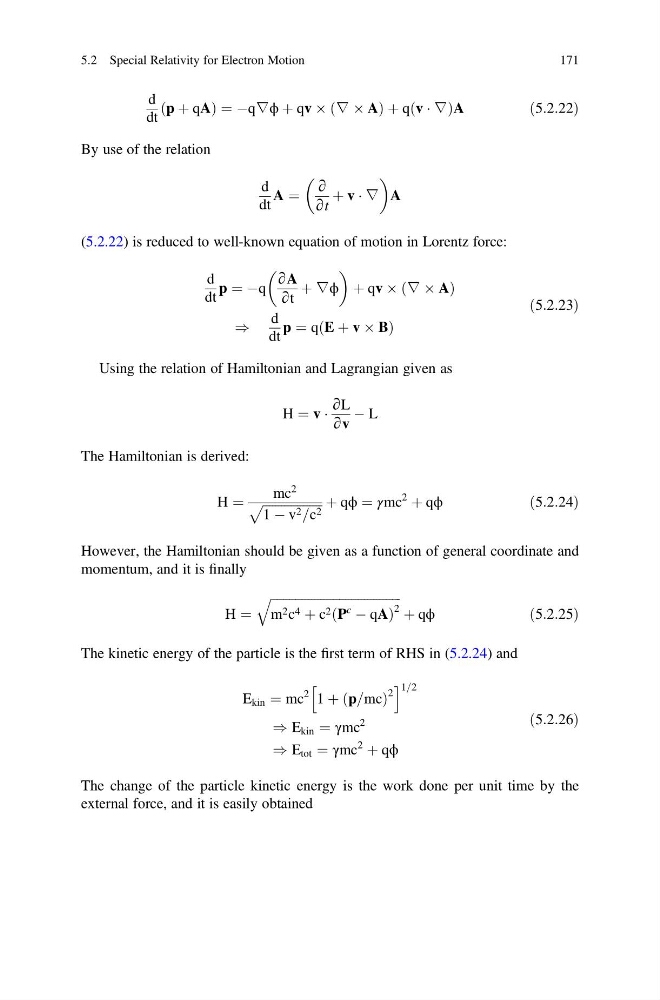
By use of the relation
d
dt
A ¼
∂
∂t
þ v Á ∇
A
(5.2.22) is reduced to well-known equation of motion in Lorentz force:
d
dt
p ¼ Àq
∂A
∂t
þ ∇ϕ
þ qv  ∇  A
ð
Þ
)
d
dt
p ¼ q E þ v  B
ð
Þ
ð5:2:23Þ
Using the relation of Hamiltonian and Lagrangian given as
H ¼ v Á
∂L
∂v
À L
The Hamiltonian is derived:
H ¼
mc
2
ffiffiffiffiffiffiffiffiffiffiffiffiffiffiffiffiffiffiffi
1 À v 2 =c 2
p
þ qϕ ¼ γmc
2
þ qϕ
ð5:2:24Þ
However, the Hamiltonian should be given as a function of general coordinate and
momentum, and it is finally
H ¼
ffiffiffiffiffiffiffiffiffiffiffiffiffiffiffiffiffiffiffiffiffiffiffiffiffiffiffiffiffiffiffiffiffiffiffiffiffiffiffiffiffi ffi
m 2 c 4 þ c 2 P
c
À qA
ð
Þ
2
q
þ qϕ
ð5:2:25Þ
The kinetic energy of the particle is the first term of RHS in (5.2.24) and
E kin ¼ mc
2 1 þ p=mc
ð
Þ
2
h
i 1=2
) E kin ¼ γmc
2
) E tot ¼ γmc
2
þ qϕ
ð5:2:26Þ
The change of the particle kinetic energy is the work done per unit time by the
external force, and it is easily obtained
5.2 Special Relativity for Electron Motion
171
dt
p þ qA
ð
Þ¼Àq∇ϕ þ qv  ∇  A
ð
Þþq v Á ∇
ð
ÞA
ð5:2:22Þ
By use of the relation
d
dt
A ¼
∂
∂t
þ v Á ∇
A
(5.2.22) is reduced to well-known equation of motion in Lorentz force:
d
dt
p ¼ Àq
∂A
∂t
þ ∇ϕ
þ qv  ∇  A
ð
Þ
)
d
dt
p ¼ q E þ v  B
ð
Þ
ð5:2:23Þ
Using the relation of Hamiltonian and Lagrangian given as
H ¼ v Á
∂L
∂v
À L
The Hamiltonian is derived:
H ¼
mc
2
ffiffiffiffiffiffiffiffiffiffiffiffiffiffiffiffiffiffiffi
1 À v 2 =c 2
p
þ qϕ ¼ γmc
2
þ qϕ
ð5:2:24Þ
However, the Hamiltonian should be given as a function of general coordinate and
momentum, and it is finally
H ¼
ffiffiffiffiffiffiffiffiffiffiffiffiffiffiffiffiffiffiffiffiffiffiffiffiffiffiffiffiffiffiffiffiffiffiffiffiffiffiffiffiffi ffi
m 2 c 4 þ c 2 P
c
À qA
ð
Þ
2
q
þ qϕ
ð5:2:25Þ
The kinetic energy of the particle is the first term of RHS in (5.2.24) and
E kin ¼ mc
2 1 þ p=mc
ð
Þ
2
h
i 1=2
) E kin ¼ γmc
2
) E tot ¼ γmc
2
þ qϕ
ð5:2:26Þ
The change of the particle kinetic energy is the work done per unit time by the
external force, and it is easily obtained
5.2 Special Relativity for Electron Motion
171