

t ¼ γ 0 t
0
þ V 0 Á x
0
=c
2
À
Á
x ¼ x ⊥
0
þ γ 0 x k
0
þ V 0 t
À
Á
ð5:2:29Þ
where γ 0 is Lorentz factor defined by V 0 and x ⊥ and x k means the coordinate
perpendicular and parallel to the moving frame direction, respectively:
γ 0 ¼
1
ffiffiffiffiffiffiffiffiffiffiffiffiffi
1 À β
2
0
q
,
β 0 ¼
V 0
c
ð5:2:30Þ
Solving (5.2.29) for x
0 and t
0 provided the following relation equivalent to (5.2.29).
t
0
¼ γ 0 t À V 0 Á x=c
2
À
Á
x
0
¼ x ⊥ þ γ 0 x k À V 0 t
À
Á
ð5:2:31Þ
It is noted that Lorentz transformation (5.2.31) can be obtained just by changing the
velocity V 0 to – V 0 and regarding S
0 frame to S frame.
The Lorentz transformation is obtained from two assumptions that:
1. The speed of light is always constant in any inertial frame.
2. The length of four dimensional vector (-ct, x, y, z) is kept constant in the
transformation:
ds
2
¼ c
2 dt
2
À dx
2
¼ c
2 dt
0 2 À dx
0 2
ð5:2:32Þ
It is well-known that (5.2.29) indicates that the time becomes slow and x-space
contracts both by 1/γ 0 (<1) in moving frame S
0 .
The elongation of the time in a moving frame is experimentally observed in
cosmic ray research. High-energy proton cosmic rays collide nuclei in the atmosphere and muons with short life time are produced. The life time of the muon is
x
z
y’
x’
y
z’
V 0
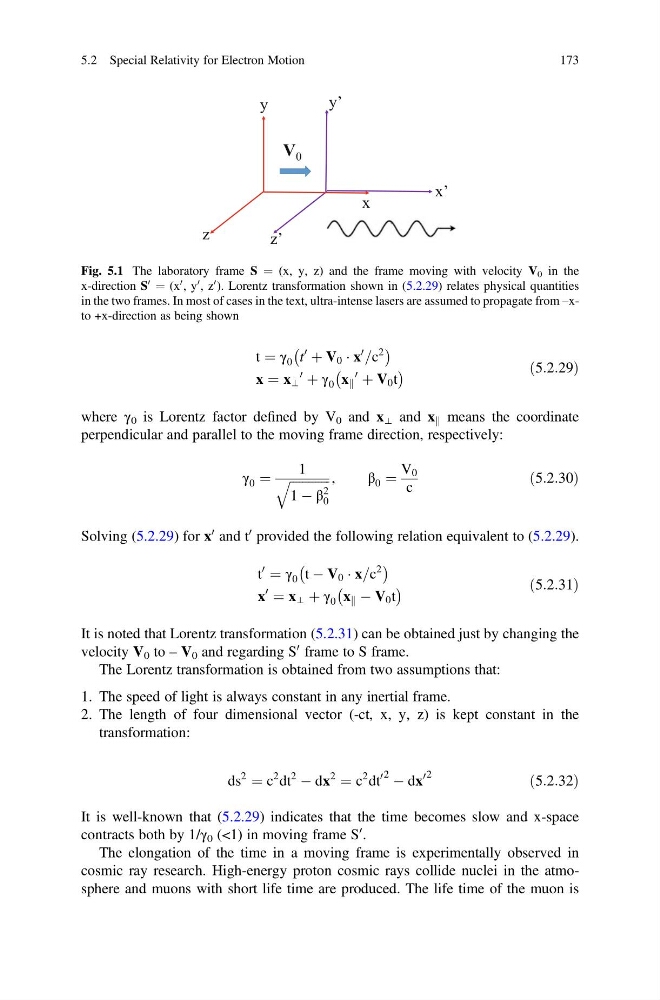
Fig. 5.1 The laboratory frame S ¼ (x, y, z) and the frame moving with velocity V 0 in the
x-direction S
0 ¼ (x
0 , y
0 , z
0 ). Lorentz transformation shown in (5.2.29) relates physical quantities
in the two frames. In most of cases in the text, ultra-intense lasers are assumed to propagate from –xto +x-direction as being shown
5.2 Special Relativity for Electron Motion
173
0
þ V 0 Á x
0
=c
2
À
Á
x ¼ x ⊥
0
þ γ 0 x k
0
þ V 0 t
À
Á
ð5:2:29Þ
where γ 0 is Lorentz factor defined by V 0 and x ⊥ and x k means the coordinate
perpendicular and parallel to the moving frame direction, respectively:
γ 0 ¼
1
ffiffiffiffiffiffiffiffiffiffiffiffiffi
1 À β
2
0
q
,
β 0 ¼
V 0
c
ð5:2:30Þ
Solving (5.2.29) for x
0 and t
0 provided the following relation equivalent to (5.2.29).
t
0
¼ γ 0 t À V 0 Á x=c
2
À
Á
x
0
¼ x ⊥ þ γ 0 x k À V 0 t
À
Á
ð5:2:31Þ
It is noted that Lorentz transformation (5.2.31) can be obtained just by changing the
velocity V 0 to – V 0 and regarding S
0 frame to S frame.
The Lorentz transformation is obtained from two assumptions that:
1. The speed of light is always constant in any inertial frame.
2. The length of four dimensional vector (-ct, x, y, z) is kept constant in the
transformation:
ds
2
¼ c
2 dt
2
À dx
2
¼ c
2 dt
0 2 À dx
0 2
ð5:2:32Þ
It is well-known that (5.2.29) indicates that the time becomes slow and x-space
contracts both by 1/γ 0 (<1) in moving frame S
0 .
The elongation of the time in a moving frame is experimentally observed in
cosmic ray research. High-energy proton cosmic rays collide nuclei in the atmosphere and muons with short life time are produced. The life time of the muon is
x
z
y’
x’
y
z’
V 0
Fig. 5.1 The laboratory frame S ¼ (x, y, z) and the frame moving with velocity V 0 in the
x-direction S
0 ¼ (x
0 , y
0 , z
0 ). Lorentz transformation shown in (5.2.29) relates physical quantities
in the two frames. In most of cases in the text, ultra-intense lasers are assumed to propagate from –xto +x-direction as being shown
5.2 Special Relativity for Electron Motion
173