

4.9 Experimental Data for SRS
Precise experiment has been carried out with Trident laser in LANL [8]. In order to
produce uniform plasmas, a line focusing system is used. Then, an intense laser is
irradiated to induce the parametric instability in the uniform plasma. For diagnosing
the electron and temperatures and electron density of the plasma, another relatively
week intensity lasers are irradiated to the interaction region. Collective Thomson
scattering (CTS) diagnostics are used to determine the plasma parameters from the
diagnostic lasers scattered from the plasma. It is informative to explain briefly the
principle of CTS methods, since it is related to SRS and SBS physics.
As already explained, the incident lasers are scattered by the electrostatic waves
in plasma. Irradiating laser beam for diagnostics to the laser-plasma interaction
region, it is scattered by the ion acoustic wave and electron plasma waves induced
by the parametric instabilities. The scattering is not due to the parametric instability.
Assume that E 1 in (4.6.5) is induced by the electron density fluctuation δn 2 and
incident laser for diagnostics E 0 . In this case, the electron density fluctuation is
driven by the parametric instability by the main pulse. Measuring the scattered light,
we can obtain the information of the electron density wave. The incident laser for
diagnostics is scattered by the electrons in plasma like Thomson scattering in Sect.
2.3, while CTS is due to the scattering by the collective motions of electrons in the
plasma.
The intensity, angle, and spectra of the scattered laser by CTS have the
information of the amplitude and dispersion relation of these waves. Since they
depend on the electron and ion temperatures and and electron density, the precise
diagnostics can be done for determination of the physical parameters of the plasmas
in the interaction region.
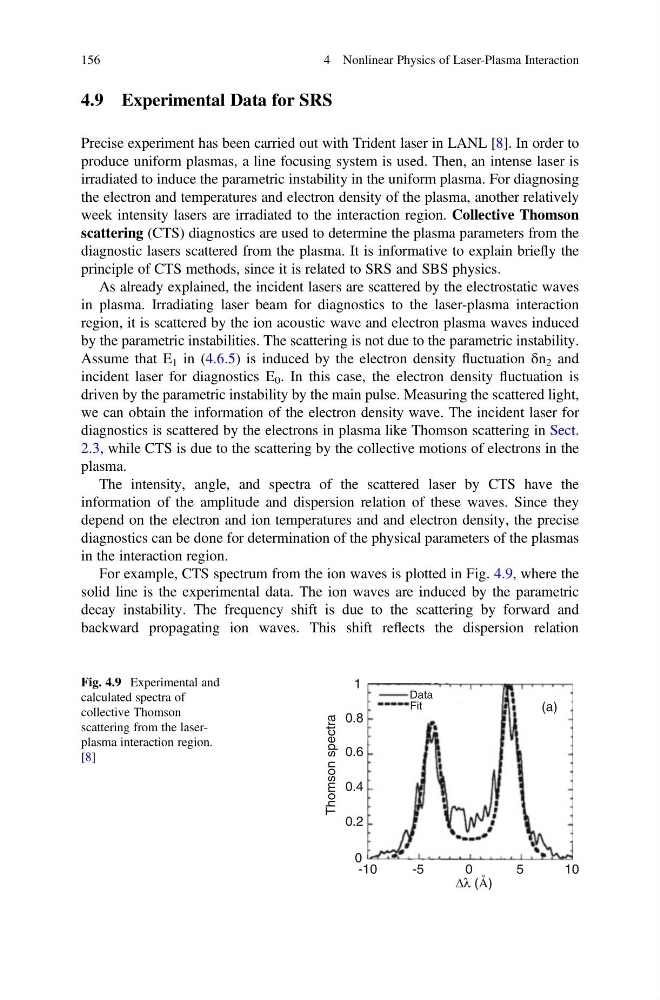
For example, CTS spectrum from the ion waves is plotted in Fig. 4.9, where the
solid line is the experimental data. The ion waves are induced by the parametric
decay instability. The frequency shift is due to the scattering by forward and
backward propagating ion waves. This shift reflects the dispersion relation
1
0.8
0.6
Thomson spectra
0.4
0.2
0
-10
-5
0
Data
(a)
Fit
Δλ (Å)
5
1 0
Fig. 4.9 Experimental and
calculated spectra of
collective Thomson
scattering from the laserplasma interaction region.
[8]
156
4 Nonlinear Physics of Laser-Plasma Interaction
Precise experiment has been carried out with Trident laser in LANL [8]. In order to
produce uniform plasmas, a line focusing system is used. Then, an intense laser is
irradiated to induce the parametric instability in the uniform plasma. For diagnosing
the electron and temperatures and electron density of the plasma, another relatively
week intensity lasers are irradiated to the interaction region. Collective Thomson
scattering (CTS) diagnostics are used to determine the plasma parameters from the
diagnostic lasers scattered from the plasma. It is informative to explain briefly the
principle of CTS methods, since it is related to SRS and SBS physics.
As already explained, the incident lasers are scattered by the electrostatic waves
in plasma. Irradiating laser beam for diagnostics to the laser-plasma interaction
region, it is scattered by the ion acoustic wave and electron plasma waves induced
by the parametric instabilities. The scattering is not due to the parametric instability.
Assume that E 1 in (4.6.5) is induced by the electron density fluctuation δn 2 and
incident laser for diagnostics E 0 . In this case, the electron density fluctuation is
driven by the parametric instability by the main pulse. Measuring the scattered light,
we can obtain the information of the electron density wave. The incident laser for
diagnostics is scattered by the electrons in plasma like Thomson scattering in Sect.
2.3, while CTS is due to the scattering by the collective motions of electrons in the
plasma.
The intensity, angle, and spectra of the scattered laser by CTS have the
information of the amplitude and dispersion relation of these waves. Since they
depend on the electron and ion temperatures and and electron density, the precise
diagnostics can be done for determination of the physical parameters of the plasmas
in the interaction region.
For example, CTS spectrum from the ion waves is plotted in Fig. 4.9, where the
solid line is the experimental data. The ion waves are induced by the parametric
decay instability. The frequency shift is due to the scattering by forward and
backward propagating ion waves. This shift reflects the dispersion relation
1
0.8
0.6
Thomson spectra
0.4
0.2
0
-10
-5
0
Data
(a)
Fit
Δλ (Å)
5
1 0
Fig. 4.9 Experimental and
calculated spectra of
collective Thomson
scattering from the laserplasma interaction region.
[8]
156
4 Nonlinear Physics of Laser-Plasma Interaction