

∂
2
∂t 2 À 3v
2
e ∇
2 þ ω
2
p0
E ¼ À
1
ε 0
∂j ext
∂t
ð4:8:1Þ
∂
2
∂t 2 À C
2
s ∇
2
E ¼ À
1
ε 0
∂j ext
∂t
ð4:8:2Þ
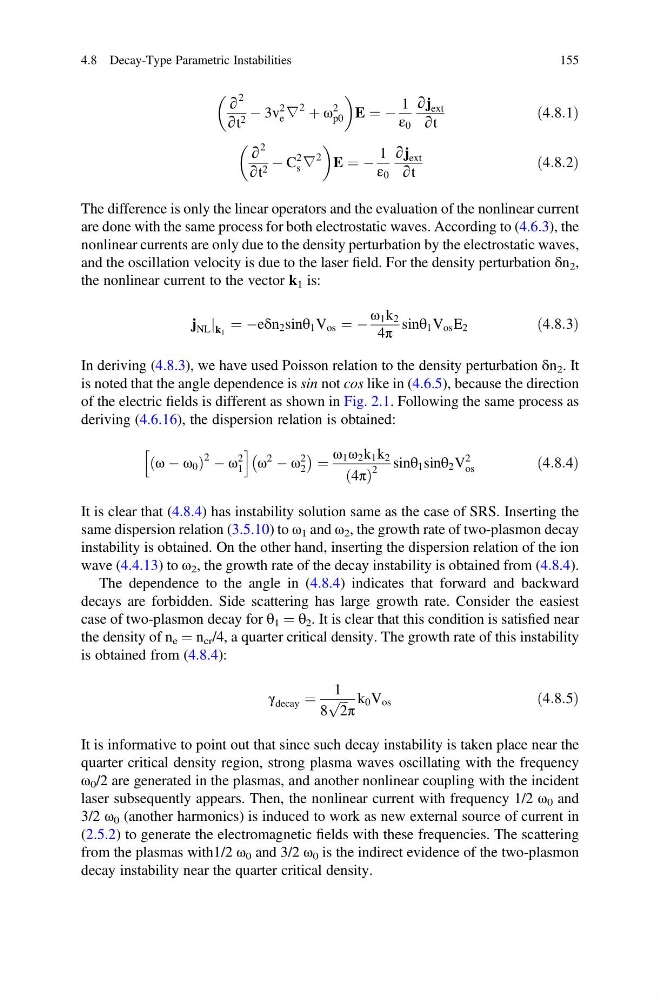
The difference is only the linear operators and the evaluation of the nonlinear current
are done with the same process for both electrostatic waves. According to (4.6.3), the
nonlinear currents are only due to the density perturbation by the electrostatic waves,
and the oscillation velocity is due to the laser field. For the density perturbation δn 2 ,
the nonlinear current to the vector k 1 is:
j NL j k 1 ¼ Àeδn 2 sinθ 1 V os ¼ À
ω 1 k 2
4π
sinθ 1 V os E 2
ð4:8:3Þ
In deriving (4.8.3), we have used Poisson relation to the density perturbation δn 2 . It
is noted that the angle dependence is sin not cos like in (4.6.5), because the direction
of the electric fields is different as shown in Fig. 2.1. Following the same process as
deriving (4.6.16), the dispersion relation is obtained:
ω À ω 0
ð
Þ
2 À ω
2
1
h
i
ω
2
À ω
2
2
À
Á ¼
ω 1 ω 2 k 1 k 2
4π
ð Þ
2
sinθ 1 sinθ 2 V
2
os
ð4:8:4Þ
It is clear that (4.8.4) has instability solution same as the case of SRS. Inserting the
same dispersion relation (3.5.10) to ω 1 and ω 2 , the growth rate of two-plasmon decay
instability is obtained. On the other hand, inserting the dispersion relation of the ion
wave (4.4.13) to ω 2 , the growth rate of the decay instability is obtained from (4.8.4).
The dependence to the angle in (4.8.4) indicates that forward and backward
decays are forbidden. Side scattering has large growth rate. Consider the easiest
case of two-plasmon decay for θ 1 ¼ θ 2 . It is clear that this condition is satisfied near
the density of n e ¼ n cr /4, a quarter critical density. The growth rate of this instability
is obtained from (4.8.4):
γ decay ¼
1
8
ffiffi ffi
2
p π
k 0 V os
ð4:8:5Þ
It is informative to point out that since such decay instability is taken place near the
quarter critical density region, strong plasma waves oscillating with the frequency
ω 0 /2 are generated in the plasmas, and another nonlinear coupling with the incident
laser subsequently appears. Then, the nonlinear current with frequency 1/2 ω 0 and
3/2 ω 0 (another harmonics) is induced to work as new external source of current in
(2.5.2) to generate the electromagnetic fields with these frequencies. The scattering
from the plasmas with1/2 ω 0 and 3/2 ω 0 is the indirect evidence of the two-plasmon
decay instability near the quarter critical density.
4.8 Decay-Type Parametric Instabilities
155
2
∂t 2 À 3v
2
e ∇
2 þ ω
2
p0
E ¼ À
1
ε 0
∂j ext
∂t
ð4:8:1Þ
∂
2
∂t 2 À C
2
s ∇
2
E ¼ À
1
ε 0
∂j ext
∂t
ð4:8:2Þ
The difference is only the linear operators and the evaluation of the nonlinear current
are done with the same process for both electrostatic waves. According to (4.6.3), the
nonlinear currents are only due to the density perturbation by the electrostatic waves,
and the oscillation velocity is due to the laser field. For the density perturbation δn 2 ,
the nonlinear current to the vector k 1 is:
j NL j k 1 ¼ Àeδn 2 sinθ 1 V os ¼ À
ω 1 k 2
4π
sinθ 1 V os E 2
ð4:8:3Þ
In deriving (4.8.3), we have used Poisson relation to the density perturbation δn 2 . It
is noted that the angle dependence is sin not cos like in (4.6.5), because the direction
of the electric fields is different as shown in Fig. 2.1. Following the same process as
deriving (4.6.16), the dispersion relation is obtained:
ω À ω 0
ð
Þ
2 À ω
2
1
h
i
ω
2
À ω
2
2
À
Á ¼
ω 1 ω 2 k 1 k 2
4π
ð Þ
2
sinθ 1 sinθ 2 V
2
os
ð4:8:4Þ
It is clear that (4.8.4) has instability solution same as the case of SRS. Inserting the
same dispersion relation (3.5.10) to ω 1 and ω 2 , the growth rate of two-plasmon decay
instability is obtained. On the other hand, inserting the dispersion relation of the ion
wave (4.4.13) to ω 2 , the growth rate of the decay instability is obtained from (4.8.4).
The dependence to the angle in (4.8.4) indicates that forward and backward
decays are forbidden. Side scattering has large growth rate. Consider the easiest
case of two-plasmon decay for θ 1 ¼ θ 2 . It is clear that this condition is satisfied near
the density of n e ¼ n cr /4, a quarter critical density. The growth rate of this instability
is obtained from (4.8.4):
γ decay ¼
1
8
ffiffi ffi
2
p π
k 0 V os
ð4:8:5Þ
It is informative to point out that since such decay instability is taken place near the
quarter critical density region, strong plasma waves oscillating with the frequency
ω 0 /2 are generated in the plasmas, and another nonlinear coupling with the incident
laser subsequently appears. Then, the nonlinear current with frequency 1/2 ω 0 and
3/2 ω 0 (another harmonics) is induced to work as new external source of current in
(2.5.2) to generate the electromagnetic fields with these frequencies. The scattering
from the plasmas with1/2 ω 0 and 3/2 ω 0 is the indirect evidence of the two-plasmon
decay instability near the quarter critical density.
4.8 Decay-Type Parametric Instabilities
155