

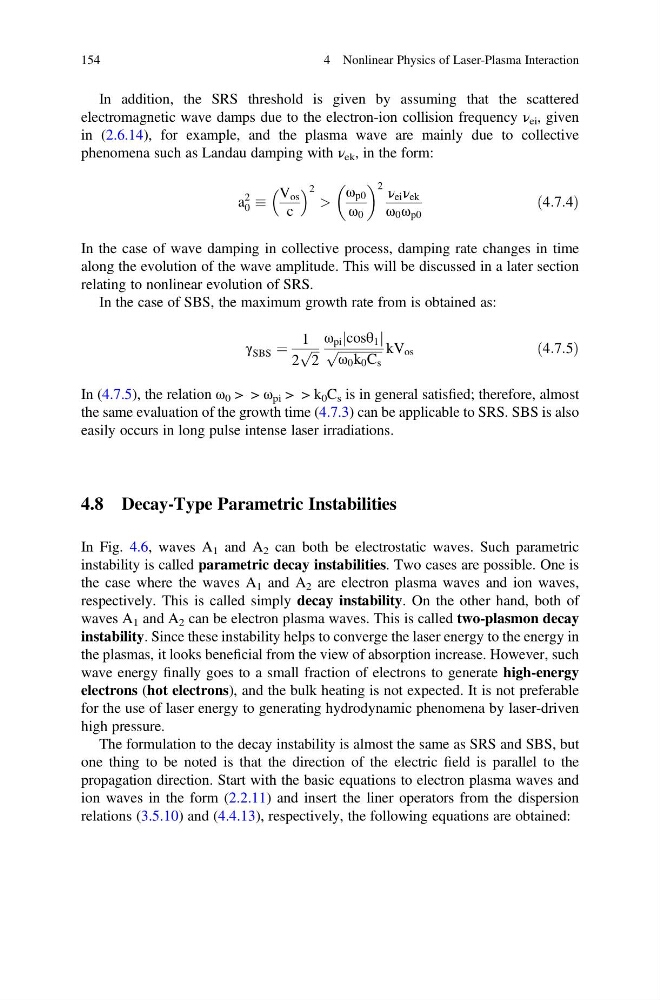
In addition, the SRS threshold is given by assuming that the scattered
electromagnetic wave damps due to the electron-ion collision frequency ν ei , given
in (2.6.14), for example, and the plasma wave are mainly due to collective
phenomena such as Landau damping with ν ek , in the form:
a
2
0
V os
c
2
>
ω p0
ω 0
2 ν ei ν ek
ω 0 ω p0
ð4:7:4Þ
In the case of wave damping in collective process, damping rate changes in time
along the evolution of the wave amplitude. This will be discussed in a later section
relating to nonlinear evolution of SRS.
In the case of SBS, the maximum growth rate from is obtained as:
γ SBS ¼
1
2
ffiffi ffi
2
p
ω pi cosθ 1
j
j
ffiffiffiffiffiffiffiffiffiffiffiffiffiffi
ω 0 k 0 C s
p
kV os
ð4:7:5Þ
In (4.7.5), the relation ω 0 > > ω pi > > k 0 C s is in general satisfied; therefore, almost
the same evaluation of the growth time (4.7.3) can be applicable to SRS. SBS is also
easily occurs in long pulse intense laser irradiations.
4.8 Decay-Type Parametric Instabilities
In Fig. 4.6, waves A 1 and A 2 can both be electrostatic waves. Such parametric
instability is called parametric decay instabilities. Two cases are possible. One is
the case where the waves A 1 and A 2 are electron plasma waves and ion waves,
respectively. This is called simply decay instability. On the other hand, both of
waves A 1 and A 2 can be electron plasma waves. This is called two-plasmon decay
instability. Since these instability helps to converge the laser energy to the energy in
the plasmas, it looks beneficial from the view of absorption increase. However, such
wave energy finally goes to a small fraction of electrons to generate high-energy
electrons (hot electrons), and the bulk heating is not expected. It is not preferable
for the use of laser energy to generating hydrodynamic phenomena by laser-driven
high pressure.
The formulation to the decay instability is almost the same as SRS and SBS, but
one thing to be noted is that the direction of the electric field is parallel to the
propagation direction. Start with the basic equations to electron plasma waves and
ion waves in the form (2.2.11) and insert the liner operators from the dispersion
relations (3.5.10) and (4.4.13), respectively, the following equations are obtained:
154
4 Nonlinear Physics of Laser-Plasma Interaction
electromagnetic wave damps due to the electron-ion collision frequency ν ei , given
in (2.6.14), for example, and the plasma wave are mainly due to collective
phenomena such as Landau damping with ν ek , in the form:
a
2
0
V os
c
2
>
ω p0
ω 0
2 ν ei ν ek
ω 0 ω p0
ð4:7:4Þ
In the case of wave damping in collective process, damping rate changes in time
along the evolution of the wave amplitude. This will be discussed in a later section
relating to nonlinear evolution of SRS.
In the case of SBS, the maximum growth rate from is obtained as:
γ SBS ¼
1
2
ffiffi ffi
2
p
ω pi cosθ 1
j
j
ffiffiffiffiffiffiffiffiffiffiffiffiffiffi
ω 0 k 0 C s
p
kV os
ð4:7:5Þ
In (4.7.5), the relation ω 0 > > ω pi > > k 0 C s is in general satisfied; therefore, almost
the same evaluation of the growth time (4.7.3) can be applicable to SRS. SBS is also
easily occurs in long pulse intense laser irradiations.
4.8 Decay-Type Parametric Instabilities
In Fig. 4.6, waves A 1 and A 2 can both be electrostatic waves. Such parametric
instability is called parametric decay instabilities. Two cases are possible. One is
the case where the waves A 1 and A 2 are electron plasma waves and ion waves,
respectively. This is called simply decay instability. On the other hand, both of
waves A 1 and A 2 can be electron plasma waves. This is called two-plasmon decay
instability. Since these instability helps to converge the laser energy to the energy in
the plasmas, it looks beneficial from the view of absorption increase. However, such
wave energy finally goes to a small fraction of electrons to generate high-energy
electrons (hot electrons), and the bulk heating is not expected. It is not preferable
for the use of laser energy to generating hydrodynamic phenomena by laser-driven
high pressure.
The formulation to the decay instability is almost the same as SRS and SBS, but
one thing to be noted is that the direction of the electric field is parallel to the
propagation direction. Start with the basic equations to electron plasma waves and
ion waves in the form (2.2.11) and insert the liner operators from the dispersion
relations (3.5.10) and (4.4.13), respectively, the following equations are obtained:
154
4 Nonlinear Physics of Laser-Plasma Interaction