

4.5 Density Profile Modification
So far, the plasma density profile is assumed to be given as freely expanding ion
flow, and the density scale length is of the order of (sound speed) times (laser pulse
duration). In the ultra-short laser irradiation, the density scale length of the order of
laser wavelength was assumed. When the laser ponderomotive pressure is
comparable to the plasma pressure given in (4.4.2), it is more realistic taken into
account the plasma profile near the cutoff density determined by the balance between
the ponderomotive force and total plasma fluid pressure. If the laser pulse is long
enough such as ns-pulse, it is appropriate to assume that a stationary density profile
is formed due to the balance of these two pressures.
The basic equation for laser waves propagating normally to the expanding plasma
is given in (2.7.1) and is shown for a given stationary density profile as:
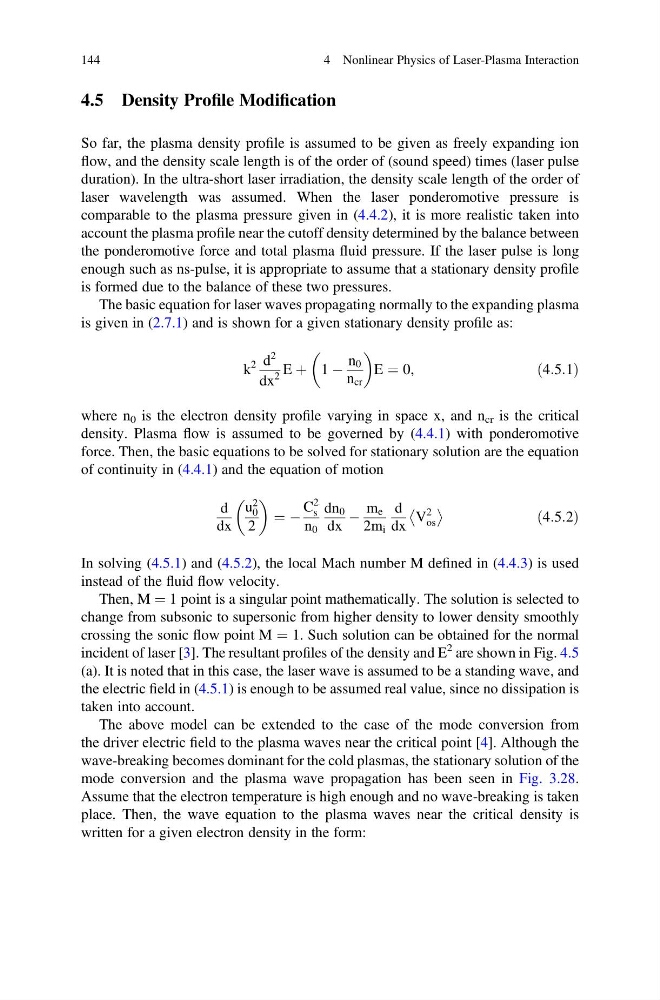
k
2 d
2
dx
2
E þ 1 À
n 0
n cr
E ¼ 0,
ð4:5:1Þ
where n 0 is the electron density profile varying in space x, and n cr is the critical
density. Plasma flow is assumed to be governed by (4.4.1) with ponderomotive
force. Then, the basic equations to be solved for stationary solution are the equation
of continuity in (4.4.1) and the equation of motion
d
dx
u
2
0
2
¼ À
C
2
s
n 0
dn 0
dx
À
m e
2m i
d
dx
V
2
os
ð4:5:2Þ
In solving (4.5.1) and (4.5.2), the local Mach number M defined in (4.4.3) is used
instead of the fluid flow velocity.
Then, M ¼ 1 point is a singular point mathematically. The solution is selected to
change from subsonic to supersonic from higher density to lower density smoothly
crossing the sonic flow point M ¼ 1. Such solution can be obtained for the normal
incident of laser [3]. The resultant profiles of the density and E
2 are shown in Fig. 4.5
(a). It is noted that in this case, the laser wave is assumed to be a standing wave, and
the electric field in (4.5.1) is enough to be assumed real value, since no dissipation is
taken into account.
The above model can be extended to the case of the mode conversion from
the driver electric field to the plasma waves near the critical point [4]. Although the
wave-breaking becomes dominant for the cold plasmas, the stationary solution of the
mode conversion and the plasma wave propagation has been seen in Fig. 3.28.
Assume that the electron temperature is high enough and no wave-breaking is taken
place. Then, the wave equation to the plasma waves near the critical density is
written for a given electron density in the form:
144
4 Nonlinear Physics of Laser-Plasma Interaction
So far, the plasma density profile is assumed to be given as freely expanding ion
flow, and the density scale length is of the order of (sound speed) times (laser pulse
duration). In the ultra-short laser irradiation, the density scale length of the order of
laser wavelength was assumed. When the laser ponderomotive pressure is
comparable to the plasma pressure given in (4.4.2), it is more realistic taken into
account the plasma profile near the cutoff density determined by the balance between
the ponderomotive force and total plasma fluid pressure. If the laser pulse is long
enough such as ns-pulse, it is appropriate to assume that a stationary density profile
is formed due to the balance of these two pressures.
The basic equation for laser waves propagating normally to the expanding plasma
is given in (2.7.1) and is shown for a given stationary density profile as:
k
2 d
2
dx
2
E þ 1 À
n 0
n cr
E ¼ 0,
ð4:5:1Þ
where n 0 is the electron density profile varying in space x, and n cr is the critical
density. Plasma flow is assumed to be governed by (4.4.1) with ponderomotive
force. Then, the basic equations to be solved for stationary solution are the equation
of continuity in (4.4.1) and the equation of motion
d
dx
u
2
0
2
¼ À
C
2
s
n 0
dn 0
dx
À
m e
2m i
d
dx
V
2
os
ð4:5:2Þ
In solving (4.5.1) and (4.5.2), the local Mach number M defined in (4.4.3) is used
instead of the fluid flow velocity.
Then, M ¼ 1 point is a singular point mathematically. The solution is selected to
change from subsonic to supersonic from higher density to lower density smoothly
crossing the sonic flow point M ¼ 1. Such solution can be obtained for the normal
incident of laser [3]. The resultant profiles of the density and E
2 are shown in Fig. 4.5
(a). It is noted that in this case, the laser wave is assumed to be a standing wave, and
the electric field in (4.5.1) is enough to be assumed real value, since no dissipation is
taken into account.
The above model can be extended to the case of the mode conversion from
the driver electric field to the plasma waves near the critical point [4]. Although the
wave-breaking becomes dominant for the cold plasmas, the stationary solution of the
mode conversion and the plasma wave propagation has been seen in Fig. 3.28.
Assume that the electron temperature is high enough and no wave-breaking is taken
place. Then, the wave equation to the plasma waves near the critical density is
written for a given electron density in the form:
144
4 Nonlinear Physics of Laser-Plasma Interaction