

v i <
ω
k
<< v e
ð4:4:12Þ
It should be noted that when the ion temperature is near the electron temperature,
the interaction between the waves and ion particles causes the damping of the ion
acoustic waves. This is called Landau damping and to be explained in Vol.
3. Assuming T e >> T i , we can obtain the following dispersion relation:
ω
2
¼ C s
2 k
2
1
1 þ k
2
λ De
2
,
ð4:4:13Þ
where C s is the sound velocity of the ion acoustic wave and defined to be:
C s ¼
ffiffiffiffiffiffiffiffiffi
γ e T e
m i
r
ð4:4:14Þ
It is clearly understood that the ion acoustic waves feel the repulsive force via
electric field due to the electron fluid which balances the electron thermal pressure
force, while the ions bear the mass of the oscillating motion, and the combination of
electron temperature and ion mass appears in (4.4.14).
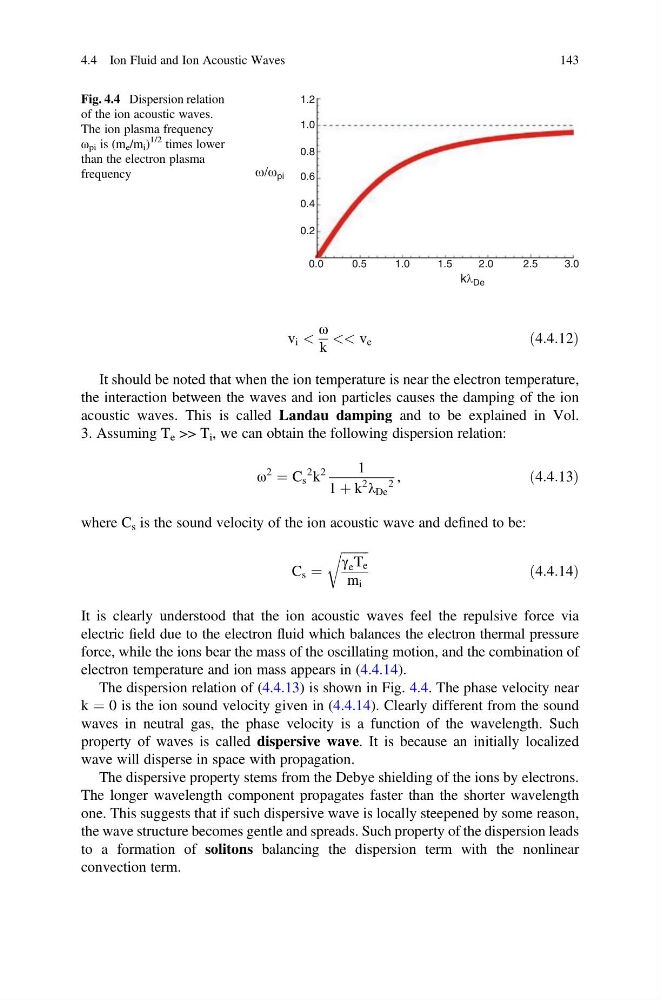
The dispersion relation of (4.4.13) is shown in Fig. 4.4. The phase velocity near
k ¼ 0 is the ion sound velocity given in (4.4.14). Clearly different from the sound
waves in neutral gas, the phase velocity is a function of the wavelength. Such
property of waves is called dispersive wave. It is because an initially localized
wave will disperse in space with propagation.
The dispersive property stems from the Debye shielding of the ions by electrons.
The longer wavelength component propagates faster than the shorter wavelength
one. This suggests that if such dispersive wave is locally steepened by some reason,
the wave structure becomes gentle and spreads. Such property of the dispersion leads
to a formation of solitons balancing the dispersion term with the nonlinear
convection term.
1.2
1.0
0.8
w/w pi
kl De
0.6
0.4
0.2
0.0
0.5
1.0
1.5
2.0
2.5
3.0
Fig. 4.4 Dispersion relation
of the ion acoustic waves.
The ion plasma frequency
ω pi is (m e /m i )
1/2 times lower
than the electron plasma
frequency
4.4 Ion Fluid and Ion Acoustic Waves
143
ω
k
<< v e
ð4:4:12Þ
It should be noted that when the ion temperature is near the electron temperature,
the interaction between the waves and ion particles causes the damping of the ion
acoustic waves. This is called Landau damping and to be explained in Vol.
3. Assuming T e >> T i , we can obtain the following dispersion relation:
ω
2
¼ C s
2 k
2
1
1 þ k
2
λ De
2
,
ð4:4:13Þ
where C s is the sound velocity of the ion acoustic wave and defined to be:
C s ¼
ffiffiffiffiffiffiffiffiffi
γ e T e
m i
r
ð4:4:14Þ
It is clearly understood that the ion acoustic waves feel the repulsive force via
electric field due to the electron fluid which balances the electron thermal pressure
force, while the ions bear the mass of the oscillating motion, and the combination of
electron temperature and ion mass appears in (4.4.14).
The dispersion relation of (4.4.13) is shown in Fig. 4.4. The phase velocity near
k ¼ 0 is the ion sound velocity given in (4.4.14). Clearly different from the sound
waves in neutral gas, the phase velocity is a function of the wavelength. Such
property of waves is called dispersive wave. It is because an initially localized
wave will disperse in space with propagation.
The dispersive property stems from the Debye shielding of the ions by electrons.
The longer wavelength component propagates faster than the shorter wavelength
one. This suggests that if such dispersive wave is locally steepened by some reason,
the wave structure becomes gentle and spreads. Such property of the dispersion leads
to a formation of solitons balancing the dispersion term with the nonlinear
convection term.
1.2
1.0
0.8
w/w pi
kl De
0.6
0.4
0.2
0.0
0.5
1.0
1.5
2.0
2.5
3.0
Fig. 4.4 Dispersion relation
of the ion acoustic waves.
The ion plasma frequency
ω pi is (m e /m i )
1/2 times lower
than the electron plasma
frequency
4.4 Ion Fluid and Ion Acoustic Waves
143