

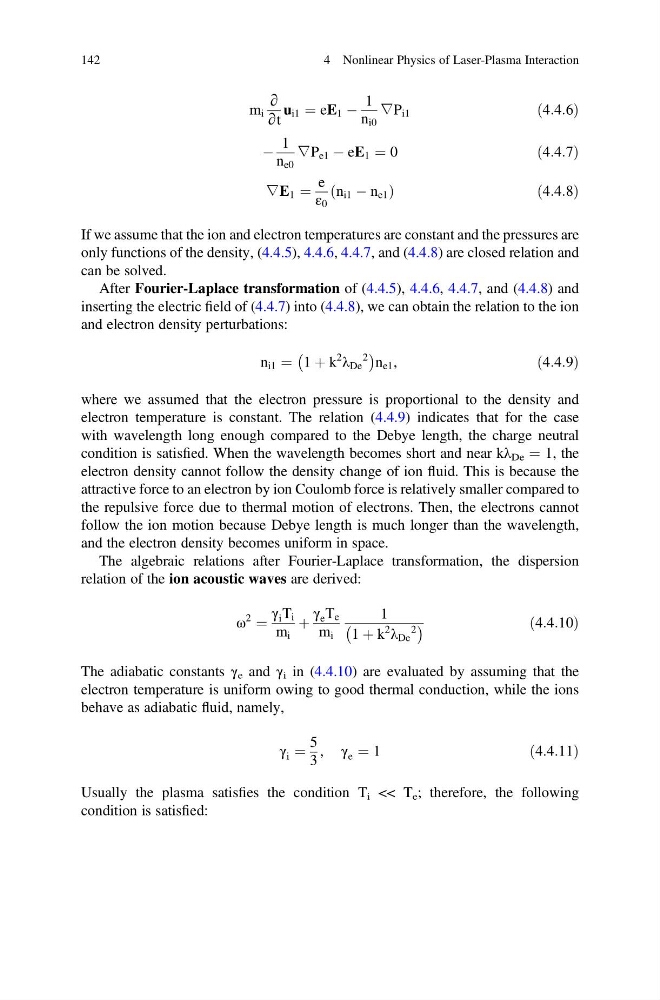
m i
∂
∂t
u i1 ¼ eE 1 À
1
n i0
∇P i1
ð4:4:6Þ
À
1
n e0
∇P e1 À eE 1 ¼ 0
ð4:4:7Þ
∇E 1 ¼
e
ε 0
n i1 À n e1
ð
Þ
ð4:4:8Þ
If we assume that the ion and electron temperatures are constant and the pressures are
only functions of the density, (4.4.5), 4.4.6, 4.4.7, and (4.4.8) are closed relation and
can be solved.
After Fourier-Laplace transformation of (4.4.5), 4.4.6, 4.4.7, and (4.4.8) and
inserting the electric field of (4.4.7) into (4.4.8), we can obtain the relation to the ion
and electron density perturbations:
n i1 ¼ 1 þ k
2
λ De
2
À
Á
n e1 ,
ð4:4:9Þ
where we assumed that the electron pressure is proportional to the density and
electron temperature is constant. The relation (4.4.9) indicates that for the case
with wavelength long enough compared to the Debye length, the charge neutral
condition is satisfied. When the wavelength becomes short and near kλ De ¼ 1, the
electron density cannot follow the density change of ion fluid. This is because the
attractive force to an electron by ion Coulomb force is relatively smaller compared to
the repulsive force due to thermal motion of electrons. Then, the electrons cannot
follow the ion motion because Debye length is much longer than the wavelength,
and the electron density becomes uniform in space.
The algebraic relations after Fourier-Laplace transformation, the dispersion
relation of the ion acoustic waves are derived:
ω
2
¼
γ i T i
m i
þ
γ e T e
m i
1
1 þ k
2
λ De
2
À
Á
ð4:4:10Þ
The adiabatic constants γ e and γ i in (4.4.10) are evaluated by assuming that the
electron temperature is uniform owing to good thermal conduction, while the ions
behave as adiabatic fluid, namely,
γ i ¼
5
3
, γ e ¼ 1
ð4:4:11Þ
Usually the plasma satisfies the condition T i << T e ; therefore, the following
condition is satisfied:
142
4 Nonlinear Physics of Laser-Plasma Interaction
∂
∂t
u i1 ¼ eE 1 À
1
n i0
∇P i1
ð4:4:6Þ
À
1
n e0
∇P e1 À eE 1 ¼ 0
ð4:4:7Þ
∇E 1 ¼
e
ε 0
n i1 À n e1
ð
Þ
ð4:4:8Þ
If we assume that the ion and electron temperatures are constant and the pressures are
only functions of the density, (4.4.5), 4.4.6, 4.4.7, and (4.4.8) are closed relation and
can be solved.
After Fourier-Laplace transformation of (4.4.5), 4.4.6, 4.4.7, and (4.4.8) and
inserting the electric field of (4.4.7) into (4.4.8), we can obtain the relation to the ion
and electron density perturbations:
n i1 ¼ 1 þ k
2
λ De
2
À
Á
n e1 ,
ð4:4:9Þ
where we assumed that the electron pressure is proportional to the density and
electron temperature is constant. The relation (4.4.9) indicates that for the case
with wavelength long enough compared to the Debye length, the charge neutral
condition is satisfied. When the wavelength becomes short and near kλ De ¼ 1, the
electron density cannot follow the density change of ion fluid. This is because the
attractive force to an electron by ion Coulomb force is relatively smaller compared to
the repulsive force due to thermal motion of electrons. Then, the electrons cannot
follow the ion motion because Debye length is much longer than the wavelength,
and the electron density becomes uniform in space.
The algebraic relations after Fourier-Laplace transformation, the dispersion
relation of the ion acoustic waves are derived:
ω
2
¼
γ i T i
m i
þ
γ e T e
m i
1
1 þ k
2
λ De
2
À
Á
ð4:4:10Þ
The adiabatic constants γ e and γ i in (4.4.10) are evaluated by assuming that the
electron temperature is uniform owing to good thermal conduction, while the ions
behave as adiabatic fluid, namely,
γ i ¼
5
3
, γ e ¼ 1
ð4:4:11Þ
Usually the plasma satisfies the condition T i << T e ; therefore, the following
condition is satisfied:
142
4 Nonlinear Physics of Laser-Plasma Interaction