

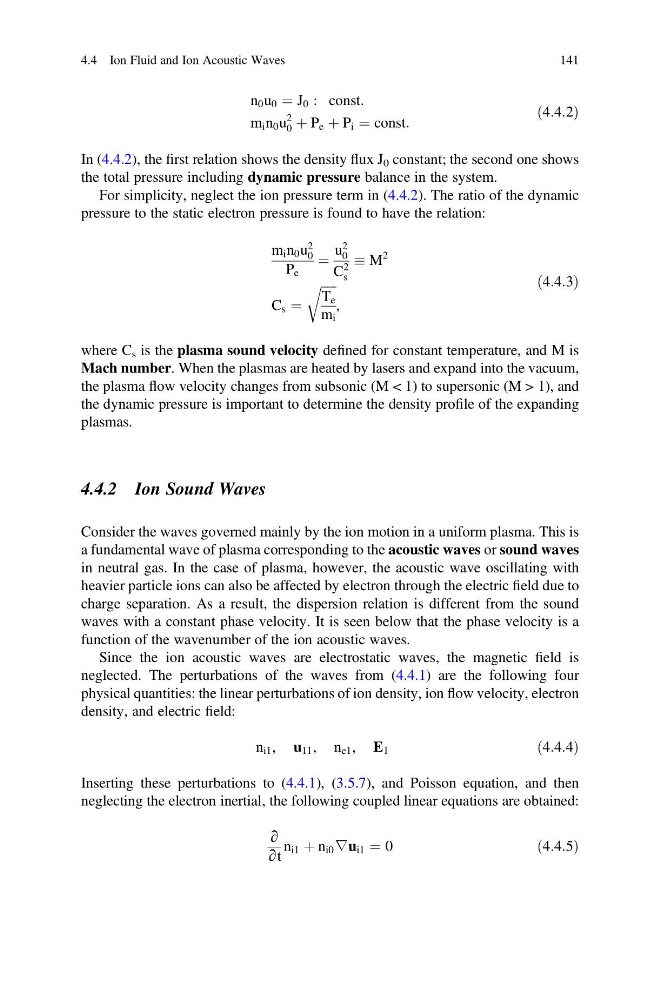
n 0 u 0 ¼ J 0 : const:
m i n 0 u
2
0 þ P e þ P i ¼ const:
ð4:4:2Þ
In (4.4.2), the first relation shows the density flux J 0 constant; the second one shows
the total pressure including dynamic pressure balance in the system.
For simplicity, neglect the ion pressure term in (4.4.2). The ratio of the dynamic
pressure to the static electron pressure is found to have the relation:
m i n 0 u
2
0
P e
¼
u
2
0
C
2
s
M
2
C s ¼
ffiffiffiffiffi
T e
m i
r
,
ð4:4:3Þ
where C s is the plasma sound velocity defined for constant temperature, and M is
Mach number. When the plasmas are heated by lasers and expand into the vacuum,
the plasma flow velocity changes from subsonic (M < 1) to supersonic (M > 1), and
the dynamic pressure is important to determine the density profile of the expanding
plasmas.
4.4.2 Ion Sound Waves
Consider the waves governed mainly by the ion motion in a uniform plasma. This is
a fundamental wave of plasma corresponding to the acoustic waves or sound waves
in neutral gas. In the case of plasma, however, the acoustic wave oscillating with
heavier particle ions can also be affected by electron through the electric field due to
charge separation. As a result, the dispersion relation is different from the sound
waves with a constant phase velocity. It is seen below that the phase velocity is a
function of the wavenumber of the ion acoustic waves.
Since the ion acoustic waves are electrostatic waves, the magnetic field is
neglected. The perturbations of the waves from (4.4.1) are the following four
physical quantities: the linear perturbations of ion density, ion flow velocity, electron
density, and electric field:
n i1 , u 11 , n e1 , E 1
ð4:4:4Þ
Inserting these perturbations to (4.4.1), (3.5.7), and Poisson equation, and then
neglecting the electron inertial, the following coupled linear equations are obtained:
∂
∂t
n i1 þ n i0 ∇u i1 ¼ 0
ð4:4:5Þ
4.4 Ion Fluid and Ion Acoustic Waves
141
m i n 0 u
2
0 þ P e þ P i ¼ const:
ð4:4:2Þ
In (4.4.2), the first relation shows the density flux J 0 constant; the second one shows
the total pressure including dynamic pressure balance in the system.
For simplicity, neglect the ion pressure term in (4.4.2). The ratio of the dynamic
pressure to the static electron pressure is found to have the relation:
m i n 0 u
2
0
P e
¼
u
2
0
C
2
s
M
2
C s ¼
ffiffiffiffiffi
T e
m i
r
,
ð4:4:3Þ
where C s is the plasma sound velocity defined for constant temperature, and M is
Mach number. When the plasmas are heated by lasers and expand into the vacuum,
the plasma flow velocity changes from subsonic (M < 1) to supersonic (M > 1), and
the dynamic pressure is important to determine the density profile of the expanding
plasmas.
4.4.2 Ion Sound Waves
Consider the waves governed mainly by the ion motion in a uniform plasma. This is
a fundamental wave of plasma corresponding to the acoustic waves or sound waves
in neutral gas. In the case of plasma, however, the acoustic wave oscillating with
heavier particle ions can also be affected by electron through the electric field due to
charge separation. As a result, the dispersion relation is different from the sound
waves with a constant phase velocity. It is seen below that the phase velocity is a
function of the wavenumber of the ion acoustic waves.
Since the ion acoustic waves are electrostatic waves, the magnetic field is
neglected. The perturbations of the waves from (4.4.1) are the following four
physical quantities: the linear perturbations of ion density, ion flow velocity, electron
density, and electric field:
n i1 , u 11 , n e1 , E 1
ð4:4:4Þ
Inserting these perturbations to (4.4.1), (3.5.7), and Poisson equation, and then
neglecting the electron inertial, the following coupled linear equations are obtained:
∂
∂t
n i1 þ n i0 ∇u i1 ¼ 0
ð4:4:5Þ
4.4 Ion Fluid and Ion Acoustic Waves
141