

4.4.1 Charge Neutral Plasma Fluids
In general, the laser wavelength is much longer than the Debye length as seen in Fig.
3.28, and neutral plasma condition is good approximation for discussing the density
profile near the critical density, which is very sensitive to the resonance absorption.
The fluid equations to the ion fluid are given with the following continuity equation
and equation of motion to be described in detail in Vol. 2:
∂
∂t
n i þ ∇ n i u i
ð
Þ ¼ 0
m i
du i
dt
¼ eE À ∇P i
ð4:4:1Þ
Since the phenomena are slow, the electric field E in (4.4.1) is replaced with E by
electron pressure force after neglecting the inertial term of the electron fluid.
Assuming the charge neutral condition (n i ¼ n e ¼ n 0 ) and stationary state in a
frame moving with the density profile, the following relations are obtained in
one-dimensional plane system:
Vacuum focus
Laser
50 μm
(a)
Z/λ
20
0
(b)
50
15 0
X /λ
Y / λ 2 0
0
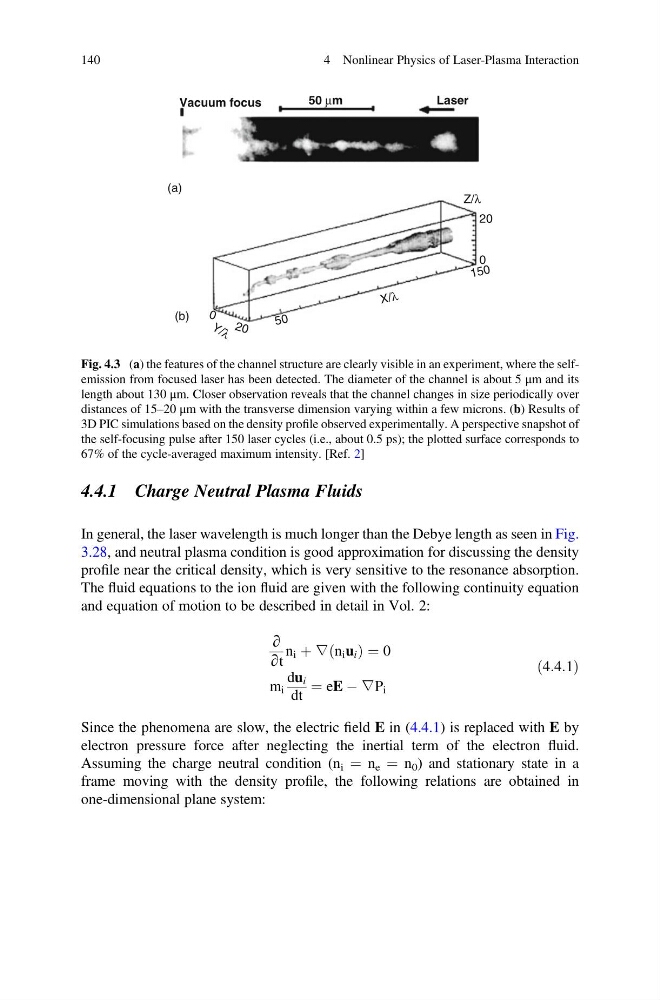
Fig. 4.3 (a) the features of the channel structure are clearly visible in an experiment, where the selfemission from focused laser has been detected. The diameter of the channel is about 5 μm and its
length about 130 μm. Closer observation reveals that the channel changes in size periodically over
distances of 15–20 μm with the transverse dimension varying within a few microns. (b) Results of
3D PIC simulations based on the density profile observed experimentally. A perspective snapshot of
the self-focusing pulse after 150 laser cycles (i.e., about 0.5 ps); the plotted surface corresponds to
67% of the cycle-averaged maximum intensity. [Ref. 2]
140
4 Nonlinear Physics of Laser-Plasma Interaction
In general, the laser wavelength is much longer than the Debye length as seen in Fig.
3.28, and neutral plasma condition is good approximation for discussing the density
profile near the critical density, which is very sensitive to the resonance absorption.
The fluid equations to the ion fluid are given with the following continuity equation
and equation of motion to be described in detail in Vol. 2:
∂
∂t
n i þ ∇ n i u i
ð
Þ ¼ 0
m i
du i
dt
¼ eE À ∇P i
ð4:4:1Þ
Since the phenomena are slow, the electric field E in (4.4.1) is replaced with E by
electron pressure force after neglecting the inertial term of the electron fluid.
Assuming the charge neutral condition (n i ¼ n e ¼ n 0 ) and stationary state in a
frame moving with the density profile, the following relations are obtained in
one-dimensional plane system:
Vacuum focus
Laser
50 μm
(a)
Z/λ
20
0
(b)
50
15 0
X /λ
Y / λ 2 0
0
Fig. 4.3 (a) the features of the channel structure are clearly visible in an experiment, where the selfemission from focused laser has been detected. The diameter of the channel is about 5 μm and its
length about 130 μm. Closer observation reveals that the channel changes in size periodically over
distances of 15–20 μm with the transverse dimension varying within a few microns. (b) Results of
3D PIC simulations based on the density profile observed experimentally. A perspective snapshot of
the self-focusing pulse after 150 laser cycles (i.e., about 0.5 ps); the plotted surface corresponds to
67% of the cycle-averaged maximum intensity. [Ref. 2]
140
4 Nonlinear Physics of Laser-Plasma Interaction