

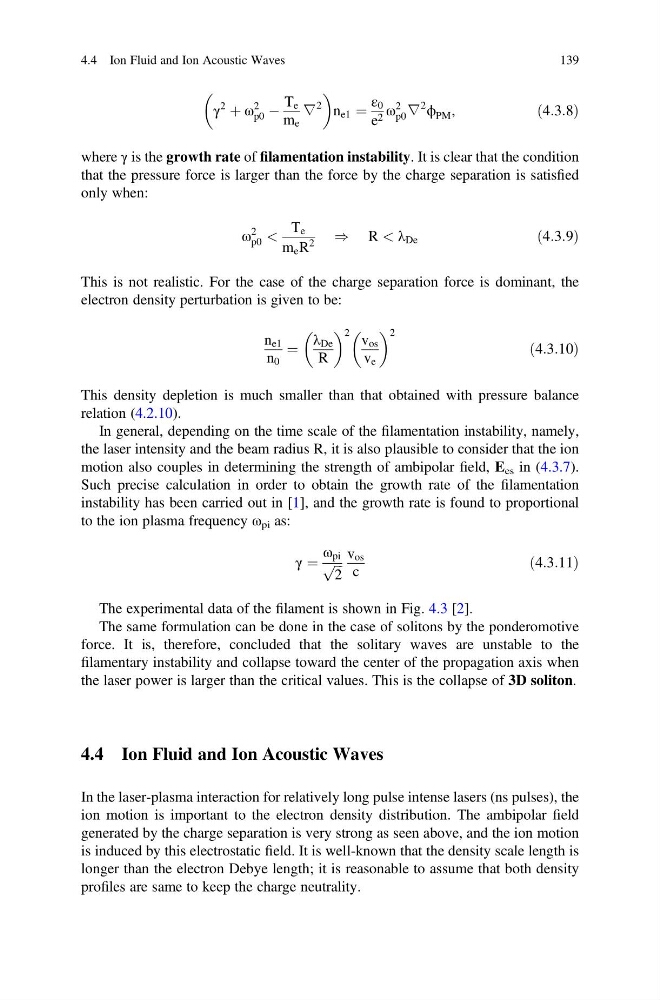
γ
2
þ ω
2
p0 À
T e
m e
∇
2
n e1 ¼
ε 0
e 2 ω
2
p0 ∇
2
ϕ PM ,
ð4:3:8Þ
where γ is the growth rate of filamentation instability. It is clear that the condition
that the pressure force is larger than the force by the charge separation is satisfied
only when:
ω
2
p0 <
T e
m e R
2
) R < λ De
ð4:3:9Þ
This is not realistic. For the case of the charge separation force is dominant, the
electron density perturbation is given to be:
n e1
n 0
¼
λ De
R
2 v os
v e
2
ð4:3:10Þ
This density depletion is much smaller than that obtained with pressure balance
relation (4.2.10).
In general, depending on the time scale of the filamentation instability, namely,
the laser intensity and the beam radius R, it is also plausible to consider that the ion
motion also couples in determining the strength of ambipolar field, E es in (4.3.7).
Such precise calculation in order to obtain the growth rate of the filamentation
instability has been carried out in [1], and the growth rate is found to proportional
to the ion plasma frequency ω pi as:
γ ¼
ω pi
ffiffi ffi
2
p
v os
c
ð4:3:11Þ
The experimental data of the filament is shown in Fig. 4.3 [2].
The same formulation can be done in the case of solitons by the ponderomotive
force. It is, therefore, concluded that the solitary waves are unstable to the
filamentary instability and collapse toward the center of the propagation axis when
the laser power is larger than the critical values. This is the collapse of 3D soliton.
4.4 Ion Fluid and Ion Acoustic Waves
In the laser-plasma interaction for relatively long pulse intense lasers (ns pulses), the
ion motion is important to the electron density distribution. The ambipolar field
generated by the charge separation is very strong as seen above, and the ion motion
is induced by this electrostatic field. It is well-known that the density scale length is
longer than the electron Debye length; it is reasonable to assume that both density
profiles are same to keep the charge neutrality.
4.4 Ion Fluid and Ion Acoustic Waves
139
2
þ ω
2
p0 À
T e
m e
∇
2
n e1 ¼
ε 0
e 2 ω
2
p0 ∇
2
ϕ PM ,
ð4:3:8Þ
where γ is the growth rate of filamentation instability. It is clear that the condition
that the pressure force is larger than the force by the charge separation is satisfied
only when:
ω
2
p0 <
T e
m e R
2
) R < λ De
ð4:3:9Þ
This is not realistic. For the case of the charge separation force is dominant, the
electron density perturbation is given to be:
n e1
n 0
¼
λ De
R
2 v os
v e
2
ð4:3:10Þ
This density depletion is much smaller than that obtained with pressure balance
relation (4.2.10).
In general, depending on the time scale of the filamentation instability, namely,
the laser intensity and the beam radius R, it is also plausible to consider that the ion
motion also couples in determining the strength of ambipolar field, E es in (4.3.7).
Such precise calculation in order to obtain the growth rate of the filamentation
instability has been carried out in [1], and the growth rate is found to proportional
to the ion plasma frequency ω pi as:
γ ¼
ω pi
ffiffi ffi
2
p
v os
c
ð4:3:11Þ
The experimental data of the filament is shown in Fig. 4.3 [2].
The same formulation can be done in the case of solitons by the ponderomotive
force. It is, therefore, concluded that the solitary waves are unstable to the
filamentary instability and collapse toward the center of the propagation axis when
the laser power is larger than the critical values. This is the collapse of 3D soliton.
4.4 Ion Fluid and Ion Acoustic Waves
In the laser-plasma interaction for relatively long pulse intense lasers (ns pulses), the
ion motion is important to the electron density distribution. The ambipolar field
generated by the charge separation is very strong as seen above, and the ion motion
is induced by this electrostatic field. It is well-known that the density scale length is
longer than the electron Debye length; it is reasonable to assume that both density
profiles are same to keep the charge neutrality.
4.4 Ion Fluid and Ion Acoustic Waves
139