

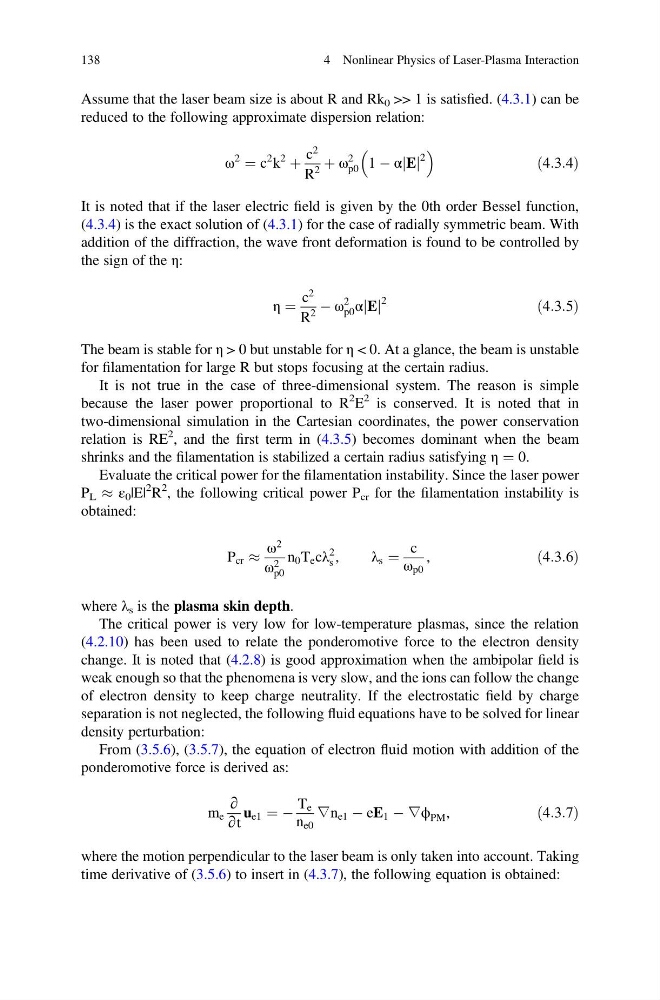
Assume that the laser beam size is about R and Rk 0 >> 1 is satisfied. (4.3.1) can be
reduced to the following approximate dispersion relation:
ω
2
¼ c
2 k
2
þ
c
2
R
2
þ ω
2
p0 1 À α E
j j
2
ð4:3:4Þ
It is noted that if the laser electric field is given by the 0th order Bessel function,
(4.3.4) is the exact solution of (4.3.1) for the case of radially symmetric beam. With
addition of the diffraction, the wave front deformation is found to be controlled by
the sign of the η:
η ¼
c
2
R
2
À ω
2
p0 α E
j j
2
ð4:3:5Þ
The beam is stable for η > 0 but unstable for η < 0. At a glance, the beam is unstable
for filamentation for large R but stops focusing at the certain radius.
It is not true in the case of three-dimensional system. The reason is simple
because the laser power proportional to R
2 E
2 is conserved. It is noted that in
two-dimensional simulation in the Cartesian coordinates, the power conservation
relation is RE
2 , and the first term in (4.3.5) becomes dominant when the beam
shrinks and the filamentation is stabilized a certain radius satisfying η ¼ 0.
Evaluate the critical power for the filamentation instability. Since the laser power
P L % ε 0 |E|
2 R
2
, the following critical power P cr for the filamentation instability is
obtained:
P cr %
ω
2
ω 2
p0
n 0 T e cλ
2
s ,
λ s ¼
c
ω p0
,
ð4:3:6Þ
where λ s is the plasma skin depth.
The critical power is very low for low-temperature plasmas, since the relation
(4.2.10) has been used to relate the ponderomotive force to the electron density
change. It is noted that (4.2.8) is good approximation when the ambipolar field is
weak enough so that the phenomena is very slow, and the ions can follow the change
of electron density to keep charge neutrality. If the electrostatic field by charge
separation is not neglected, the following fluid equations have to be solved for linear
density perturbation:
From (3.5.6), (3.5.7), the equation of electron fluid motion with addition of the
ponderomotive force is derived as:
m e
∂
∂t
u e1 ¼ À
T e
n e0
∇n e1 À eE 1 À ∇ϕ PM ,
ð4:3:7Þ
where the motion perpendicular to the laser beam is only taken into account. Taking
time derivative of (3.5.6) to insert in (4.3.7), the following equation is obtained:
138
4 Nonlinear Physics of Laser-Plasma Interaction
reduced to the following approximate dispersion relation:
ω
2
¼ c
2 k
2
þ
c
2
R
2
þ ω
2
p0 1 À α E
j j
2
ð4:3:4Þ
It is noted that if the laser electric field is given by the 0th order Bessel function,
(4.3.4) is the exact solution of (4.3.1) for the case of radially symmetric beam. With
addition of the diffraction, the wave front deformation is found to be controlled by
the sign of the η:
η ¼
c
2
R
2
À ω
2
p0 α E
j j
2
ð4:3:5Þ
The beam is stable for η > 0 but unstable for η < 0. At a glance, the beam is unstable
for filamentation for large R but stops focusing at the certain radius.
It is not true in the case of three-dimensional system. The reason is simple
because the laser power proportional to R
2 E
2 is conserved. It is noted that in
two-dimensional simulation in the Cartesian coordinates, the power conservation
relation is RE
2 , and the first term in (4.3.5) becomes dominant when the beam
shrinks and the filamentation is stabilized a certain radius satisfying η ¼ 0.
Evaluate the critical power for the filamentation instability. Since the laser power
P L % ε 0 |E|
2 R
2
, the following critical power P cr for the filamentation instability is
obtained:
P cr %
ω
2
ω 2
p0
n 0 T e cλ
2
s ,
λ s ¼
c
ω p0
,
ð4:3:6Þ
where λ s is the plasma skin depth.
The critical power is very low for low-temperature plasmas, since the relation
(4.2.10) has been used to relate the ponderomotive force to the electron density
change. It is noted that (4.2.8) is good approximation when the ambipolar field is
weak enough so that the phenomena is very slow, and the ions can follow the change
of electron density to keep charge neutrality. If the electrostatic field by charge
separation is not neglected, the following fluid equations have to be solved for linear
density perturbation:
From (3.5.6), (3.5.7), the equation of electron fluid motion with addition of the
ponderomotive force is derived as:
m e
∂
∂t
u e1 ¼ À
T e
n e0
∇n e1 À eE 1 À ∇ϕ PM ,
ð4:3:7Þ
where the motion perpendicular to the laser beam is only taken into account. Taking
time derivative of (3.5.6) to insert in (4.3.7), the following equation is obtained:
138
4 Nonlinear Physics of Laser-Plasma Interaction