

∂
2
∂t 2 E À c
2
∇
2 E þ ω
2
p0 1 À α E
j j
2
E,
ð4:3:1Þ
where from (4.2.10) and (4.1.6),
α E
j j
2 ¼
1
2
v os
v e
2
ð4:3:2Þ
For the validation of Taylor expansion, v os /v e << 1 is assumed.
For the case of uniform laser beams propagating in the x-direction with the
wavenumber k in plane geometry is governed the nonlinear dispersion relation:
ω
2
¼ c
2 k
2
þ ω
2
p0 1 À α E
j j
2
ð4:3:3Þ
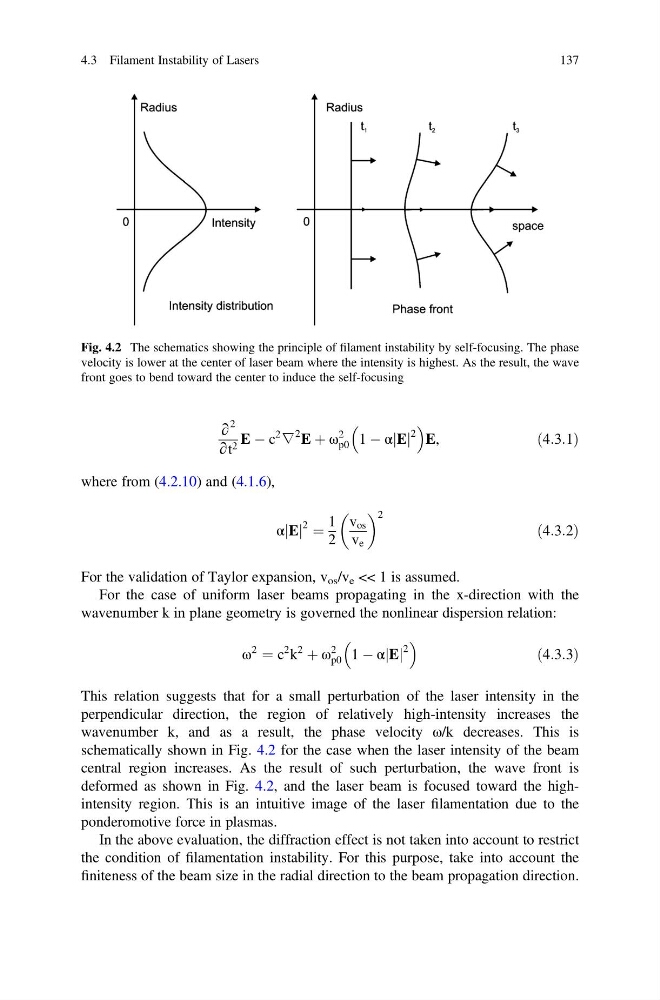
This relation suggests that for a small perturbation of the laser intensity in the
perpendicular direction, the region of relatively high-intensity increases the
wavenumber k, and as a result, the phase velocity ω/k decreases. This is
schematically shown in Fig. 4.2 for the case when the laser intensity of the beam
central region increases. As the result of such perturbation, the wave front is
deformed as shown in Fig. 4.2, and the laser beam is focused toward the highintensity region. This is an intuitive image of the laser filamentation due to the
ponderomotive force in plasmas.
In the above evaluation, the diffraction effect is not taken into account to restrict
the condition of filamentation instability. For this purpose, take into account the
finiteness of the beam size in the radial direction to the beam propagation direction.
Fig. 4.2 The schematics showing the principle of filament instability by self-focusing. The phase
velocity is lower at the center of laser beam where the intensity is highest. As the result, the wave
front goes to bend toward the center to induce the self-focusing
4.3 Filament Instability of Lasers
137
2
∂t 2 E À c
2
∇
2 E þ ω
2
p0 1 À α E
j j
2
E,
ð4:3:1Þ
where from (4.2.10) and (4.1.6),
α E
j j
2 ¼
1
2
v os
v e
2
ð4:3:2Þ
For the validation of Taylor expansion, v os /v e << 1 is assumed.
For the case of uniform laser beams propagating in the x-direction with the
wavenumber k in plane geometry is governed the nonlinear dispersion relation:
ω
2
¼ c
2 k
2
þ ω
2
p0 1 À α E
j j
2
ð4:3:3Þ
This relation suggests that for a small perturbation of the laser intensity in the
perpendicular direction, the region of relatively high-intensity increases the
wavenumber k, and as a result, the phase velocity ω/k decreases. This is
schematically shown in Fig. 4.2 for the case when the laser intensity of the beam
central region increases. As the result of such perturbation, the wave front is
deformed as shown in Fig. 4.2, and the laser beam is focused toward the highintensity region. This is an intuitive image of the laser filamentation due to the
ponderomotive force in plasmas.
In the above evaluation, the diffraction effect is not taken into account to restrict
the condition of filamentation instability. For this purpose, take into account the
finiteness of the beam size in the radial direction to the beam propagation direction.
Fig. 4.2 The schematics showing the principle of filament instability by self-focusing. The phase
velocity is lower at the center of laser beam where the intensity is highest. As the result, the wave
front goes to bend toward the center to induce the self-focusing
4.3 Filament Instability of Lasers
137