

3k D
2
1 þ iν=ω
d
2
dx
2
E þ 1 À
n 0
n cr
E ¼ E d
ð4:5:3Þ
The wave Eq. (4.5.3) should be solved consistently with (4.5.2) for the complex
value of the electric field E. In (4.5.3), an effective collisionless damping rate ν is
included so that the plasma wave amplitude is reduced along the propagation to the
downstream region. Since the solution E becomes complex, the problem is regarded
as an eigenvalue problem in two-dimensional space in the complex quantities of E. A
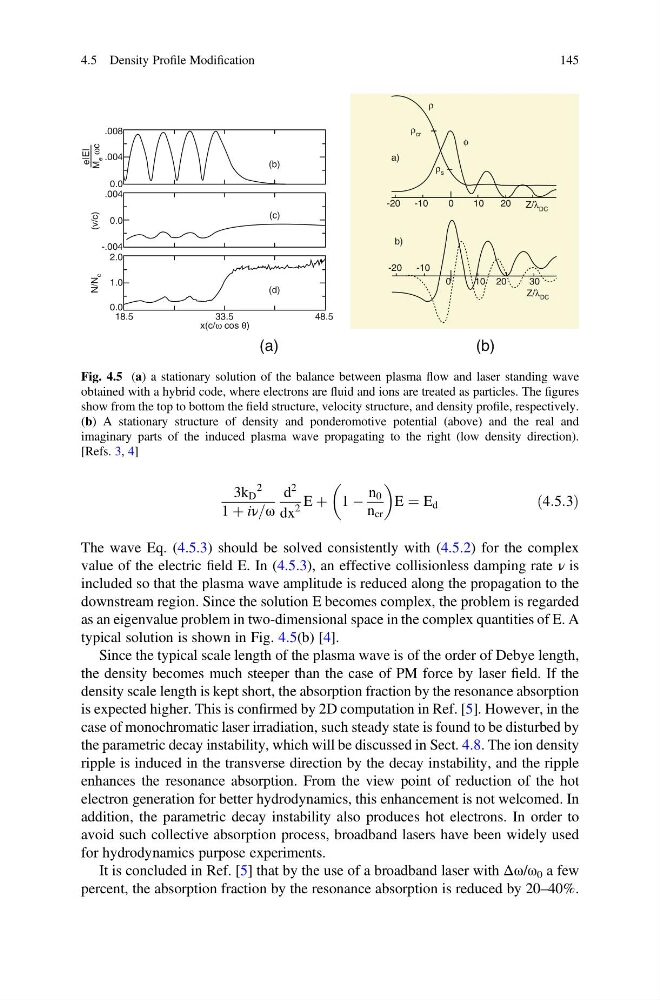
typical solution is shown in Fig. 4.5(b) [4].
Since the typical scale length of the plasma wave is of the order of Debye length,
the density becomes much steeper than the case of PM force by laser field. If the
density scale length is kept short, the absorption fraction by the resonance absorption
is expected higher. This is confirmed by 2D computation in Ref. [5]. However, in the
case of monochromatic laser irradiation, such steady state is found to be disturbed by
the parametric decay instability, which will be discussed in Sect. 4.8. The ion density
ripple is induced in the transverse direction by the decay instability, and the ripple
enhances the resonance absorption. From the view point of reduction of the hot
electron generation for better hydrodynamics, this enhancement is not welcomed. In
addition, the parametric decay instability also produces hot electrons. In order to
avoid such collective absorption process, broadband lasers have been widely used
for hydrodynamics purpose experiments.
It is concluded in Ref. [5] that by the use of a broadband laser with Δω/ω 0 a few
percent, the absorption fraction by the resonance absorption is reduced by 20–40%.
.008
e|E|
(v/c)
N/N
c
M
e
ωc
(b)
(c)
(d)
.004
.004
-.004
0.0
0.0
2.0
1.0
0.0
18.5
33.5
x(c/ω cos θ)
(a)
(b)
48.5
-20
-20
a)
b)
-10
-10
10
10
20
20
30
Z/λ DC
Z/λ DC
ρ
ρ cr
ρ s
φ
0
0
Fig. 4.5 (a) a stationary solution of the balance between plasma flow and laser standing wave
obtained with a hybrid code, where electrons are fluid and ions are treated as particles. The figures
show from the top to bottom the field structure, velocity structure, and density profile, respectively.
(b) A stationary structure of density and ponderomotive potential (above) and the real and
imaginary parts of the induced plasma wave propagating to the right (low density direction).
[Refs. 3, 4]
4.5 Density Profile Modification
145
2
1 þ iν=ω
d
2
dx
2
E þ 1 À
n 0
n cr
E ¼ E d
ð4:5:3Þ
The wave Eq. (4.5.3) should be solved consistently with (4.5.2) for the complex
value of the electric field E. In (4.5.3), an effective collisionless damping rate ν is
included so that the plasma wave amplitude is reduced along the propagation to the
downstream region. Since the solution E becomes complex, the problem is regarded
as an eigenvalue problem in two-dimensional space in the complex quantities of E. A
typical solution is shown in Fig. 4.5(b) [4].
Since the typical scale length of the plasma wave is of the order of Debye length,
the density becomes much steeper than the case of PM force by laser field. If the
density scale length is kept short, the absorption fraction by the resonance absorption
is expected higher. This is confirmed by 2D computation in Ref. [5]. However, in the
case of monochromatic laser irradiation, such steady state is found to be disturbed by
the parametric decay instability, which will be discussed in Sect. 4.8. The ion density
ripple is induced in the transverse direction by the decay instability, and the ripple
enhances the resonance absorption. From the view point of reduction of the hot
electron generation for better hydrodynamics, this enhancement is not welcomed. In
addition, the parametric decay instability also produces hot electrons. In order to
avoid such collective absorption process, broadband lasers have been widely used
for hydrodynamics purpose experiments.
It is concluded in Ref. [5] that by the use of a broadband laser with Δω/ω 0 a few
percent, the absorption fraction by the resonance absorption is reduced by 20–40%.
.008
e|E|
(v/c)
N/N
c
M
e
ωc
(b)
(c)
(d)
.004
.004
-.004
0.0
0.0
2.0
1.0
0.0
18.5
33.5
x(c/ω cos θ)
(a)
(b)
48.5
-20
-20
a)
b)
-10
-10
10
10
20
20
30
Z/λ DC
Z/λ DC
ρ
ρ cr
ρ s
φ
0
0
Fig. 4.5 (a) a stationary solution of the balance between plasma flow and laser standing wave
obtained with a hybrid code, where electrons are fluid and ions are treated as particles. The figures
show from the top to bottom the field structure, velocity structure, and density profile, respectively.
(b) A stationary structure of density and ponderomotive potential (above) and the real and
imaginary parts of the induced plasma wave propagating to the right (low density direction).
[Refs. 3, 4]
4.5 Density Profile Modification
145