

v g ¼
c
2 k
ω
ð4:2:4Þ
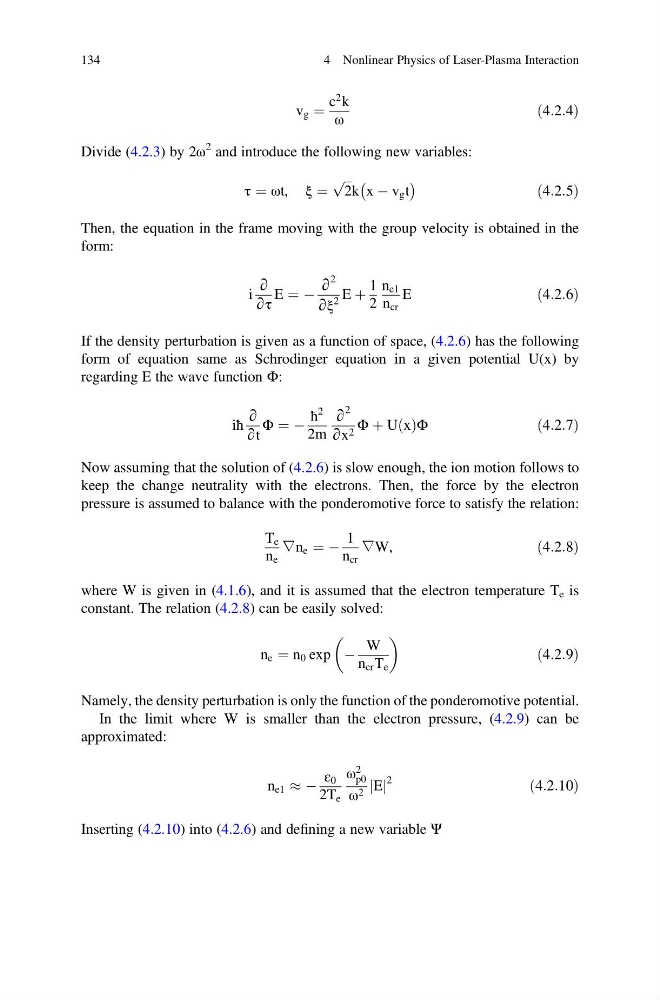
Divide (4.2.3) by 2ω
2 and introduce the following new variables:
τ ¼ ωt, ξ ¼
ffiffi ffi
2
p
k x À v g t
À
Á
ð4:2:5Þ
Then, the equation in the frame moving with the group velocity is obtained in the
form:
i
∂
∂τ
E ¼ À
∂
2
∂ξ
2
E þ
1
2
n e1
n cr
E
ð4:2:6Þ
If the density perturbation is given as a function of space, (4.2.6) has the following
form of equation same as Schrodinger equation in a given potential U(x) by
regarding E the wave function Φ:
iħ
∂
∂t
Φ ¼ À
ħ
2
2m
∂
2
∂x 2 Φ þ U x
ð ÞΦ
ð4:2:7Þ
Now assuming that the solution of (4.2.6) is slow enough, the ion motion follows to
keep the change neutrality with the electrons. Then, the force by the electron
pressure is assumed to balance with the ponderomotive force to satisfy the relation:
T e
n e
∇n e ¼ À
1
n cr
∇W,
ð4:2:8Þ
where W is given in (4.1.6), and it is assumed that the electron temperature T e is
constant. The relation (4.2.8) can be easily solved:
n e ¼ n 0 exp À
W
n cr T e
ð4:2:9Þ
Namely, the density perturbation is only the function of the ponderomotive potential.
In the limit where W is smaller than the electron pressure, (4.2.9) can be
approximated:
n e1 % À
ε 0
2T e
ω
2
p0
ω 2 E
j j
2
ð4:2:10Þ
Inserting (4.2.10) into (4.2.6) and defining a new variable Ψ
134
4 Nonlinear Physics of Laser-Plasma Interaction
c
2 k
ω
ð4:2:4Þ
Divide (4.2.3) by 2ω
2 and introduce the following new variables:
τ ¼ ωt, ξ ¼
ffiffi ffi
2
p
k x À v g t
À
Á
ð4:2:5Þ
Then, the equation in the frame moving with the group velocity is obtained in the
form:
i
∂
∂τ
E ¼ À
∂
2
∂ξ
2
E þ
1
2
n e1
n cr
E
ð4:2:6Þ
If the density perturbation is given as a function of space, (4.2.6) has the following
form of equation same as Schrodinger equation in a given potential U(x) by
regarding E the wave function Φ:
iħ
∂
∂t
Φ ¼ À
ħ
2
2m
∂
2
∂x 2 Φ þ U x
ð ÞΦ
ð4:2:7Þ
Now assuming that the solution of (4.2.6) is slow enough, the ion motion follows to
keep the change neutrality with the electrons. Then, the force by the electron
pressure is assumed to balance with the ponderomotive force to satisfy the relation:
T e
n e
∇n e ¼ À
1
n cr
∇W,
ð4:2:8Þ
where W is given in (4.1.6), and it is assumed that the electron temperature T e is
constant. The relation (4.2.8) can be easily solved:
n e ¼ n 0 exp À
W
n cr T e
ð4:2:9Þ
Namely, the density perturbation is only the function of the ponderomotive potential.
In the limit where W is smaller than the electron pressure, (4.2.9) can be
approximated:
n e1 % À
ε 0
2T e
ω
2
p0
ω 2 E
j j
2
ð4:2:10Þ
Inserting (4.2.10) into (4.2.6) and defining a new variable Ψ
134
4 Nonlinear Physics of Laser-Plasma Interaction