

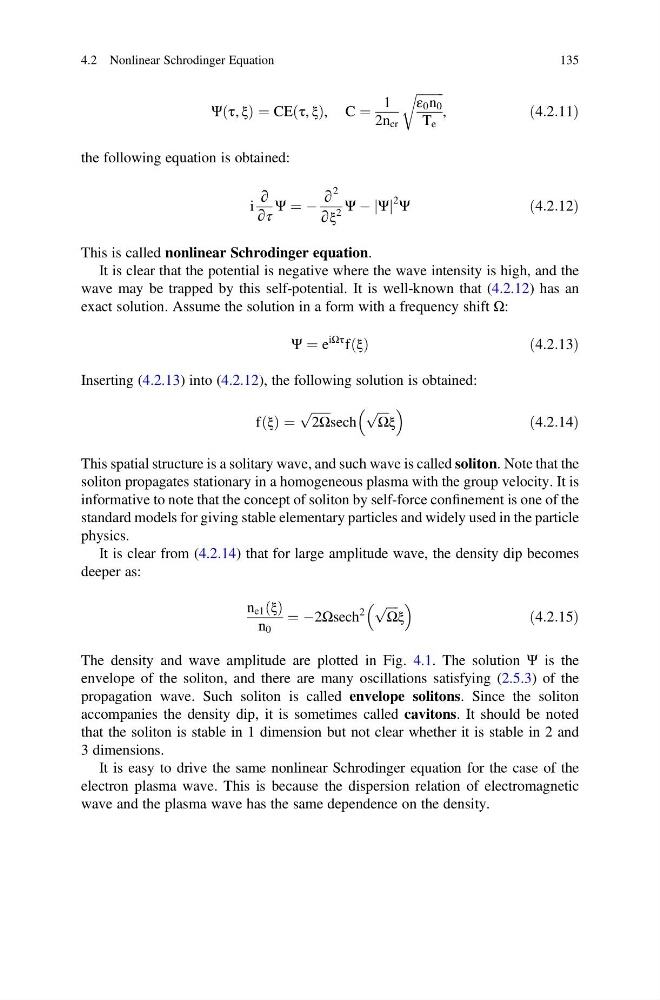
Ψ τ, ξ
ð Þ ¼ CE τ, ξ
ð Þ, C ¼
1
2n cr
ffiffiffiffiffiffiffiffi ffi
ε 0 n 0
T e
r
,
ð4:2:11Þ
the following equation is obtained:
i
∂
∂τ
Ψ ¼ À
∂
2
∂ξ
2
Ψ À Ψ
j j
2 Ψ
ð4:2:12Þ
This is called nonlinear Schrodinger equation.
It is clear that the potential is negative where the wave intensity is high, and the
wave may be trapped by this self-potential. It is well-known that (4.2.12) has an
exact solution. Assume the solution in a form with a frequency shift Ω:
Ψ ¼ e
iΩτ f ξ
ð Þ
ð4:2:13Þ
Inserting (4.2.13) into (4.2.12), the following solution is obtained:
f ξ
ð Þ ¼
ffiffiffiffiffiffi
2Ω
p
sech
ffiffiffiffi
Ω
p ξ
ð4:2:14Þ
This spatial structure is a solitary wave, and such wave is called soliton. Note that the
soliton propagates stationary in a homogeneous plasma with the group velocity. It is
informative to note that the concept of soliton by self-force confinement is one of the
standard models for giving stable elementary particles and widely used in the particle
physics.
It is clear from (4.2.14) that for large amplitude wave, the density dip becomes
deeper as:
n e1 ξ
ð Þ
n 0
¼ À2Ωsech
2
ffiffiffiffi
Ω
p ξ
ð4:2:15Þ
The density and wave amplitude are plotted in Fig. 4.1. The solution Ψ is the
envelope of the soliton, and there are many oscillations satisfying (2.5.3) of the
propagation wave. Such soliton is called envelope solitons. Since the soliton
accompanies the density dip, it is sometimes called cavitons. It should be noted
that the soliton is stable in 1 dimension but not clear whether it is stable in 2 and
3 dimensions.
It is easy to drive the same nonlinear Schrodinger equation for the case of the
electron plasma wave. This is because the dispersion relation of electromagnetic
wave and the plasma wave has the same dependence on the density.
4.2 Nonlinear Schrodinger Equation
135
ð Þ ¼ CE τ, ξ
ð Þ, C ¼
1
2n cr
ffiffiffiffiffiffiffiffi ffi
ε 0 n 0
T e
r
,
ð4:2:11Þ
the following equation is obtained:
i
∂
∂τ
Ψ ¼ À
∂
2
∂ξ
2
Ψ À Ψ
j j
2 Ψ
ð4:2:12Þ
This is called nonlinear Schrodinger equation.
It is clear that the potential is negative where the wave intensity is high, and the
wave may be trapped by this self-potential. It is well-known that (4.2.12) has an
exact solution. Assume the solution in a form with a frequency shift Ω:
Ψ ¼ e
iΩτ f ξ
ð Þ
ð4:2:13Þ
Inserting (4.2.13) into (4.2.12), the following solution is obtained:
f ξ
ð Þ ¼
ffiffiffiffiffiffi
2Ω
p
sech
ffiffiffiffi
Ω
p ξ
ð4:2:14Þ
This spatial structure is a solitary wave, and such wave is called soliton. Note that the
soliton propagates stationary in a homogeneous plasma with the group velocity. It is
informative to note that the concept of soliton by self-force confinement is one of the
standard models for giving stable elementary particles and widely used in the particle
physics.
It is clear from (4.2.14) that for large amplitude wave, the density dip becomes
deeper as:
n e1 ξ
ð Þ
n 0
¼ À2Ωsech
2
ffiffiffiffi
Ω
p ξ
ð4:2:15Þ
The density and wave amplitude are plotted in Fig. 4.1. The solution Ψ is the
envelope of the soliton, and there are many oscillations satisfying (2.5.3) of the
propagation wave. Such soliton is called envelope solitons. Since the soliton
accompanies the density dip, it is sometimes called cavitons. It should be noted
that the soliton is stable in 1 dimension but not clear whether it is stable in 2 and
3 dimensions.
It is easy to drive the same nonlinear Schrodinger equation for the case of the
electron plasma wave. This is because the dispersion relation of electromagnetic
wave and the plasma wave has the same dependence on the density.
4.2 Nonlinear Schrodinger Equation
135