

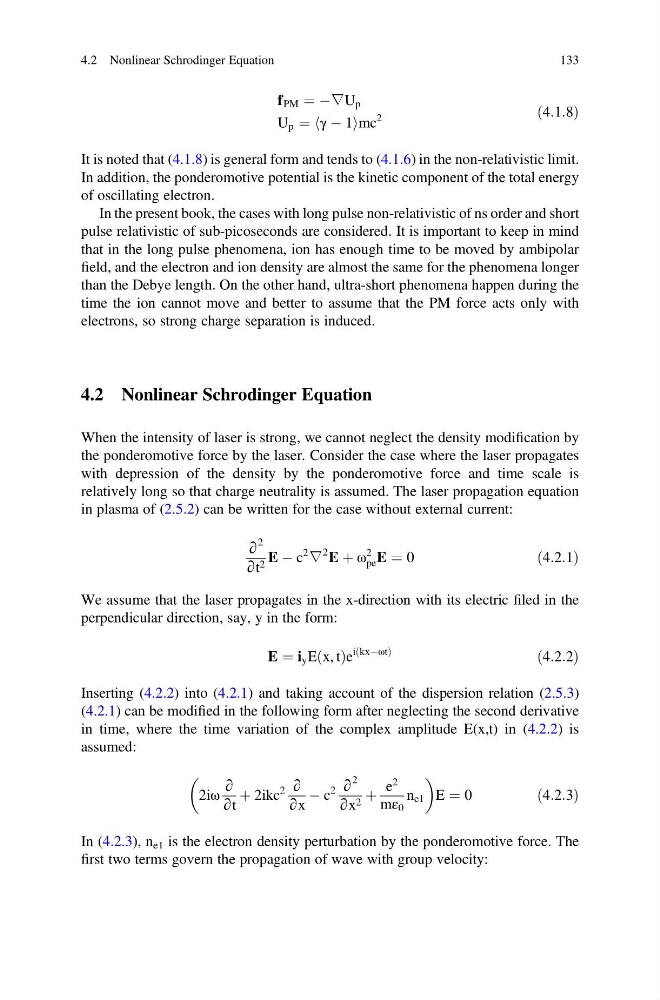
f PM ¼ À∇U p
U p ¼ γ À 1
h
imc
2
ð4:1:8Þ
It is noted that (4.1.8) is general form and tends to (4.1.6) in the non-relativistic limit.
In addition, the ponderomotive potential is the kinetic component of the total energy
of oscillating electron.
In the present book, the cases with long pulse non-relativistic of ns order and short
pulse relativistic of sub-picoseconds are considered. It is important to keep in mind
that in the long pulse phenomena, ion has enough time to be moved by ambipolar
field, and the electron and ion density are almost the same for the phenomena longer
than the Debye length. On the other hand, ultra-short phenomena happen during the
time the ion cannot move and better to assume that the PM force acts only with
electrons, so strong charge separation is induced.
4.2 Nonlinear Schrodinger Equation
When the intensity of laser is strong, we cannot neglect the density modification by
the ponderomotive force by the laser. Consider the case where the laser propagates
with depression of the density by the ponderomotive force and time scale is
relatively long so that charge neutrality is assumed. The laser propagation equation
in plasma of (2.5.2) can be written for the case without external current:
∂
2
∂t 2 E À c
2
∇
2 E þ ω
2
pe E ¼ 0
ð4:2:1Þ
We assume that the laser propagates in the x-direction with its electric filed in the
perpendicular direction, say, y in the form:
E ¼ i y E x, t
ð Þe
i kxÀωt
ð
Þ
ð4:2:2Þ
Inserting (4.2.2) into (4.2.1) and taking account of the dispersion relation (2.5.3)
(4.2.1) can be modified in the following form after neglecting the second derivative
in time, where the time variation of the complex amplitude E(x,t) in (4.2.2) is
assumed:
2iω
∂
∂t
þ 2ikc
2 ∂
∂x
À c
2 ∂
2
∂x 2 þ
e
2
mε 0
n e1
E ¼ 0
ð4:2:3Þ
In (4.2.3), n e1 is the electron density perturbation by the ponderomotive force. The
first two terms govern the propagation of wave with group velocity:
4.2 Nonlinear Schrodinger Equation
133
U p ¼ γ À 1
h
imc
2
ð4:1:8Þ
It is noted that (4.1.8) is general form and tends to (4.1.6) in the non-relativistic limit.
In addition, the ponderomotive potential is the kinetic component of the total energy
of oscillating electron.
In the present book, the cases with long pulse non-relativistic of ns order and short
pulse relativistic of sub-picoseconds are considered. It is important to keep in mind
that in the long pulse phenomena, ion has enough time to be moved by ambipolar
field, and the electron and ion density are almost the same for the phenomena longer
than the Debye length. On the other hand, ultra-short phenomena happen during the
time the ion cannot move and better to assume that the PM force acts only with
electrons, so strong charge separation is induced.
4.2 Nonlinear Schrodinger Equation
When the intensity of laser is strong, we cannot neglect the density modification by
the ponderomotive force by the laser. Consider the case where the laser propagates
with depression of the density by the ponderomotive force and time scale is
relatively long so that charge neutrality is assumed. The laser propagation equation
in plasma of (2.5.2) can be written for the case without external current:
∂
2
∂t 2 E À c
2
∇
2 E þ ω
2
pe E ¼ 0
ð4:2:1Þ
We assume that the laser propagates in the x-direction with its electric filed in the
perpendicular direction, say, y in the form:
E ¼ i y E x, t
ð Þe
i kxÀωt
ð
Þ
ð4:2:2Þ
Inserting (4.2.2) into (4.2.1) and taking account of the dispersion relation (2.5.3)
(4.2.1) can be modified in the following form after neglecting the second derivative
in time, where the time variation of the complex amplitude E(x,t) in (4.2.2) is
assumed:
2iω
∂
∂t
þ 2ikc
2 ∂
∂x
À c
2 ∂
2
∂x 2 þ
e
2
mε 0
n e1
E ¼ 0
ð4:2:3Þ
In (4.2.3), n e1 is the electron density perturbation by the ponderomotive force. The
first two terms govern the propagation of wave with group velocity:
4.2 Nonlinear Schrodinger Equation
133