

F
h i ¼ Àe ξ Á ∇
ð
ÞE
h
iÀ e v  B
h
i,
ð4:1:2Þ
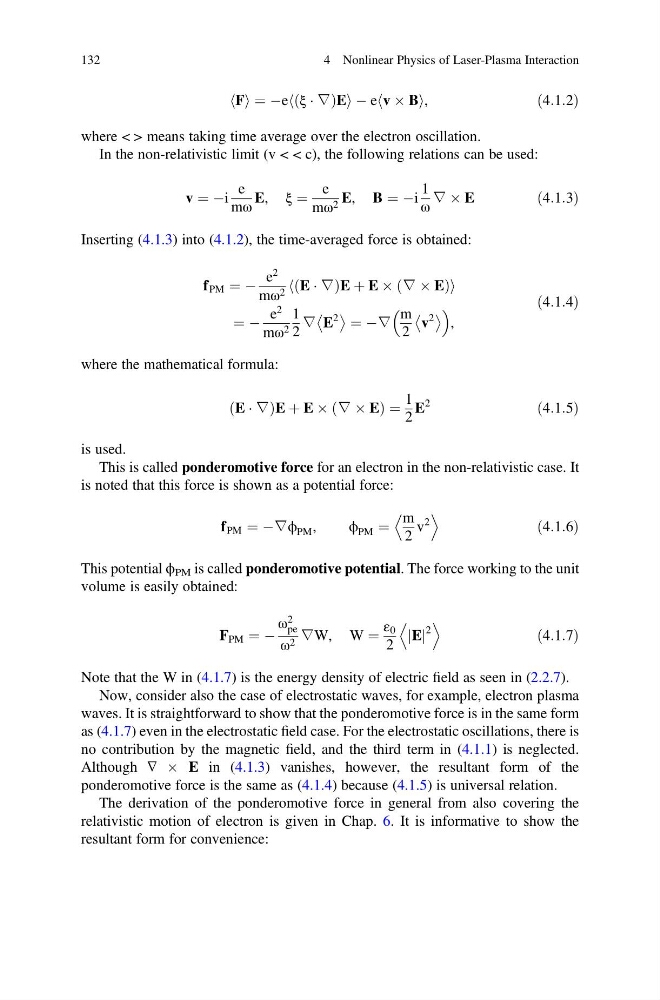
where < > means taking time average over the electron oscillation.
In the non-relativistic limit (v < < c), the following relations can be used:
v ¼ Ài
e
mω
E, ξ ¼
e
mω 2 E, B ¼ Ài
1
ω
∇ Â E
ð4:1:3Þ
Inserting (4.1.3) into (4.1.2), the time-averaged force is obtained:
f PM ¼ À
e
2
mω 2 E Á ∇
ð
ÞE þ E Â ∇ Â E
ð
Þ
h
i
¼ À
e
2
mω 2
1
2
∇ E
2
¼ À∇
m
2
v
2
,
ð4:1:4Þ
where the mathematical formula:
E Á ∇
ð
ÞE þ E Â ∇ Â E
ð
Þ¼
1
2
E
2
ð4:1:5Þ
is used.
This is called ponderomotive force for an electron in the non-relativistic case. It
is noted that this force is shown as a potential force:
f PM ¼ À∇ϕ PM ,
ϕ PM ¼
m
2
v
2
D
E
ð4:1:6Þ
This potential ϕ PM is called ponderomotive potential. The force working to the unit
volume is easily obtained:
F PM ¼ À
ω
2
pe
ω 2 ∇W, W ¼
ε 0
2
E
j j
2
D
E
ð4:1:7Þ
Note that the W in (4.1.7) is the energy density of electric field as seen in (2.2.7).
Now, consider also the case of electrostatic waves, for example, electron plasma
waves. It is straightforward to show that the ponderomotive force is in the same form
as (4.1.7) even in the electrostatic field case. For the electrostatic oscillations, there is
no contribution by the magnetic field, and the third term in (4.1.1) is neglected.
Although ∇ Â E in (4.1.3) vanishes, however, the resultant form of the
ponderomotive force is the same as (4.1.4) because (4.1.5) is universal relation.
The derivation of the ponderomotive force in general from also covering the
relativistic motion of electron is given in Chap. 6. It is informative to show the
resultant form for convenience:
132
4 Nonlinear Physics of Laser-Plasma Interaction
h i ¼ Àe ξ Á ∇
ð
ÞE
h
iÀ e v  B
h
i,
ð4:1:2Þ
where < > means taking time average over the electron oscillation.
In the non-relativistic limit (v < < c), the following relations can be used:
v ¼ Ài
e
mω
E, ξ ¼
e
mω 2 E, B ¼ Ài
1
ω
∇ Â E
ð4:1:3Þ
Inserting (4.1.3) into (4.1.2), the time-averaged force is obtained:
f PM ¼ À
e
2
mω 2 E Á ∇
ð
ÞE þ E Â ∇ Â E
ð
Þ
h
i
¼ À
e
2
mω 2
1
2
∇ E
2
¼ À∇
m
2
v
2
,
ð4:1:4Þ
where the mathematical formula:
E Á ∇
ð
ÞE þ E Â ∇ Â E
ð
Þ¼
1
2
E
2
ð4:1:5Þ
is used.
This is called ponderomotive force for an electron in the non-relativistic case. It
is noted that this force is shown as a potential force:
f PM ¼ À∇ϕ PM ,
ϕ PM ¼
m
2
v
2
D
E
ð4:1:6Þ
This potential ϕ PM is called ponderomotive potential. The force working to the unit
volume is easily obtained:
F PM ¼ À
ω
2
pe
ω 2 ∇W, W ¼
ε 0
2
E
j j
2
D
E
ð4:1:7Þ
Note that the W in (4.1.7) is the energy density of electric field as seen in (2.2.7).
Now, consider also the case of electrostatic waves, for example, electron plasma
waves. It is straightforward to show that the ponderomotive force is in the same form
as (4.1.7) even in the electrostatic field case. For the electrostatic oscillations, there is
no contribution by the magnetic field, and the third term in (4.1.1) is neglected.
Although ∇ Â E in (4.1.3) vanishes, however, the resultant form of the
ponderomotive force is the same as (4.1.4) because (4.1.5) is universal relation.
The derivation of the ponderomotive force in general from also covering the
relativistic motion of electron is given in Chap. 6. It is informative to show the
resultant form for convenience:
132
4 Nonlinear Physics of Laser-Plasma Interaction