

P L ¼
c
2
ε 0 E
2
0 cosθ
ð3:10:16Þ
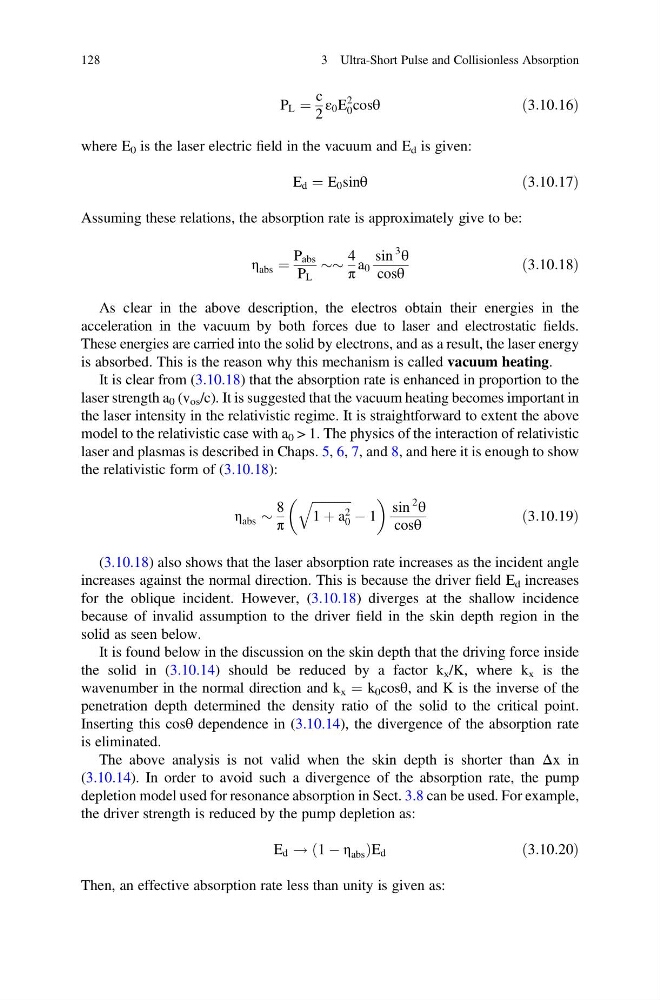
where E 0 is the laser electric field in the vacuum and E d is given:
E d ¼ E 0 sinθ
ð3:10:17Þ
Assuming these relations, the absorption rate is approximately give to be:
η abs ¼
P abs
P L
$$
4
π
a 0
sin
3
θ
cosθ
ð3:10:18Þ
As clear in the above description, the electros obtain their energies in the
acceleration in the vacuum by both forces due to laser and electrostatic fields.
These energies are carried into the solid by electrons, and as a result, the laser energy
is absorbed. This is the reason why this mechanism is called vacuum heating.
It is clear from (3.10.18) that the absorption rate is enhanced in proportion to the
laser strength a 0 (v os /c). It is suggested that the vacuum heating becomes important in
the laser intensity in the relativistic regime. It is straightforward to extent the above
model to the relativistic case with a 0 > 1. The physics of the interaction of relativistic
laser and plasmas is described in Chaps. 5, 6, 7, and 8, and here it is enough to show
the relativistic form of (3.10.18):
η abs $
8
π
ffiffiffiffiffiffiffiffiffiffiffiffi ffi
1 þ a 2
0
q
À 1
sin
2
θ
cosθ
ð3:10:19Þ
(3.10.18) also shows that the laser absorption rate increases as the incident angle
increases against the normal direction. This is because the driver field E d increases
for the oblique incident. However, (3.10.18) diverges at the shallow incidence
because of invalid assumption to the driver field in the skin depth region in the
solid as seen below.
It is found below in the discussion on the skin depth that the driving force inside
the solid in (3.10.14) should be reduced by a factor k x /K, where k x is the
wavenumber in the normal direction and k x ¼ k 0 cosθ, and K is the inverse of the
penetration depth determined the density ratio of the solid to the critical point.
Inserting this cosθ dependence in (3.10.14), the divergence of the absorption rate
is eliminated.
The above analysis is not valid when the skin depth is shorter than Δx in
(3.10.14). In order to avoid such a divergence of the absorption rate, the pump
depletion model used for resonance absorption in Sect. 3.8 can be used. For example,
the driver strength is reduced by the pump depletion as:
E d ! 1 À η abs
ð
Þ E d
ð3:10:20Þ
Then, an effective absorption rate less than unity is given as:
128
3 Ultra-Short Pulse and Collisionless Absorption
c
2
ε 0 E
2
0 cosθ
ð3:10:16Þ
where E 0 is the laser electric field in the vacuum and E d is given:
E d ¼ E 0 sinθ
ð3:10:17Þ
Assuming these relations, the absorption rate is approximately give to be:
η abs ¼
P abs
P L
$$
4
π
a 0
sin
3
θ
cosθ
ð3:10:18Þ
As clear in the above description, the electros obtain their energies in the
acceleration in the vacuum by both forces due to laser and electrostatic fields.
These energies are carried into the solid by electrons, and as a result, the laser energy
is absorbed. This is the reason why this mechanism is called vacuum heating.
It is clear from (3.10.18) that the absorption rate is enhanced in proportion to the
laser strength a 0 (v os /c). It is suggested that the vacuum heating becomes important in
the laser intensity in the relativistic regime. It is straightforward to extent the above
model to the relativistic case with a 0 > 1. The physics of the interaction of relativistic
laser and plasmas is described in Chaps. 5, 6, 7, and 8, and here it is enough to show
the relativistic form of (3.10.18):
η abs $
8
π
ffiffiffiffiffiffiffiffiffiffiffiffi ffi
1 þ a 2
0
q
À 1
sin
2
θ
cosθ
ð3:10:19Þ
(3.10.18) also shows that the laser absorption rate increases as the incident angle
increases against the normal direction. This is because the driver field E d increases
for the oblique incident. However, (3.10.18) diverges at the shallow incidence
because of invalid assumption to the driver field in the skin depth region in the
solid as seen below.
It is found below in the discussion on the skin depth that the driving force inside
the solid in (3.10.14) should be reduced by a factor k x /K, where k x is the
wavenumber in the normal direction and k x ¼ k 0 cosθ, and K is the inverse of the
penetration depth determined the density ratio of the solid to the critical point.
Inserting this cosθ dependence in (3.10.14), the divergence of the absorption rate
is eliminated.
The above analysis is not valid when the skin depth is shorter than Δx in
(3.10.14). In order to avoid such a divergence of the absorption rate, the pump
depletion model used for resonance absorption in Sect. 3.8 can be used. For example,
the driver strength is reduced by the pump depletion as:
E d ! 1 À η abs
ð
Þ E d
ð3:10:20Þ
Then, an effective absorption rate less than unity is given as:
128
3 Ultra-Short Pulse and Collisionless Absorption