

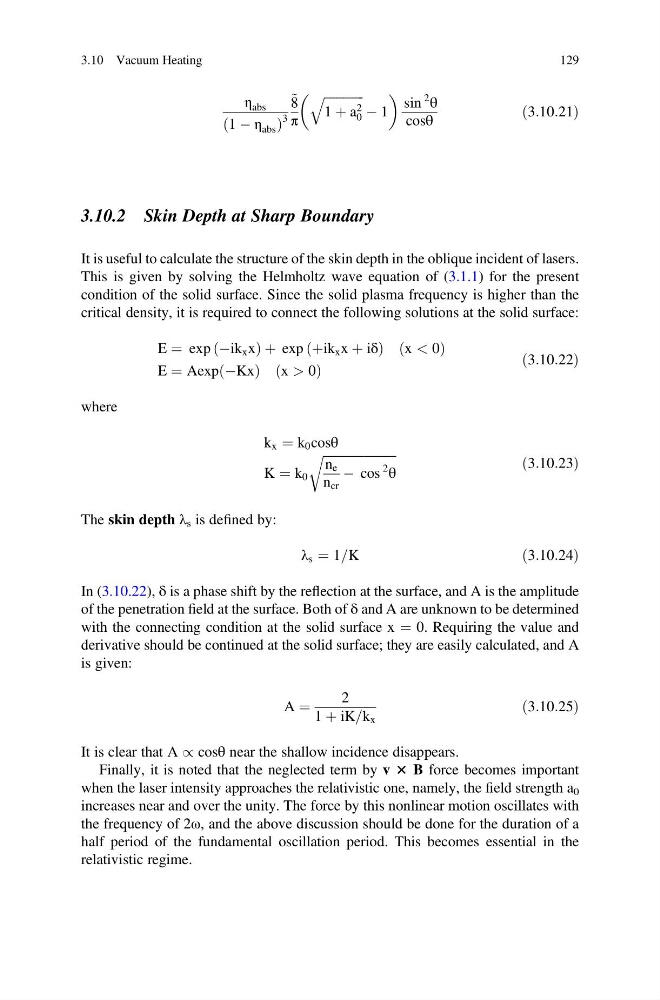
η abs
1 À η abs
ð
Þ
3
~ 8
π
ffiffiffiffiffiffiffiffiffiffiffiffi ffi
1 þ a 2
0
q
À 1
sin
2
θ
cosθ
ð3:10:21Þ
3.10.2 Skin Depth at Sharp Boundary
It is useful to calculate the structure of the skin depth in the oblique incident of lasers.
This is given by solving the Helmholtz wave equation of (3.1.1) for the present
condition of the solid surface. Since the solid plasma frequency is higher than the
critical density, it is required to connect the following solutions at the solid surface:
E ¼ exp Àik x x
ð
Þþ exp þik x x þ iδ
ð
Þ x < 0
ð
Þ
E ¼ Aexp ÀKx
ð
Þ x > 0
ð
Þ
ð3:10:22Þ
where
k x ¼ k 0 cosθ
K ¼ k 0
ffiffiffiffiffiffiffiffiffiffiffiffiffiffiffiffiffiffiffiffiffiffiffi ffi
n e
n cr
À cos
2
θ
r
ð3:10:23Þ
The skin depth λ s is defined by:
λ s ¼ 1=K
ð3:10:24Þ
In (3.10.22), δ is a phase shift by the reflection at the surface, and A is the amplitude
of the penetration field at the surface. Both of δ and A are unknown to be determined
with the connecting condition at the solid surface x ¼ 0. Requiring the value and
derivative should be continued at the solid surface; they are easily calculated, and A
is given:
A ¼
2
1 þ iK=k x
ð3:10:25Þ
It is clear that A / cosθ near the shallow incidence disappears.
Finally, it is noted that the neglected term by v 3 B force becomes important
when the laser intensity approaches the relativistic one, namely, the field strength a 0
increases near and over the unity. The force by this nonlinear motion oscillates with
the frequency of 2ω, and the above discussion should be done for the duration of a
half period of the fundamental oscillation period. This becomes essential in the
relativistic regime.
3.10 Vacuum Heating
129
1 À η abs
ð
Þ
3
~ 8
π
ffiffiffiffiffiffiffiffiffiffiffiffi ffi
1 þ a 2
0
q
À 1
sin
2
θ
cosθ
ð3:10:21Þ
3.10.2 Skin Depth at Sharp Boundary
It is useful to calculate the structure of the skin depth in the oblique incident of lasers.
This is given by solving the Helmholtz wave equation of (3.1.1) for the present
condition of the solid surface. Since the solid plasma frequency is higher than the
critical density, it is required to connect the following solutions at the solid surface:
E ¼ exp Àik x x
ð
Þþ exp þik x x þ iδ
ð
Þ x < 0
ð
Þ
E ¼ Aexp ÀKx
ð
Þ x > 0
ð
Þ
ð3:10:22Þ
where
k x ¼ k 0 cosθ
K ¼ k 0
ffiffiffiffiffiffiffiffiffiffiffiffiffiffiffiffiffiffiffiffiffiffiffi ffi
n e
n cr
À cos
2
θ
r
ð3:10:23Þ
The skin depth λ s is defined by:
λ s ¼ 1=K
ð3:10:24Þ
In (3.10.22), δ is a phase shift by the reflection at the surface, and A is the amplitude
of the penetration field at the surface. Both of δ and A are unknown to be determined
with the connecting condition at the solid surface x ¼ 0. Requiring the value and
derivative should be continued at the solid surface; they are easily calculated, and A
is given:
A ¼
2
1 þ iK=k x
ð3:10:25Þ
It is clear that A / cosθ near the shallow incidence disappears.
Finally, it is noted that the neglected term by v 3 B force becomes important
when the laser intensity approaches the relativistic one, namely, the field strength a 0
increases near and over the unity. The force by this nonlinear motion oscillates with
the frequency of 2ω, and the above discussion should be done for the duration of a
half period of the fundamental oscillation period. This becomes essential in the
relativistic regime.
3.10 Vacuum Heating
129