

direction to the right in Fig. 3.33, the electrons near the solid surface are accelerated
to the vacuum. Then, strong electrostatic field due to the charge separation appears in
the direction so that the electrons are pulled back toward the inside of the solid.
When the sigh of the laser field becomes opposite after the half cycle, the laser and
electrostatic field both work as strong force so that the electrons are accelerated
toward the inward of the solid. Then, these electrons escape from the interaction
region near the surface to the solid inside with accelerated high energy. Of course, a
part of the electrons accelerated to the vacuum can continue to accelerate over the
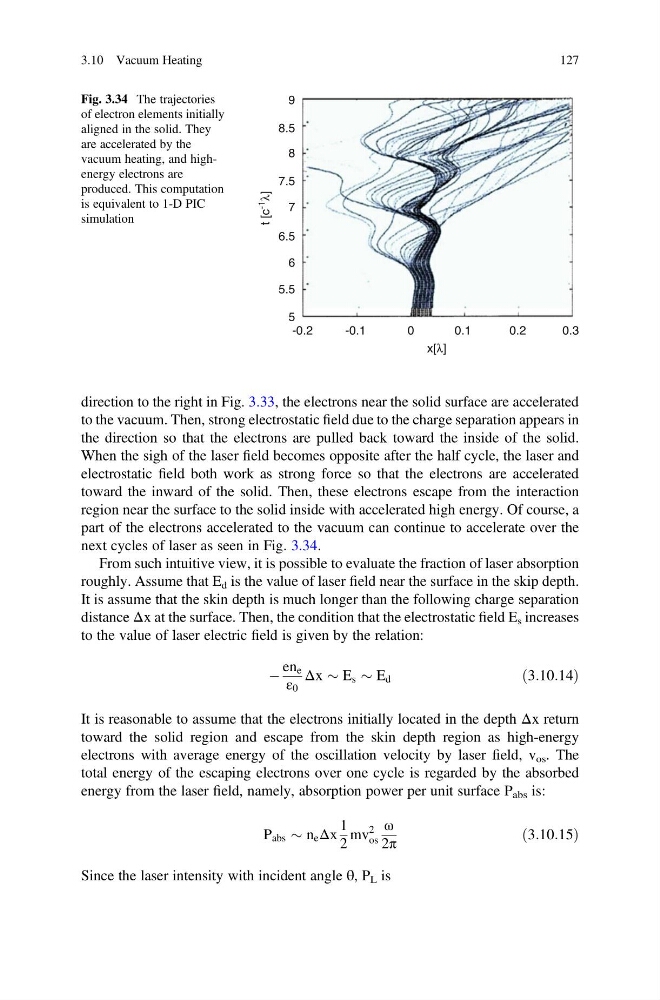
next cycles of laser as seen in Fig. 3.34.
From such intuitive view, it is possible to evaluate the fraction of laser absorption
roughly. Assume that E d is the value of laser field near the surface in the skip depth.
It is assume that the skin depth is much longer than the following charge separation
distance Δx at the surface. Then, the condition that the electrostatic field E s increases
to the value of laser electric field is given by the relation:
À
en e
ε 0
Δx $ E s $ E d
ð3:10:14Þ
It is reasonable to assume that the electrons initially located in the depth Δx return
toward the solid region and escape from the skin depth region as high-energy
electrons with average energy of the oscillation velocity by laser field, v os . The
total energy of the escaping electrons over one cycle is regarded by the absorbed
energy from the laser field, namely, absorption power per unit surface P abs is:
P abs $ n e Δx
1
2
mv
2
os
ω
2π
ð3:10:15Þ
Since the laser intensity with incident angle θ, P L is
9
8.5
8
7.5
7
6.5
6
5
-0.2
-0.1
0
0.1
x[λ]
t [c -1
λ]
0.2
0.3
5.5
Fig. 3.34 The trajectories
of electron elements initially
aligned in the solid. They
are accelerated by the
vacuum heating, and highenergy electrons are
produced. This computation
is equivalent to 1-D PIC
simulation
3.10 Vacuum Heating
127
to the vacuum. Then, strong electrostatic field due to the charge separation appears in
the direction so that the electrons are pulled back toward the inside of the solid.
When the sigh of the laser field becomes opposite after the half cycle, the laser and
electrostatic field both work as strong force so that the electrons are accelerated
toward the inward of the solid. Then, these electrons escape from the interaction
region near the surface to the solid inside with accelerated high energy. Of course, a
part of the electrons accelerated to the vacuum can continue to accelerate over the
next cycles of laser as seen in Fig. 3.34.
From such intuitive view, it is possible to evaluate the fraction of laser absorption
roughly. Assume that E d is the value of laser field near the surface in the skip depth.
It is assume that the skin depth is much longer than the following charge separation
distance Δx at the surface. Then, the condition that the electrostatic field E s increases
to the value of laser electric field is given by the relation:
À
en e
ε 0
Δx $ E s $ E d
ð3:10:14Þ
It is reasonable to assume that the electrons initially located in the depth Δx return
toward the solid region and escape from the skin depth region as high-energy
electrons with average energy of the oscillation velocity by laser field, v os . The
total energy of the escaping electrons over one cycle is regarded by the absorbed
energy from the laser field, namely, absorption power per unit surface P abs is:
P abs $ n e Δx
1
2
mv
2
os
ω
2π
ð3:10:15Þ
Since the laser intensity with incident angle θ, P L is
9
8.5
8
7.5
7
6.5
6
5
-0.2
-0.1
0
0.1
x[λ]
t [c -1
λ]
0.2
0.3
5.5
Fig. 3.34 The trajectories
of electron elements initially
aligned in the solid. They
are accelerated by the
vacuum heating, and highenergy electrons are
produced. This computation
is equivalent to 1-D PIC
simulation
3.10 Vacuum Heating
127