

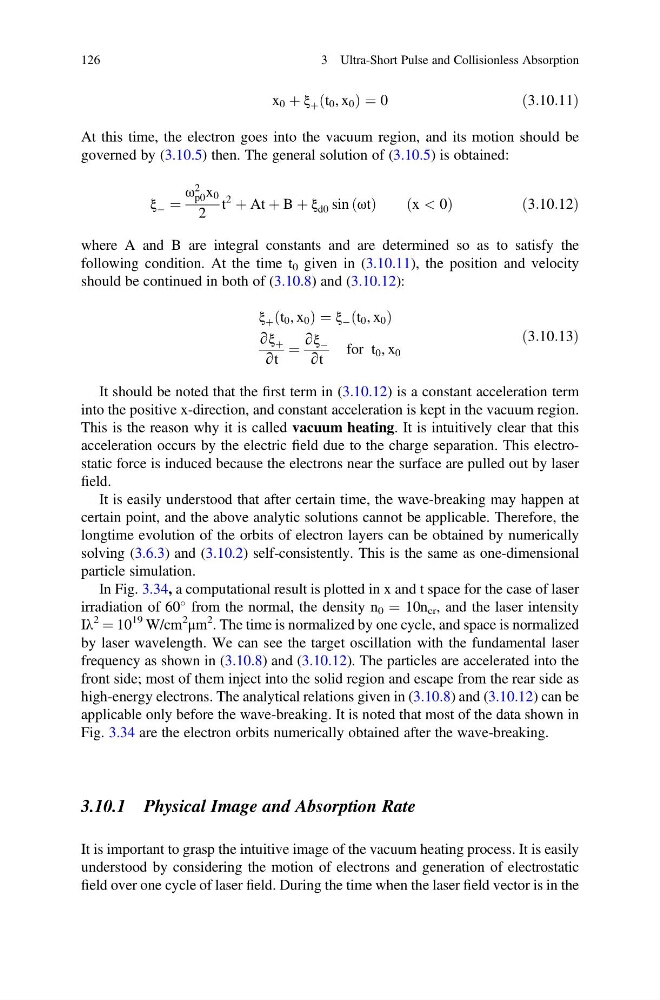
x 0 þ ξ þ t 0 , x 0
ð
Þ¼0
ð3:10:11Þ
At this time, the electron goes into the vacuum region, and its motion should be
governed by (3.10.5) then. The general solution of (3.10.5) is obtained:
ξ À ¼
ω
2
p0 x 0
2
t
2
þ At þ B þ ξ d0 sin ωt
ð Þ
x < 0
ð
Þ
ð3:10:12Þ
where A and B are integral constants and are determined so as to satisfy the
following condition. At the time t 0 given in (3.10.11), the position and velocity
should be continued in both of (3.10.8) and (3.10.12):
ξ þ t 0 , x 0
ð
Þ¼ξ À t 0 , x 0
ð
Þ
∂ξ þ
∂t
¼
∂ξ À
∂t
for t 0 , x 0
ð3:10:13Þ
It should be noted that the first term in (3.10.12) is a constant acceleration term
into the positive x-direction, and constant acceleration is kept in the vacuum region.
This is the reason why it is called vacuum heating. It is intuitively clear that this
acceleration occurs by the electric field due to the charge separation. This electrostatic force is induced because the electrons near the surface are pulled out by laser
field.
It is easily understood that after certain time, the wave-breaking may happen at
certain point, and the above analytic solutions cannot be applicable. Therefore, the
longtime evolution of the orbits of electron layers can be obtained by numerically
solving (3.6.3) and (3.10.2) self-consistently. This is the same as one-dimensional
particle simulation.
In Fig. 3.34, a computational result is plotted in x and t space for the case of laser
irradiation of 60
from the normal, the density n 0 ¼ 10n cr , and the laser intensity
Iλ
2
¼ 10
19 W/cm
2
μm
2 . The time is normalized by one cycle, and space is normalized
by laser wavelength. We can see the target oscillation with the fundamental laser
frequency as shown in (3.10.8) and (3.10.12). The particles are accelerated into the
front side; most of them inject into the solid region and escape from the rear side as
high-energy electrons. The analytical relations given in (3.10.8) and (3.10.12) can be
applicable only before the wave-breaking. It is noted that most of the data shown in
Fig. 3.34 are the electron orbits numerically obtained after the wave-breaking.
3.10.1 Physical Image and Absorption Rate
It is important to grasp the intuitive image of the vacuum heating process. It is easily
understood by considering the motion of electrons and generation of electrostatic
field over one cycle of laser field. During the time when the laser field vector is in the
126
3 Ultra-Short Pulse and Collisionless Absorption
ð
Þ¼0
ð3:10:11Þ
At this time, the electron goes into the vacuum region, and its motion should be
governed by (3.10.5) then. The general solution of (3.10.5) is obtained:
ξ À ¼
ω
2
p0 x 0
2
t
2
þ At þ B þ ξ d0 sin ωt
ð Þ
x < 0
ð
Þ
ð3:10:12Þ
where A and B are integral constants and are determined so as to satisfy the
following condition. At the time t 0 given in (3.10.11), the position and velocity
should be continued in both of (3.10.8) and (3.10.12):
ξ þ t 0 , x 0
ð
Þ¼ξ À t 0 , x 0
ð
Þ
∂ξ þ
∂t
¼
∂ξ À
∂t
for t 0 , x 0
ð3:10:13Þ
It should be noted that the first term in (3.10.12) is a constant acceleration term
into the positive x-direction, and constant acceleration is kept in the vacuum region.
This is the reason why it is called vacuum heating. It is intuitively clear that this
acceleration occurs by the electric field due to the charge separation. This electrostatic force is induced because the electrons near the surface are pulled out by laser
field.
It is easily understood that after certain time, the wave-breaking may happen at
certain point, and the above analytic solutions cannot be applicable. Therefore, the
longtime evolution of the orbits of electron layers can be obtained by numerically
solving (3.6.3) and (3.10.2) self-consistently. This is the same as one-dimensional
particle simulation.
In Fig. 3.34, a computational result is plotted in x and t space for the case of laser
irradiation of 60
from the normal, the density n 0 ¼ 10n cr , and the laser intensity
Iλ
2
¼ 10
19 W/cm
2
μm
2 . The time is normalized by one cycle, and space is normalized
by laser wavelength. We can see the target oscillation with the fundamental laser
frequency as shown in (3.10.8) and (3.10.12). The particles are accelerated into the
front side; most of them inject into the solid region and escape from the rear side as
high-energy electrons. The analytical relations given in (3.10.8) and (3.10.12) can be
applicable only before the wave-breaking. It is noted that most of the data shown in
Fig. 3.34 are the electron orbits numerically obtained after the wave-breaking.
3.10.1 Physical Image and Absorption Rate
It is important to grasp the intuitive image of the vacuum heating process. It is easily
understood by considering the motion of electrons and generation of electrostatic
field over one cycle of laser field. During the time when the laser field vector is in the
126
3 Ultra-Short Pulse and Collisionless Absorption