

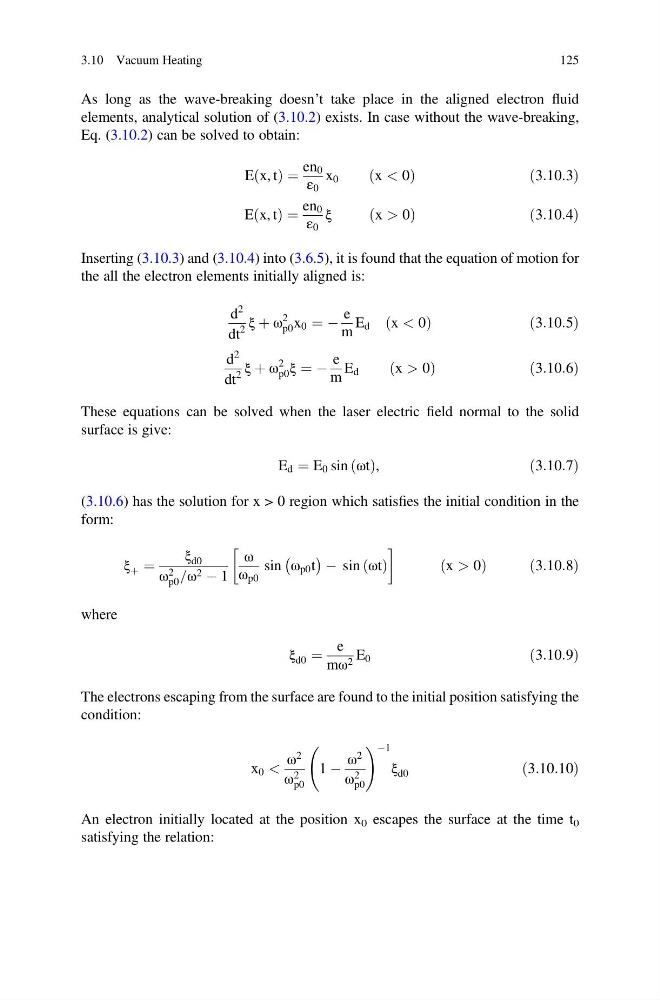
As long as the wave-breaking doesn’t take place in the aligned electron fluid
elements, analytical solution of (3.10.2) exists. In case without the wave-breaking,
Eq. (3.10.2) can be solved to obtain:
E x, t
ð Þ ¼
en 0
ε 0
x 0
x < 0
ð
Þ
ð3:10:3Þ
E x, t
ð Þ ¼
en 0
ε 0
ξ
x > 0
ð
Þ
ð3:10:4Þ
Inserting (3.10.3) and (3.10.4) into (3.6.5), it is found that the equation of motion for
the all the electron elements initially aligned is:
d
2
dt
2
ξ þ ω
2
p0 x 0 ¼ À
e
m
E d x < 0
ð
Þ
ð3:10:5Þ
d
2
dt
2
ξ þ ω
2
p0 ξ ¼ À
e
m
E d
x > 0
ð
Þ
ð3:10:6Þ
These equations can be solved when the laser electric field normal to the solid
surface is give:
E d ¼ E 0 sin ωt
ð Þ,
ð3:10:7Þ
(3.10.6) has the solution for x > 0 region which satisfies the initial condition in the
form:
ξ þ ¼
ξ d0
ω 2
p0 =ω 2 À 1
ω
ω p0
sin ω p0 t
À
Á À sin ωt
ð Þ
!
x > 0
ð
Þ
ð3:10:8Þ
where
ξ d0 ¼
e
mω 2 E 0
ð3:10:9Þ
The electrons escaping from the surface are found to the initial position satisfying the
condition:
x 0 <
ω
2
ω 2
p0
1 À
ω
2
ω 2
p0
! À1
ξ d0
ð3:10:10Þ
An electron initially located at the position x 0 escapes the surface at the time t 0
satisfying the relation:
3.10 Vacuum Heating
125
elements, analytical solution of (3.10.2) exists. In case without the wave-breaking,
Eq. (3.10.2) can be solved to obtain:
E x, t
ð Þ ¼
en 0
ε 0
x 0
x < 0
ð
Þ
ð3:10:3Þ
E x, t
ð Þ ¼
en 0
ε 0
ξ
x > 0
ð
Þ
ð3:10:4Þ
Inserting (3.10.3) and (3.10.4) into (3.6.5), it is found that the equation of motion for
the all the electron elements initially aligned is:
d
2
dt
2
ξ þ ω
2
p0 x 0 ¼ À
e
m
E d x < 0
ð
Þ
ð3:10:5Þ
d
2
dt
2
ξ þ ω
2
p0 ξ ¼ À
e
m
E d
x > 0
ð
Þ
ð3:10:6Þ
These equations can be solved when the laser electric field normal to the solid
surface is give:
E d ¼ E 0 sin ωt
ð Þ,
ð3:10:7Þ
(3.10.6) has the solution for x > 0 region which satisfies the initial condition in the
form:
ξ þ ¼
ξ d0
ω 2
p0 =ω 2 À 1
ω
ω p0
sin ω p0 t
À
Á À sin ωt
ð Þ
!
x > 0
ð
Þ
ð3:10:8Þ
where
ξ d0 ¼
e
mω 2 E 0
ð3:10:9Þ
The electrons escaping from the surface are found to the initial position satisfying the
condition:
x 0 <
ω
2
ω 2
p0
1 À
ω
2
ω 2
p0
! À1
ξ d0
ð3:10:10Þ
An electron initially located at the position x 0 escapes the surface at the time t 0
satisfying the relation:
3.10 Vacuum Heating
125