

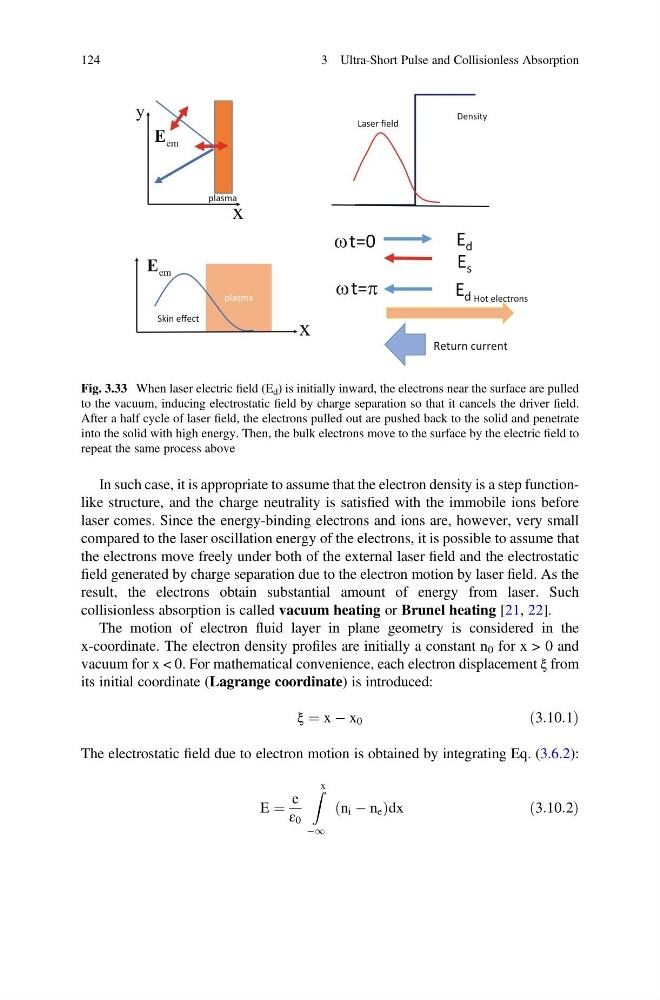
In such case, it is appropriate to assume that the electron density is a step functionlike structure, and the charge neutrality is satisfied with the immobile ions before
laser comes. Since the energy-binding electrons and ions are, however, very small
compared to the laser oscillation energy of the electrons, it is possible to assume that
the electrons move freely under both of the external laser field and the electrostatic
field generated by charge separation due to the electron motion by laser field. As the
result, the electrons obtain substantial amount of energy from laser. Such
collisionless absorption is called vacuum heating or Brunel heating [21, 22].
The motion of electron fluid layer in plane geometry is considered in the
x-coordinate. The electron density profiles are initially a constant n 0 for x > 0 and
vacuum for x < 0. For mathematical convenience, each electron displacement ξ from
its initial coordinate (Lagrange coordinate) is introduced:
ξ ¼ x À x 0
ð3:10:1Þ
The electrostatic field due to electron motion is obtained by integrating Eq. (3.6.2):
E ¼
e
ε 0
Z x
À1
n i À n e
ð
Þdx
ð3:10:2Þ
plasma
em
E
plasma
x
y
x
em
E
Skin effect
ωt=0
E d
E s
E d
ωt=π
Density
Laser field
Hot electrons
Return current
Fig. 3.33 When laser electric field (E d ) is initially inward, the electrons near the surface are pulled
to the vacuum, inducing electrostatic field by charge separation so that it cancels the driver field.
After a half cycle of laser field, the electrons pulled out are pushed back to the solid and penetrate
into the solid with high energy. Then, the bulk electrons move to the surface by the electric field to
repeat the same process above
124
3 Ultra-Short Pulse and Collisionless Absorption
laser comes. Since the energy-binding electrons and ions are, however, very small
compared to the laser oscillation energy of the electrons, it is possible to assume that
the electrons move freely under both of the external laser field and the electrostatic
field generated by charge separation due to the electron motion by laser field. As the
result, the electrons obtain substantial amount of energy from laser. Such
collisionless absorption is called vacuum heating or Brunel heating [21, 22].
The motion of electron fluid layer in plane geometry is considered in the
x-coordinate. The electron density profiles are initially a constant n 0 for x > 0 and
vacuum for x < 0. For mathematical convenience, each electron displacement ξ from
its initial coordinate (Lagrange coordinate) is introduced:
ξ ¼ x À x 0
ð3:10:1Þ
The electrostatic field due to electron motion is obtained by integrating Eq. (3.6.2):
E ¼
e
ε 0
Z x
À1
n i À n e
ð
Þdx
ð3:10:2Þ
plasma
em
E
plasma
x
y
x
em
E
Skin effect
ωt=0
E d
E s
E d
ωt=π
Density
Laser field
Hot electrons
Return current
Fig. 3.33 When laser electric field (E d ) is initially inward, the electrons near the surface are pulled
to the vacuum, inducing electrostatic field by charge separation so that it cancels the driver field.
After a half cycle of laser field, the electrons pulled out are pushed back to the solid and penetrate
into the solid with high energy. Then, the bulk electrons move to the surface by the electric field to
repeat the same process above
124
3 Ultra-Short Pulse and Collisionless Absorption