

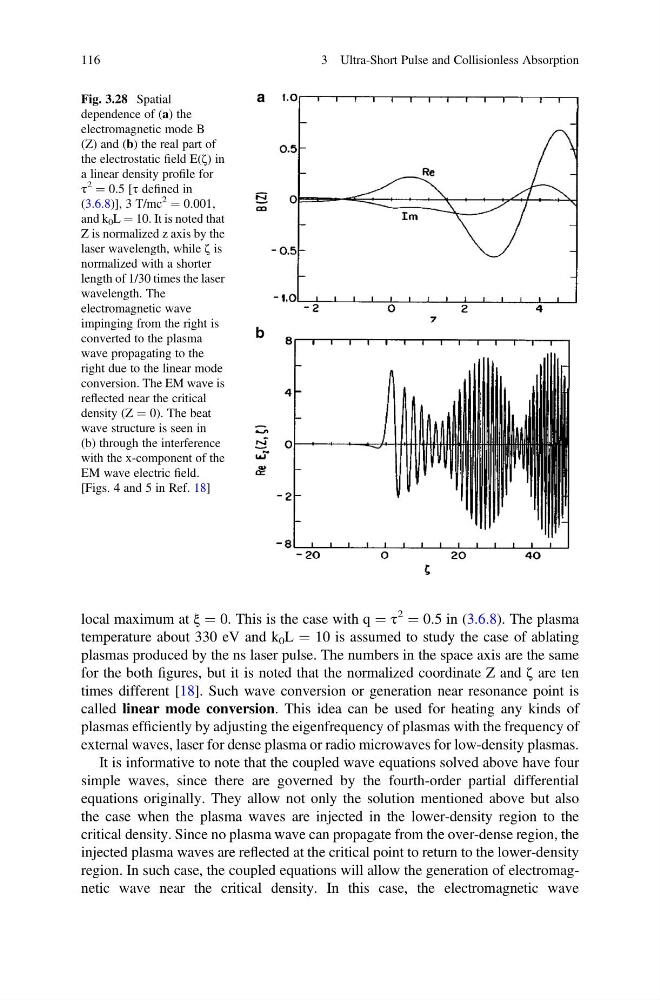
local maximum at ξ ¼ 0. This is the case with q ¼ τ
2
¼ 0.5 in (3.6.8). The plasma
temperature about 330 eV and k 0 L ¼ 10 is assumed to study the case of ablating
plasmas produced by the ns laser pulse. The numbers in the space axis are the same
for the both figures, but it is noted that the normalized coordinate Z and ζ are ten
times different [18]. Such wave conversion or generation near resonance point is
called linear mode conversion. This idea can be used for heating any kinds of
plasmas efficiently by adjusting the eigenfrequency of plasmas with the frequency of
external waves, laser for dense plasma or radio microwaves for low-density plasmas.
It is informative to note that the coupled wave equations solved above have four
simple waves, since there are governed by the fourth-order partial differential
equations originally. They allow not only the solution mentioned above but also
the case when the plasma waves are injected in the lower-density region to the
critical density. Since no plasma wave can propagate from the over-dense region, the
injected plasma waves are reflected at the critical point to return to the lower-density
region. In such case, the coupled equations will allow the generation of electromagnetic wave near the critical density. In this case, the electromagnetic wave
Fig. 3.28 Spatial
dependence of (a) the
electromagnetic mode B
(Z) and (b) the real part of
the electrostatic field E(ζ) in
a linear density profile for
τ
2 ¼ 0.5 [τ defined in
(3.6.8)], 3 T/mc
2 ¼ 0.001,
and k 0 L ¼ 10. It is noted that
Z is normalized z axis by the
laser wavelength, while ζ is
normalized with a shorter
length of 1/30 times the laser
wavelength. The
electromagnetic wave
impinging from the right is
converted to the plasma
wave propagating to the
right due to the linear mode
conversion. The EM wave is
reflected near the critical
density (Z ¼ 0). The beat
wave structure is seen in
(b) through the interference
with the x-component of the
EM wave electric field.
[Figs. 4 and 5 in Ref. 18]
116
3 Ultra-Short Pulse and Collisionless Absorption
2
¼ 0.5 in (3.6.8). The plasma
temperature about 330 eV and k 0 L ¼ 10 is assumed to study the case of ablating
plasmas produced by the ns laser pulse. The numbers in the space axis are the same
for the both figures, but it is noted that the normalized coordinate Z and ζ are ten
times different [18]. Such wave conversion or generation near resonance point is
called linear mode conversion. This idea can be used for heating any kinds of
plasmas efficiently by adjusting the eigenfrequency of plasmas with the frequency of
external waves, laser for dense plasma or radio microwaves for low-density plasmas.
It is informative to note that the coupled wave equations solved above have four
simple waves, since there are governed by the fourth-order partial differential
equations originally. They allow not only the solution mentioned above but also
the case when the plasma waves are injected in the lower-density region to the
critical density. Since no plasma wave can propagate from the over-dense region, the
injected plasma waves are reflected at the critical point to return to the lower-density
region. In such case, the coupled equations will allow the generation of electromagnetic wave near the critical density. In this case, the electromagnetic wave
Fig. 3.28 Spatial
dependence of (a) the
electromagnetic mode B
(Z) and (b) the real part of
the electrostatic field E(ζ) in
a linear density profile for
τ
2 ¼ 0.5 [τ defined in
(3.6.8)], 3 T/mc
2 ¼ 0.001,
and k 0 L ¼ 10. It is noted that
Z is normalized z axis by the
laser wavelength, while ζ is
normalized with a shorter
length of 1/30 times the laser
wavelength. The
electromagnetic wave
impinging from the right is
converted to the plasma
wave propagating to the
right due to the linear mode
conversion. The EM wave is
reflected near the critical
density (Z ¼ 0). The beat
wave structure is seen in
(b) through the interference
with the x-component of the
EM wave electric field.
[Figs. 4 and 5 in Ref. 18]
116
3 Ultra-Short Pulse and Collisionless Absorption