

critical point by 180
means there should be real part of hE Á ji. In the limit of no
dissipation, the phase changes like a step function, and the velocity given by y in
(3.7.3) becomes delta function. Then, integrating in space, the total hE Á ji is given in
the form (3.7.3).
3.8 Linear Mode Conversion in Resonance Absorption
As shown in Fig. 3.23, the electron plasma waves can propagate in plasmas with
finite temperature (v e > 0). This fact means the plasma waves dominantly generated
near the critical density propagate to the lower density region, and the electron
oscillation energy given by the resonance is carried toward the low-density plasmas.
Then, it is possible to assume stationary oscillating solutions in solving (2.2.10) for
laser field and (3.5.10) with external current by laser field on RHS. This is the fourthorder differential equations, and the solutions are obtained numerically. The basic
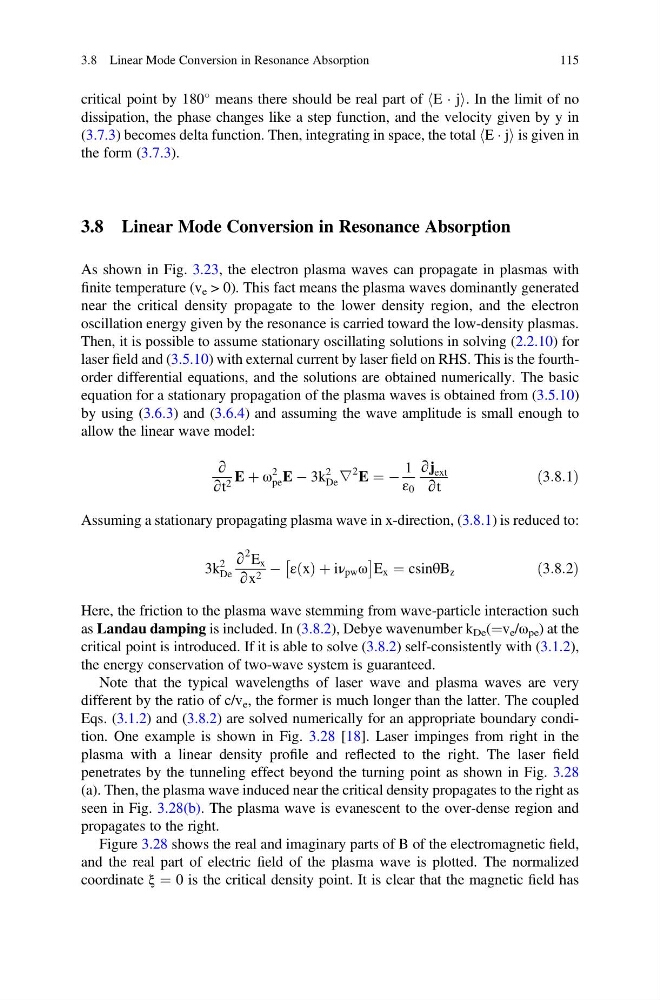
equation for a stationary propagation of the plasma waves is obtained from (3.5.10)
by using (3.6.3) and (3.6.4) and assuming the wave amplitude is small enough to
allow the linear wave model:
∂
∂t 2 E þ ω
2
pe E À 3k
2
De ∇
2 E ¼ À
1
ε 0
∂j ext
∂t
ð3:8:1Þ
Assuming a stationary propagating plasma wave in x-direction, (3.8.1) is reduced to:
3k
2
De
∂
2 E x
∂x 2 À ε x
ð Þ þ iν pw ω
Â
Ã
E x ¼ csinθB z
ð3:8:2Þ
Here, the friction to the plasma wave stemming from wave-particle interaction such
as Landau damping is included. In (3.8.2), Debye wavenumber k De (¼v e /ω pe ) at the
critical point is introduced. If it is able to solve (3.8.2) self-consistently with (3.1.2),
the energy conservation of two-wave system is guaranteed.
Note that the typical wavelengths of laser wave and plasma waves are very
different by the ratio of c/v e , the former is much longer than the latter. The coupled
Eqs. (3.1.2) and (3.8.2) are solved numerically for an appropriate boundary condition. One example is shown in Fig. 3.28 [18]. Laser impinges from right in the
plasma with a linear density profile and reflected to the right. The laser field
penetrates by the tunneling effect beyond the turning point as shown in Fig. 3.28
(a). Then, the plasma wave induced near the critical density propagates to the right as
seen in Fig. 3.28(b). The plasma wave is evanescent to the over-dense region and
propagates to the right.
Figure 3.28 shows the real and imaginary parts of B of the electromagnetic field,
and the real part of electric field of the plasma wave is plotted. The normalized
coordinate ξ ¼ 0 is the critical density point. It is clear that the magnetic field has
3.8 Linear Mode Conversion in Resonance Absorption
115
means there should be real part of hE Á ji. In the limit of no
dissipation, the phase changes like a step function, and the velocity given by y in
(3.7.3) becomes delta function. Then, integrating in space, the total hE Á ji is given in
the form (3.7.3).
3.8 Linear Mode Conversion in Resonance Absorption
As shown in Fig. 3.23, the electron plasma waves can propagate in plasmas with
finite temperature (v e > 0). This fact means the plasma waves dominantly generated
near the critical density propagate to the lower density region, and the electron
oscillation energy given by the resonance is carried toward the low-density plasmas.
Then, it is possible to assume stationary oscillating solutions in solving (2.2.10) for
laser field and (3.5.10) with external current by laser field on RHS. This is the fourthorder differential equations, and the solutions are obtained numerically. The basic
equation for a stationary propagation of the plasma waves is obtained from (3.5.10)
by using (3.6.3) and (3.6.4) and assuming the wave amplitude is small enough to
allow the linear wave model:
∂
∂t 2 E þ ω
2
pe E À 3k
2
De ∇
2 E ¼ À
1
ε 0
∂j ext
∂t
ð3:8:1Þ
Assuming a stationary propagating plasma wave in x-direction, (3.8.1) is reduced to:
3k
2
De
∂
2 E x
∂x 2 À ε x
ð Þ þ iν pw ω
Â
Ã
E x ¼ csinθB z
ð3:8:2Þ
Here, the friction to the plasma wave stemming from wave-particle interaction such
as Landau damping is included. In (3.8.2), Debye wavenumber k De (¼v e /ω pe ) at the
critical point is introduced. If it is able to solve (3.8.2) self-consistently with (3.1.2),
the energy conservation of two-wave system is guaranteed.
Note that the typical wavelengths of laser wave and plasma waves are very
different by the ratio of c/v e , the former is much longer than the latter. The coupled
Eqs. (3.1.2) and (3.8.2) are solved numerically for an appropriate boundary condition. One example is shown in Fig. 3.28 [18]. Laser impinges from right in the
plasma with a linear density profile and reflected to the right. The laser field
penetrates by the tunneling effect beyond the turning point as shown in Fig. 3.28
(a). Then, the plasma wave induced near the critical density propagates to the right as
seen in Fig. 3.28(b). The plasma wave is evanescent to the over-dense region and
propagates to the right.
Figure 3.28 shows the real and imaginary parts of B of the electromagnetic field,
and the real part of electric field of the plasma wave is plotted. The normalized
coordinate ξ ¼ 0 is the critical density point. It is clear that the magnetic field has
3.8 Linear Mode Conversion in Resonance Absorption
115