

and it is expected that high amplitude electrostatic fields are generated around the
critical density.
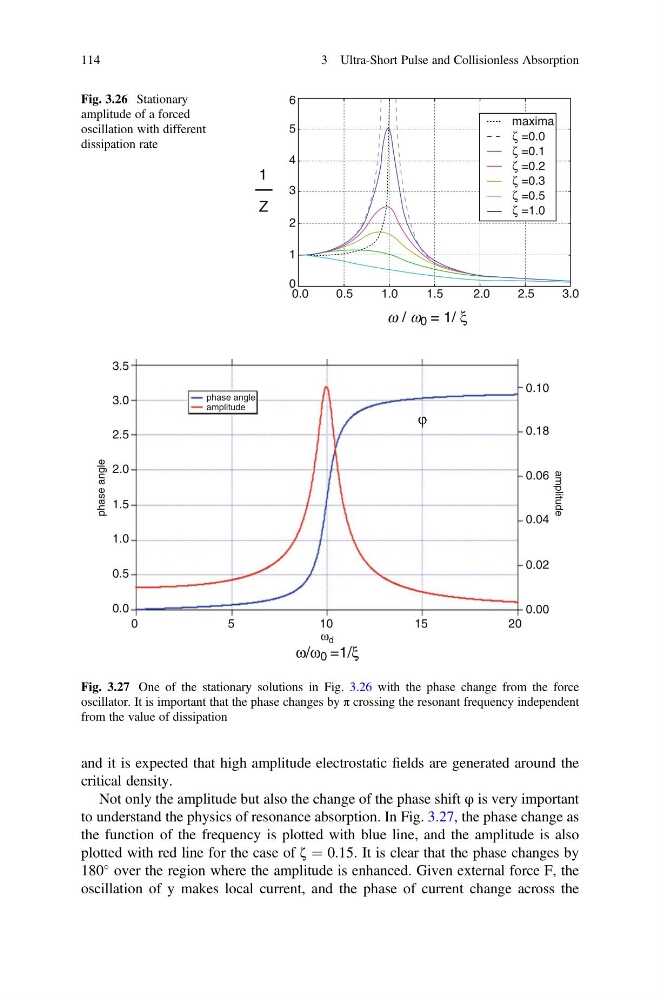
Not only the amplitude but also the change of the phase shift φ is very important
to understand the physics of resonance absorption. In Fig. 3.27, the phase change as
the function of the frequency is plotted with blue line, and the amplitude is also
plotted with red line for the case of ζ ¼ 0.15. It is clear that the phase changes by
180
over the region where the amplitude is enhanced. Given external force F, the
oscillation of y makes local current, and the phase of current change across the
0.0
1
Z
0
1
2
3
4
maxima
ζ =0.0
ζ =0.1
ζ =0.2
ζ =0.3
ζ =0.5
ζ =1.0
ω / ω 0 = 1/ ξ
5
6
0.5
1.0
1.5
2.0
2.5
3.0
Fig. 3.26 Stationary
amplitude of a forced
oscillation with different
dissipation rate
3.5
phase angle
phase angle
amplitude
amplitude
0.10
0.18
0.06
0.04
0.02
0.00
3.0
2.5
2.0
1.5
1.0
0.5
0.0
0
5
1 0
ω/ω 0 =1/ξ
ω d
15
ϕ
20
Fig. 3.27 One of the stationary solutions in Fig. 3.26 with the phase change from the force
oscillator. It is important that the phase changes by π crossing the resonant frequency independent
from the value of dissipation
114
3 Ultra-Short Pulse and Collisionless Absorption
critical density.
Not only the amplitude but also the change of the phase shift φ is very important
to understand the physics of resonance absorption. In Fig. 3.27, the phase change as
the function of the frequency is plotted with blue line, and the amplitude is also
plotted with red line for the case of ζ ¼ 0.15. It is clear that the phase changes by
180
over the region where the amplitude is enhanced. Given external force F, the
oscillation of y makes local current, and the phase of current change across the
0.0
1
Z
0
1
2
3
4
maxima
ζ =0.0
ζ =0.1
ζ =0.2
ζ =0.3
ζ =0.5
ζ =1.0
ω / ω 0 = 1/ ξ
5
6
0.5
1.0
1.5
2.0
2.5
3.0
Fig. 3.26 Stationary
amplitude of a forced
oscillation with different
dissipation rate
3.5
phase angle
phase angle
amplitude
amplitude
0.10
0.18
0.06
0.04
0.02
0.00
3.0
2.5
2.0
1.5
1.0
0.5
0.0
0
5
1 0
ω/ω 0 =1/ξ
ω d
15
ϕ
20
Fig. 3.27 One of the stationary solutions in Fig. 3.26 with the phase change from the force
oscillator. It is important that the phase changes by π crossing the resonant frequency independent
from the value of dissipation
114
3 Ultra-Short Pulse and Collisionless Absorption