

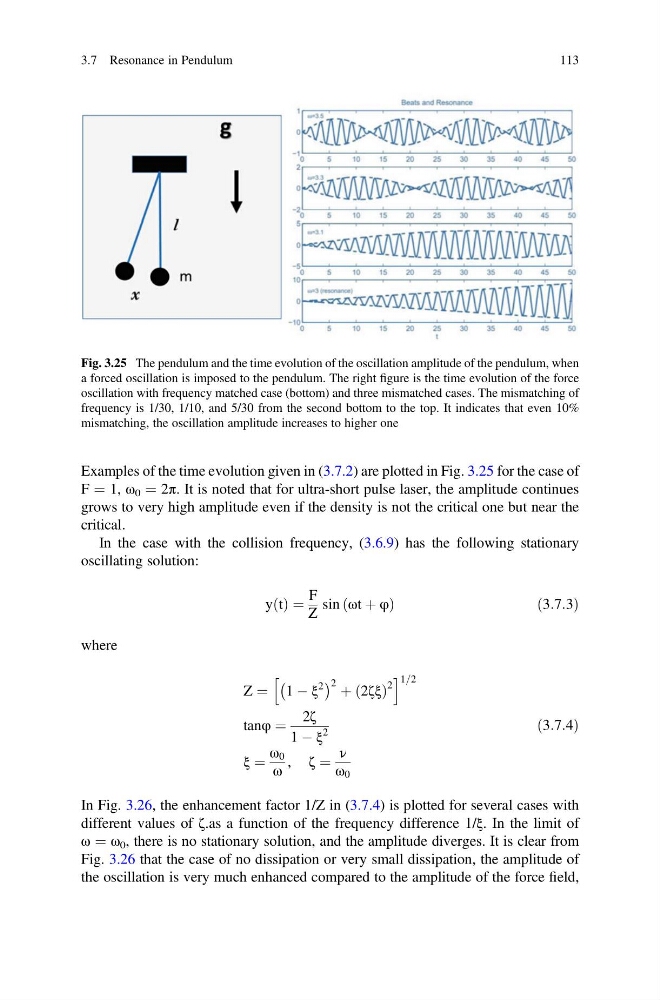
Examples of the time evolution given in (3.7.2) are plotted in Fig. 3.25 for the case of
F ¼ 1, ω 0 ¼ 2π. It is noted that for ultra-short pulse laser, the amplitude continues
grows to very high amplitude even if the density is not the critical one but near the
critical.
In the case with the collision frequency, (3.6.9) has the following stationary
oscillating solution:
y t
ð Þ ¼
F
Z
sin ωt þ φ
ð
Þ
ð3:7:3Þ
where
Z ¼ 1 À ξ
2
À
Á 2 þ 2ζξ
ð Þ
2
h
i 1=2
tanφ ¼
2ζ
1 À ξ
2
ξ ¼
ω 0
ω
, ζ ¼
ν
ω 0
ð3:7:4Þ
In Fig. 3.26, the enhancement factor 1/Z in (3.7.4) is plotted for several cases with
different values of ζ.as a function of the frequency difference 1/ξ. In the limit of
ω ¼ ω 0 , there is no stationary solution, and the amplitude diverges. It is clear from
Fig. 3.26 that the case of no dissipation or very small dissipation, the amplitude of
the oscillation is very much enhanced compared to the amplitude of the force field,
Fig. 3.25 The pendulum and the time evolution of the oscillation amplitude of the pendulum, when
a forced oscillation is imposed to the pendulum. The right figure is the time evolution of the force
oscillation with frequency matched case (bottom) and three mismatched cases. The mismatching of
frequency is 1/30, 1/10, and 5/30 from the second bottom to the top. It indicates that even 10%
mismatching, the oscillation amplitude increases to higher one
3.7 Resonance in Pendulum
113
F ¼ 1, ω 0 ¼ 2π. It is noted that for ultra-short pulse laser, the amplitude continues
grows to very high amplitude even if the density is not the critical one but near the
critical.
In the case with the collision frequency, (3.6.9) has the following stationary
oscillating solution:
y t
ð Þ ¼
F
Z
sin ωt þ φ
ð
Þ
ð3:7:3Þ
where
Z ¼ 1 À ξ
2
À
Á 2 þ 2ζξ
ð Þ
2
h
i 1=2
tanφ ¼
2ζ
1 À ξ
2
ξ ¼
ω 0
ω
, ζ ¼
ν
ω 0
ð3:7:4Þ
In Fig. 3.26, the enhancement factor 1/Z in (3.7.4) is plotted for several cases with
different values of ζ.as a function of the frequency difference 1/ξ. In the limit of
ω ¼ ω 0 , there is no stationary solution, and the amplitude diverges. It is clear from
Fig. 3.26 that the case of no dissipation or very small dissipation, the amplitude of
the oscillation is very much enhanced compared to the amplitude of the force field,
Fig. 3.25 The pendulum and the time evolution of the oscillation amplitude of the pendulum, when
a forced oscillation is imposed to the pendulum. The right figure is the time evolution of the force
oscillation with frequency matched case (bottom) and three mismatched cases. The mismatching of
frequency is 1/30, 1/10, and 5/30 from the second bottom to the top. It indicates that even 10%
mismatching, the oscillation amplitude increases to higher one
3.7 Resonance in Pendulum
113