

Z 1
À1
f x
ð Þ
x À x 0
dx ¼ P
Z 1
À1
f x
ð Þ
x À x 0
dx þ iSπf x 0
ð Þ
ð3:6:16Þ
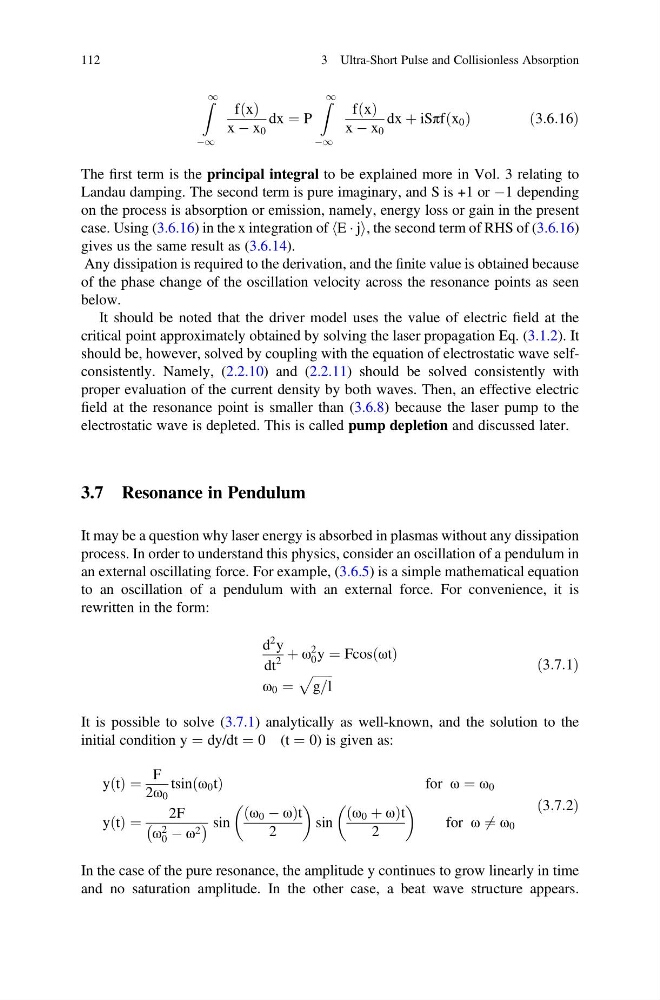
The first term is the principal integral to be explained more in Vol. 3 relating to
Landau damping. The second term is pure imaginary, and S is +1 or À1 depending
on the process is absorption or emission, namely, energy loss or gain in the present
case. Using (3.6.16) in the x integration of hE Á ji, the second term of RHS of (3.6.16)
gives us the same result as (3.6.14).
Any dissipation is required to the derivation, and the finite value is obtained because
of the phase change of the oscillation velocity across the resonance points as seen
below.
It should be noted that the driver model uses the value of electric field at the
critical point approximately obtained by solving the laser propagation Eq. (3.1.2). It
should be, however, solved by coupling with the equation of electrostatic wave selfconsistently. Namely, (2.2.10) and (2.2.11) should be solved consistently with
proper evaluation of the current density by both waves. Then, an effective electric
field at the resonance point is smaller than (3.6.8) because the laser pump to the
electrostatic wave is depleted. This is called pump depletion and discussed later.
3.7 Resonance in Pendulum
It may be a question why laser energy is absorbed in plasmas without any dissipation
process. In order to understand this physics, consider an oscillation of a pendulum in
an external oscillating force. For example, (3.6.5) is a simple mathematical equation
to an oscillation of a pendulum with an external force. For convenience, it is
rewritten in the form:
d
2 y
dt
2
þ ω
2
0 y ¼ Fcos ωt
ð Þ
ω 0 ¼
ffiffiffiffiffiffi ffi
g=l
p
ð3:7:1Þ
It is possible to solve (3.7.1) analytically as well-known, and the solution to the
initial condition y ¼ dy/dt ¼ 0 (t ¼ 0) is given as:
y t
ð Þ ¼
F
2ω 0
tsin ω 0 t
ð Þ
for ω ¼ ω 0
y t
ð Þ ¼
2F
ω 2
0 À ω 2
À
Ásin
ω 0 À ω
ð
Þt
2
sin
ω 0 þ ω
ð
Þt
2
for ω 6 ¼ ω 0
ð3:7:2Þ
In the case of the pure resonance, the amplitude y continues to grow linearly in time
and no saturation amplitude. In the other case, a beat wave structure appears.
112
3 Ultra-Short Pulse and Collisionless Absorption
À1
f x
ð Þ
x À x 0
dx ¼ P
Z 1
À1
f x
ð Þ
x À x 0
dx þ iSπf x 0
ð Þ
ð3:6:16Þ
The first term is the principal integral to be explained more in Vol. 3 relating to
Landau damping. The second term is pure imaginary, and S is +1 or À1 depending
on the process is absorption or emission, namely, energy loss or gain in the present
case. Using (3.6.16) in the x integration of hE Á ji, the second term of RHS of (3.6.16)
gives us the same result as (3.6.14).
Any dissipation is required to the derivation, and the finite value is obtained because
of the phase change of the oscillation velocity across the resonance points as seen
below.
It should be noted that the driver model uses the value of electric field at the
critical point approximately obtained by solving the laser propagation Eq. (3.1.2). It
should be, however, solved by coupling with the equation of electrostatic wave selfconsistently. Namely, (2.2.10) and (2.2.11) should be solved consistently with
proper evaluation of the current density by both waves. Then, an effective electric
field at the resonance point is smaller than (3.6.8) because the laser pump to the
electrostatic wave is depleted. This is called pump depletion and discussed later.
3.7 Resonance in Pendulum
It may be a question why laser energy is absorbed in plasmas without any dissipation
process. In order to understand this physics, consider an oscillation of a pendulum in
an external oscillating force. For example, (3.6.5) is a simple mathematical equation
to an oscillation of a pendulum with an external force. For convenience, it is
rewritten in the form:
d
2 y
dt
2
þ ω
2
0 y ¼ Fcos ωt
ð Þ
ω 0 ¼
ffiffiffiffiffiffi ffi
g=l
p
ð3:7:1Þ
It is possible to solve (3.7.1) analytically as well-known, and the solution to the
initial condition y ¼ dy/dt ¼ 0 (t ¼ 0) is given as:
y t
ð Þ ¼
F
2ω 0
tsin ω 0 t
ð Þ
for ω ¼ ω 0
y t
ð Þ ¼
2F
ω 2
0 À ω 2
À
Ásin
ω 0 À ω
ð
Þt
2
sin
ω 0 þ ω
ð
Þt
2
for ω 6 ¼ ω 0
ð3:7:2Þ
In the case of the pure resonance, the amplitude y continues to grow linearly in time
and no saturation amplitude. In the other case, a beat wave structure appears.
112
3 Ultra-Short Pulse and Collisionless Absorption