

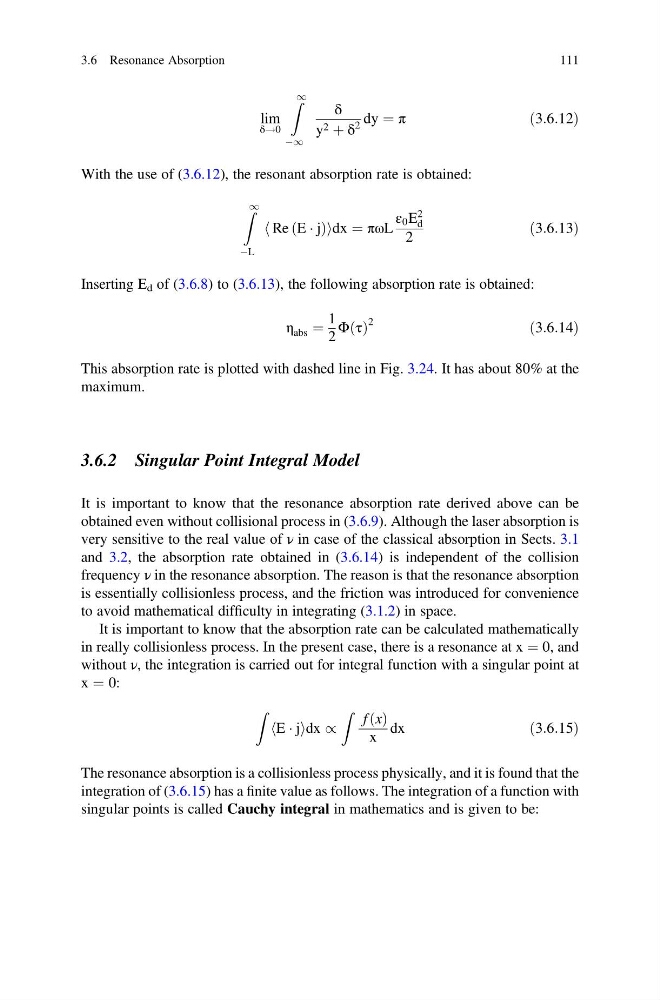
lim
δ!0
Z 1
À1
δ
y 2 þ δ
2
dy ¼ π
ð3:6:12Þ
With the use of (3.6.12), the resonant absorption rate is obtained:
Z 1
ÀL
Re E Á j
ð
Þ
h
i dx ¼ πωL
ε 0 E
2
d
2
ð3:6:13Þ
Inserting E d of (3.6.8) to (3.6.13), the following absorption rate is obtained:
η abs ¼
1
2
Φ τ
ð Þ
2
ð3:6:14Þ
This absorption rate is plotted with dashed line in Fig. 3.24. It has about 80% at the
maximum.
3.6.2 Singular Point Integral Model
It is important to know that the resonance absorption rate derived above can be
obtained even without collisional process in (3.6.9). Although the laser absorption is
very sensitive to the real value of ν in case of the classical absorption in Sects. 3.1
and 3.2, the absorption rate obtained in (3.6.14) is independent of the collision
frequency ν in the resonance absorption. The reason is that the resonance absorption
is essentially collisionless process, and the friction was introduced for convenience
to avoid mathematical difficulty in integrating (3.1.2) in space.
It is important to know that the absorption rate can be calculated mathematically
in really collisionless process. In the present case, there is a resonance at x ¼ 0, and
without ν, the integration is carried out for integral function with a singular point at
x ¼ 0:
Z
E Á j
h
idx /
Z
f x
ð Þ
x
dx
ð3:6:15Þ
The resonance absorption is a collisionless process physically, and it is found that the
integration of (3.6.15) has a finite value as follows. The integration of a function with
singular points is called Cauchy integral in mathematics and is given to be:
3.6 Resonance Absorption
111
δ!0
Z 1
À1
δ
y 2 þ δ
2
dy ¼ π
ð3:6:12Þ
With the use of (3.6.12), the resonant absorption rate is obtained:
Z 1
ÀL
Re E Á j
ð
Þ
h
i dx ¼ πωL
ε 0 E
2
d
2
ð3:6:13Þ
Inserting E d of (3.6.8) to (3.6.13), the following absorption rate is obtained:
η abs ¼
1
2
Φ τ
ð Þ
2
ð3:6:14Þ
This absorption rate is plotted with dashed line in Fig. 3.24. It has about 80% at the
maximum.
3.6.2 Singular Point Integral Model
It is important to know that the resonance absorption rate derived above can be
obtained even without collisional process in (3.6.9). Although the laser absorption is
very sensitive to the real value of ν in case of the classical absorption in Sects. 3.1
and 3.2, the absorption rate obtained in (3.6.14) is independent of the collision
frequency ν in the resonance absorption. The reason is that the resonance absorption
is essentially collisionless process, and the friction was introduced for convenience
to avoid mathematical difficulty in integrating (3.1.2) in space.
It is important to know that the absorption rate can be calculated mathematically
in really collisionless process. In the present case, there is a resonance at x ¼ 0, and
without ν, the integration is carried out for integral function with a singular point at
x ¼ 0:
Z
E Á j
h
idx /
Z
f x
ð Þ
x
dx
ð3:6:15Þ
The resonance absorption is a collisionless process physically, and it is found that the
integration of (3.6.15) has a finite value as follows. The integration of a function with
singular points is called Cauchy integral in mathematics and is given to be:
3.6 Resonance Absorption
111