

finite incident angle. In case of glass laser, it is about 0.1μm and may be possible to
obtain such density scale length in sub-picosecond laser irradiation. However, it may
be difficult to expect such density steepening within the driven hydrodynamic
expansion of plasmas in the case of relatively long ns laser pulse. It will be explained
that in such case, the laser pressure helps to keep steepened density profiled near the
critical point, and substantial driver field is obtained.
It is noted that the driver field (3.6.5) is directly proportional to the magnetic field
at the critical point, and the laser field induces the plasma oscillation by the
electrostatic field. Through this process, the laser energy is transferred to the plasma
wave oscillation energy. Such physical process is called resonance absorption. In
order to estimate laser absorption rate by the resonant absorption, we have the
following three different ways with different physical models. Such consideration
is widely used in many cases.
3.6.1 Collisional Absorption Model
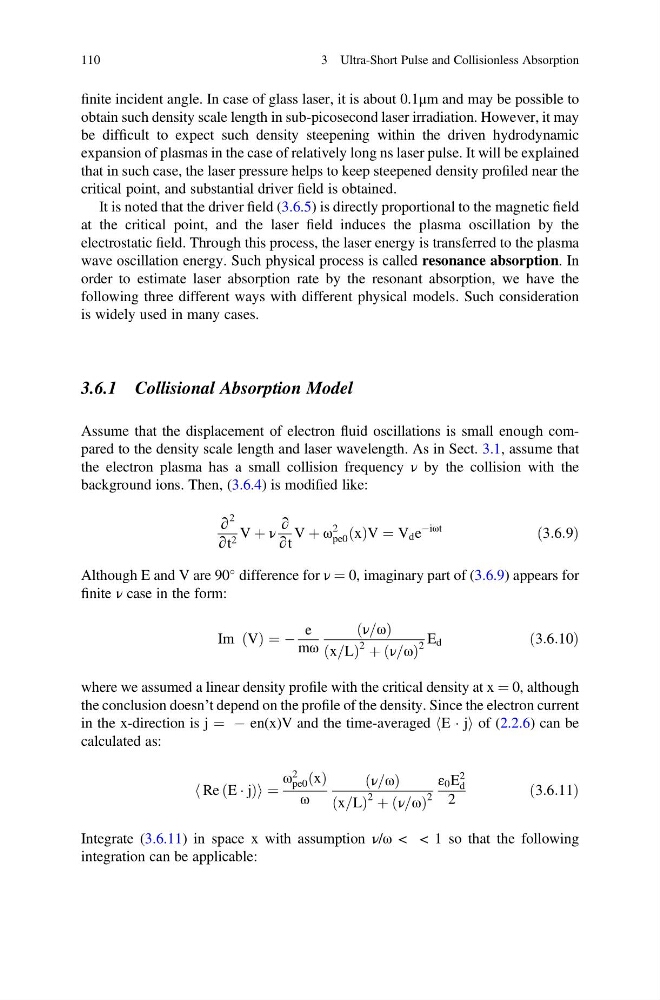
Assume that the displacement of electron fluid oscillations is small enough compared to the density scale length and laser wavelength. As in Sect. 3.1, assume that
the electron plasma has a small collision frequency ν by the collision with the
background ions. Then, (3.6.4) is modified like:
∂
2
∂t 2 V þ ν
∂
∂t
V þ ω
2
pe0 x
ð ÞV ¼ V d e
Àiωt
ð3:6:9Þ
Although E and V are 90
difference for ν ¼ 0, imaginary part of (3.6.9) appears for
finite ν case in the form:
Im V
ð Þ ¼ À
e
mω
ν=ω
ð
Þ
x=L
ð
Þ
2 þ ν=ω
ð
Þ
2
E d
ð3:6:10Þ
where we assumed a linear density profile with the critical density at x ¼ 0, although
the conclusion doesn’t depend on the profile of the density. Since the electron current
in the x-direction is j ¼ À en(x)V and the time-averaged hE Á ji of (2.2.6) can be
calculated as:
Re E Á j
ð
Þ
h
i¼
ω
2
pe0 x
ð Þ
ω
ν=ω
ð
Þ
x=L
ð
Þ
2 þ ν=ω
ð
Þ
2
ε 0 E
2
d
2
ð3:6:11Þ
Integrate (3.6.11) in space x with assumption ν/ω < < 1 so that the following
integration can be applicable:
110
3 Ultra-Short Pulse and Collisionless Absorption
obtain such density scale length in sub-picosecond laser irradiation. However, it may
be difficult to expect such density steepening within the driven hydrodynamic
expansion of plasmas in the case of relatively long ns laser pulse. It will be explained
that in such case, the laser pressure helps to keep steepened density profiled near the
critical point, and substantial driver field is obtained.
It is noted that the driver field (3.6.5) is directly proportional to the magnetic field
at the critical point, and the laser field induces the plasma oscillation by the
electrostatic field. Through this process, the laser energy is transferred to the plasma
wave oscillation energy. Such physical process is called resonance absorption. In
order to estimate laser absorption rate by the resonant absorption, we have the
following three different ways with different physical models. Such consideration
is widely used in many cases.
3.6.1 Collisional Absorption Model
Assume that the displacement of electron fluid oscillations is small enough compared to the density scale length and laser wavelength. As in Sect. 3.1, assume that
the electron plasma has a small collision frequency ν by the collision with the
background ions. Then, (3.6.4) is modified like:
∂
2
∂t 2 V þ ν
∂
∂t
V þ ω
2
pe0 x
ð ÞV ¼ V d e
Àiωt
ð3:6:9Þ
Although E and V are 90
difference for ν ¼ 0, imaginary part of (3.6.9) appears for
finite ν case in the form:
Im V
ð Þ ¼ À
e
mω
ν=ω
ð
Þ
x=L
ð
Þ
2 þ ν=ω
ð
Þ
2
E d
ð3:6:10Þ
where we assumed a linear density profile with the critical density at x ¼ 0, although
the conclusion doesn’t depend on the profile of the density. Since the electron current
in the x-direction is j ¼ À en(x)V and the time-averaged hE Á ji of (2.2.6) can be
calculated as:
Re E Á j
ð
Þ
h
i¼
ω
2
pe0 x
ð Þ
ω
ν=ω
ð
Þ
x=L
ð
Þ
2 þ ν=ω
ð
Þ
2
ε 0 E
2
d
2
ð3:6:11Þ
Integrate (3.6.11) in space x with assumption ν/ω < < 1 so that the following
integration can be applicable:
110
3 Ultra-Short Pulse and Collisionless Absorption