

penetrates to the critical density by the tunneling effect after the turning point (3.1.3).
And the electric field oscillates the electron, and charge separation appears since the
density is inhomogeneous in x-direction. Due to the resonance at the cutoff point, the
induced electrostatic field is enhanced, and large amplitude current is induced to
increase the hj Á Ei term in (2.2.2). In the case of s-polarization, there is no
x-component of the laser electric field in the plasmas, and no resonance is induced.
In order to study the energy conversion rate from laser to the plasma waves, a
driver model is usually assumed. In this model, the x-component of laser field is
calculated by solving (3.1.2) approximately, and its value at the critical point is used
to solve the induction of the plasma oscillation around the critical point. Given the
strength of laser field at the critical point, the electrostatic field E in the x-direction
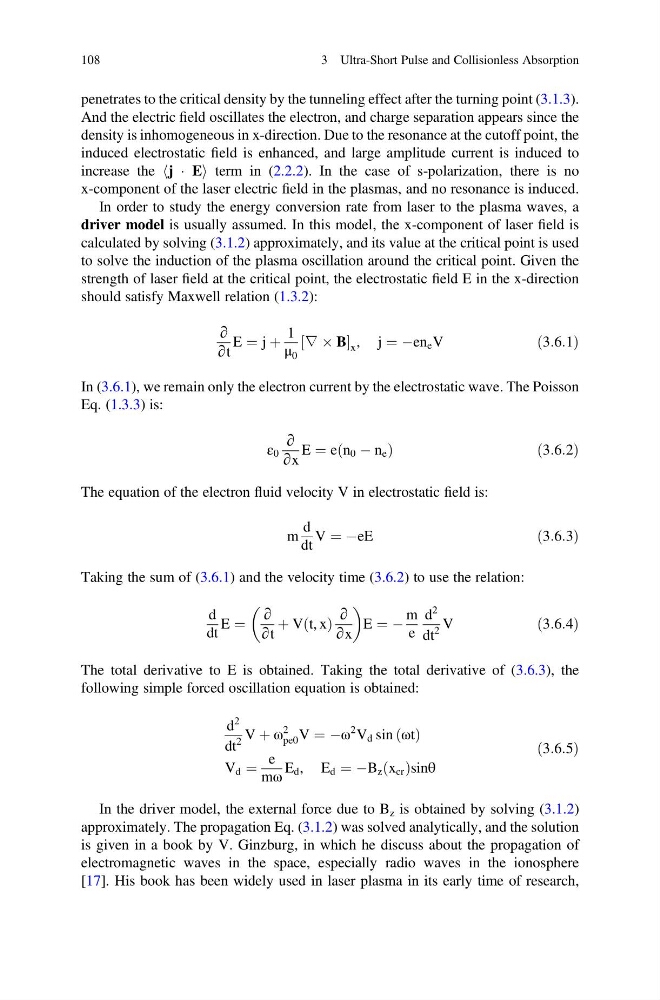
should satisfy Maxwell relation (1.3.2):
∂
∂t
E ¼ j þ
1
μ 0
∇ Â B
½
x , j ¼ Àen e V
ð3:6:1Þ
In (3.6.1), we remain only the electron current by the electrostatic wave. The Poisson
Eq. (1.3.3) is:
ε 0
∂
∂x
E ¼ e n 0 À n e
ð
Þ
ð3:6:2Þ
The equation of the electron fluid velocity V in electrostatic field is:
m
d
dt
V ¼ ÀeE
ð3:6:3Þ
Taking the sum of (3.6.1) and the velocity time (3.6.2) to use the relation:
d
dt
E ¼
∂
∂t
þ V t, x
ð Þ
∂
∂x
E ¼ À
m
e
d
2
dt
2
V
ð3:6:4Þ
The total derivative to E is obtained. Taking the total derivative of (3.6.3), the
following simple forced oscillation equation is obtained:
d
2
dt
2
V þ ω
2
pe0 V ¼ Àω
2 V d sin ωt
ð Þ
V d ¼
e
mω
E d , E d ¼ ÀB z x cr
ð Þsinθ
ð3:6:5Þ
In the driver model, the external force due to B z is obtained by solving (3.1.2)
approximately. The propagation Eq. (3.1.2) was solved analytically, and the solution
is given in a book by V. Ginzburg, in which he discuss about the propagation of
electromagnetic waves in the space, especially radio waves in the ionosphere
[17]. His book has been widely used in laser plasma in its early time of research,
108
3 Ultra-Short Pulse and Collisionless Absorption
And the electric field oscillates the electron, and charge separation appears since the
density is inhomogeneous in x-direction. Due to the resonance at the cutoff point, the
induced electrostatic field is enhanced, and large amplitude current is induced to
increase the hj Á Ei term in (2.2.2). In the case of s-polarization, there is no
x-component of the laser electric field in the plasmas, and no resonance is induced.
In order to study the energy conversion rate from laser to the plasma waves, a
driver model is usually assumed. In this model, the x-component of laser field is
calculated by solving (3.1.2) approximately, and its value at the critical point is used
to solve the induction of the plasma oscillation around the critical point. Given the
strength of laser field at the critical point, the electrostatic field E in the x-direction
should satisfy Maxwell relation (1.3.2):
∂
∂t
E ¼ j þ
1
μ 0
∇ Â B
½
x , j ¼ Àen e V
ð3:6:1Þ
In (3.6.1), we remain only the electron current by the electrostatic wave. The Poisson
Eq. (1.3.3) is:
ε 0
∂
∂x
E ¼ e n 0 À n e
ð
Þ
ð3:6:2Þ
The equation of the electron fluid velocity V in electrostatic field is:
m
d
dt
V ¼ ÀeE
ð3:6:3Þ
Taking the sum of (3.6.1) and the velocity time (3.6.2) to use the relation:
d
dt
E ¼
∂
∂t
þ V t, x
ð Þ
∂
∂x
E ¼ À
m
e
d
2
dt
2
V
ð3:6:4Þ
The total derivative to E is obtained. Taking the total derivative of (3.6.3), the
following simple forced oscillation equation is obtained:
d
2
dt
2
V þ ω
2
pe0 V ¼ Àω
2 V d sin ωt
ð Þ
V d ¼
e
mω
E d , E d ¼ ÀB z x cr
ð Þsinθ
ð3:6:5Þ
In the driver model, the external force due to B z is obtained by solving (3.1.2)
approximately. The propagation Eq. (3.1.2) was solved analytically, and the solution
is given in a book by V. Ginzburg, in which he discuss about the propagation of
electromagnetic waves in the space, especially radio waves in the ionosphere
[17]. His book has been widely used in laser plasma in its early time of research,
108
3 Ultra-Short Pulse and Collisionless Absorption