

a ¼ e
ik 0 rÀiω 0 t
X
Δk
A k 0 þ Δk
ð
Þ e
iΔkrÀiΔωt
ð3:5:12Þ
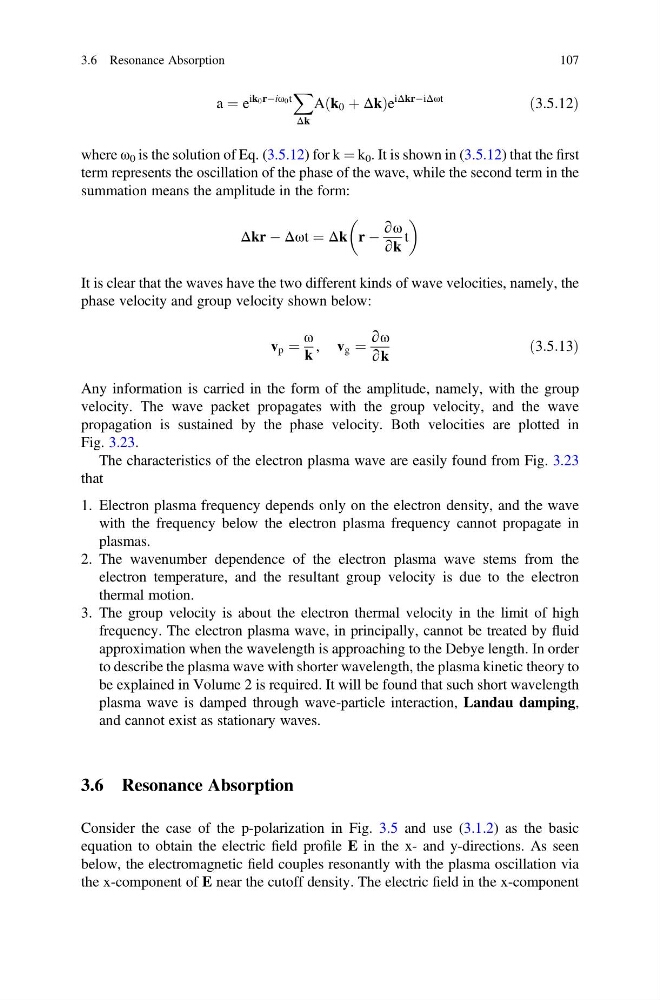
where ω 0 is the solution of Eq. (3.5.12) for k ¼ k 0 . It is shown in (3.5.12) that the first
term represents the oscillation of the phase of the wave, while the second term in the
summation means the amplitude in the form:
Δkr À Δωt ¼ Δk r À
∂ω
∂k
t
It is clear that the waves have the two different kinds of wave velocities, namely, the
phase velocity and group velocity shown below:
v p ¼
ω
k
, v g ¼
∂ω
∂k
ð3:5:13Þ
Any information is carried in the form of the amplitude, namely, with the group
velocity. The wave packet propagates with the group velocity, and the wave
propagation is sustained by the phase velocity. Both velocities are plotted in
Fig. 3.23.
The characteristics of the electron plasma wave are easily found from Fig. 3.23
that
1. Electron plasma frequency depends only on the electron density, and the wave
with the frequency below the electron plasma frequency cannot propagate in
plasmas.
2. The wavenumber dependence of the electron plasma wave stems from the
electron temperature, and the resultant group velocity is due to the electron
thermal motion.
3. The group velocity is about the electron thermal velocity in the limit of high
frequency. The electron plasma wave, in principally, cannot be treated by fluid
approximation when the wavelength is approaching to the Debye length. In order
to describe the plasma wave with shorter wavelength, the plasma kinetic theory to
be explained in Volume 2 is required. It will be found that such short wavelength
plasma wave is damped through wave-particle interaction, Landau damping,
and cannot exist as stationary waves.
3.6 Resonance Absorption
Consider the case of the p-polarization in Fig. 3.5 and use (3.1.2) as the basic
equation to obtain the electric field profile E in the x- and y-directions. As seen
below, the electromagnetic field couples resonantly with the plasma oscillation via
the x-component of E near the cutoff density. The electric field in the x-component
3.6 Resonance Absorption
107
ik 0 rÀiω 0 t
X
Δk
A k 0 þ Δk
ð
Þ e
iΔkrÀiΔωt
ð3:5:12Þ
where ω 0 is the solution of Eq. (3.5.12) for k ¼ k 0 . It is shown in (3.5.12) that the first
term represents the oscillation of the phase of the wave, while the second term in the
summation means the amplitude in the form:
Δkr À Δωt ¼ Δk r À
∂ω
∂k
t
It is clear that the waves have the two different kinds of wave velocities, namely, the
phase velocity and group velocity shown below:
v p ¼
ω
k
, v g ¼
∂ω
∂k
ð3:5:13Þ
Any information is carried in the form of the amplitude, namely, with the group
velocity. The wave packet propagates with the group velocity, and the wave
propagation is sustained by the phase velocity. Both velocities are plotted in
Fig. 3.23.
The characteristics of the electron plasma wave are easily found from Fig. 3.23
that
1. Electron plasma frequency depends only on the electron density, and the wave
with the frequency below the electron plasma frequency cannot propagate in
plasmas.
2. The wavenumber dependence of the electron plasma wave stems from the
electron temperature, and the resultant group velocity is due to the electron
thermal motion.
3. The group velocity is about the electron thermal velocity in the limit of high
frequency. The electron plasma wave, in principally, cannot be treated by fluid
approximation when the wavelength is approaching to the Debye length. In order
to describe the plasma wave with shorter wavelength, the plasma kinetic theory to
be explained in Volume 2 is required. It will be found that such short wavelength
plasma wave is damped through wave-particle interaction, Landau damping,
and cannot exist as stationary waves.
3.6 Resonance Absorption
Consider the case of the p-polarization in Fig. 3.5 and use (3.1.2) as the basic
equation to obtain the electric field profile E in the x- and y-directions. As seen
below, the electromagnetic field couples resonantly with the plasma oscillation via
the x-component of E near the cutoff density. The electric field in the x-component
3.6 Resonance Absorption
107