

P e1 ¼
∂P e
∂n e
n e1 ¼ γT e n e1
ð3:5:9Þ
In Eq. (3.5.9), γ is the adiabatic constant. In the case of one-dimensional wave,
namely, the degree of freedom N ¼ 1; then, it is known that:
γ ¼
N þ 2
N
¼ 3
The three basic Eqs. (3.5.6), (3.5.7), and (3.5.8) are homogeneous equations. After
the Fourier-Laplace transformation, (3.5.6), (3.5.7), and (3.5.8) provide the dispersion relation to the electron plasma wave.
ω
2
¼ ω pe
2
þ 3v e
2 k
2
ð3:5:10Þ
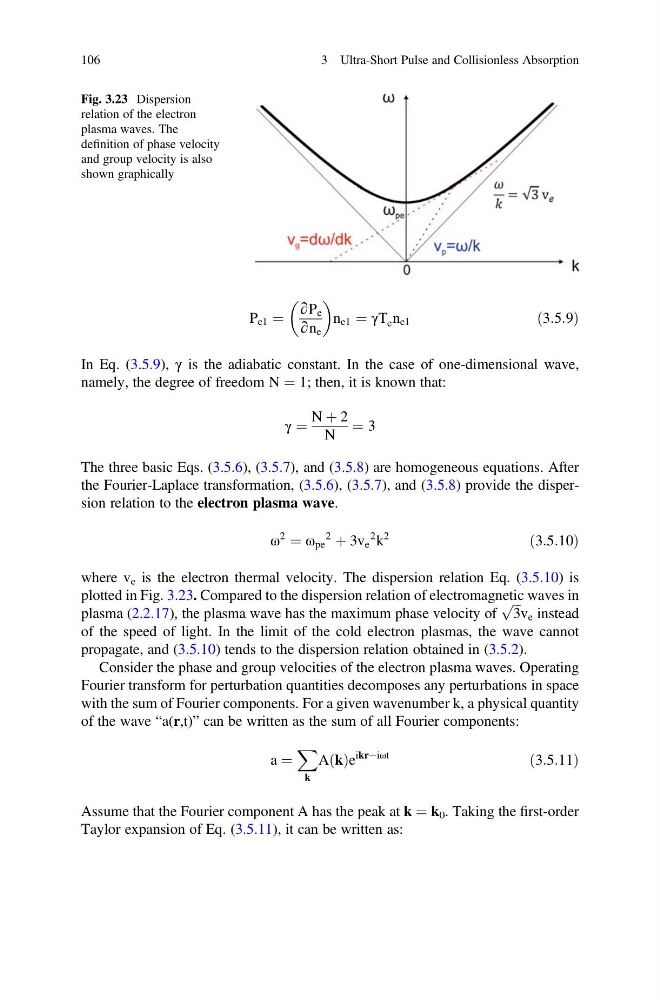
where v e is the electron thermal velocity. The dispersion relation Eq. (3.5.10) is
plotted in Fig. 3.23. Compared to the dispersion relation of electromagnetic waves in
plasma (2.2.17), the plasma wave has the maximum phase velocity of
ffiffi ffi
3
p
v e instead
of the speed of light. In the limit of the cold electron plasmas, the wave cannot
propagate, and (3.5.10) tends to the dispersion relation obtained in (3.5.2).
Consider the phase and group velocities of the electron plasma waves. Operating
Fourier transform for perturbation quantities decomposes any perturbations in space
with the sum of Fourier components. For a given wavenumber k, a physical quantity
of the wave “a(r,t)” can be written as the sum of all Fourier components:
a ¼
X
k
A k
ð Þe
ikrÀiωt
ð3:5:11Þ
Assume that the Fourier component A has the peak at k ¼ k 0 . Taking the first-order
Taylor expansion of Eq. (3.5.11), it can be written as:
Fig. 3.23 Dispersion
relation of the electron
plasma waves. The
definition of phase velocity
and group velocity is also
shown graphically
106
3 Ultra-Short Pulse and Collisionless Absorption
∂P e
∂n e
n e1 ¼ γT e n e1
ð3:5:9Þ
In Eq. (3.5.9), γ is the adiabatic constant. In the case of one-dimensional wave,
namely, the degree of freedom N ¼ 1; then, it is known that:
γ ¼
N þ 2
N
¼ 3
The three basic Eqs. (3.5.6), (3.5.7), and (3.5.8) are homogeneous equations. After
the Fourier-Laplace transformation, (3.5.6), (3.5.7), and (3.5.8) provide the dispersion relation to the electron plasma wave.
ω
2
¼ ω pe
2
þ 3v e
2 k
2
ð3:5:10Þ
where v e is the electron thermal velocity. The dispersion relation Eq. (3.5.10) is
plotted in Fig. 3.23. Compared to the dispersion relation of electromagnetic waves in
plasma (2.2.17), the plasma wave has the maximum phase velocity of
ffiffi ffi
3
p
v e instead
of the speed of light. In the limit of the cold electron plasmas, the wave cannot
propagate, and (3.5.10) tends to the dispersion relation obtained in (3.5.2).
Consider the phase and group velocities of the electron plasma waves. Operating
Fourier transform for perturbation quantities decomposes any perturbations in space
with the sum of Fourier components. For a given wavenumber k, a physical quantity
of the wave “a(r,t)” can be written as the sum of all Fourier components:
a ¼
X
k
A k
ð Þe
ikrÀiωt
ð3:5:11Þ
Assume that the Fourier component A has the peak at k ¼ k 0 . Taking the first-order
Taylor expansion of Eq. (3.5.11), it can be written as:
Fig. 3.23 Dispersion
relation of the electron
plasma waves. The
definition of phase velocity
and group velocity is also
shown graphically
106
3 Ultra-Short Pulse and Collisionless Absorption